Split the Cucumber Season into Visible Milestones
Cucumbers change quickly, so a page filled with “watered the plant today” looks empty. Before you start writing, sketch a timeline with four stages: sowing and sprouting, leaf growth, vining and trellising, flowering and fruiting. Choose one or two things you can actually see for each stage, such as seed leaves opening, the first true leaf appearing, a tendril searching for support, or the first female flower opening.
Draw that timeline along the edge of your newspaper, or shape it as a curling vine, so readers can tell at a glance how long you observed the plant.
Turning Daily Notes into Real Observations
A line like “March 10, sunny, watered” reads like a duty rota. Try the frame date + what I did + how the plant changed + what I noticed or wondered. One sentence is enough when it is specific.
Sentence frames you can adapt
- March 12 – I pushed the soaked seeds about one centimetre into the soil. Mum said that was too deep for them to push through.
- March 18 – Two small mounds appeared on the surface. The first seedling broke through, still wearing its seed leaves like a little hat.
- March 27 – The second true leaf opened, with fine serrated edges and thicker than the seed leaves.
- April 6 – A tendril wrapped around the bamboo cane. I gave it a nudge, and the next day it was holding on by itself.
- April 20 – The first female flower opened, with a tiny cucumber behind it like a miniature green finger.
Keep one or two surprises in your notes, such as “the soil was still damp the next day, so it really does not need watering every day”. It sounds far more honest than a perfect success story.
Three Kinds of Text That Fill the Page
A handwritten newspaper needs more than a diary. Prepare your text in three blocks:
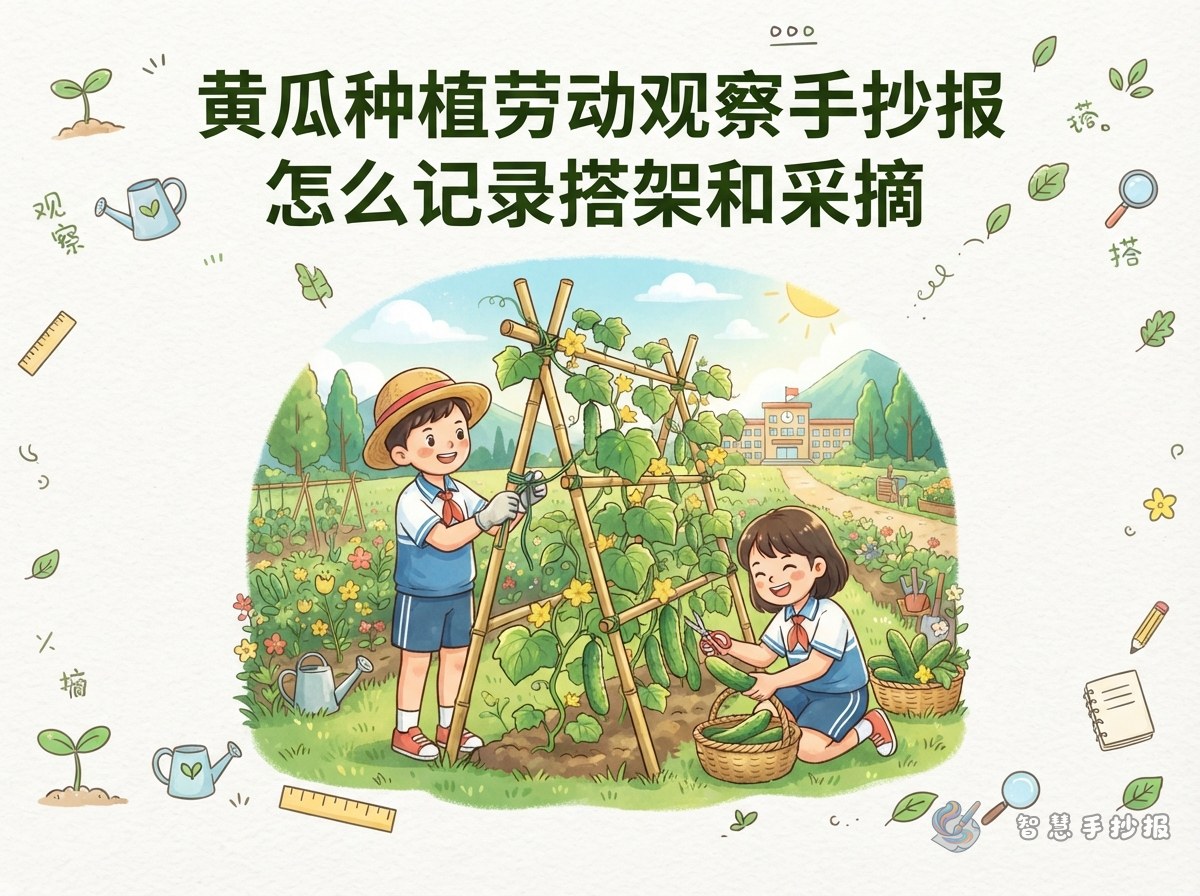
- Quick facts – cucumber is a climbing plant that grips with tendrils; male and female flowers grow on the same plant; a trellis improves airflow and light, which helps the fruit grow straight.
- Gardening tips – water by checking the soil, not the sky; set up the trellis before the vines start running; cut the fruit with scissors instead of pulling the vine.
- One feeling sentence – growing a cucumber from seed to plate taught me that one cucumber takes more than forty days.
Place the three blocks in separate sections and your page gains structure without repeating the diary.
Let a Vine Organise Your Layout
A vine-shaped layout suits this topic well. Draw one main vine up the middle with five nodes: seed, seedling, vining, flowering, fruiting. Hang a text box beside each node and join the boxes with tendrils. On the left, keep a data corner with a small table for date, weather and stem height. In the bottom right, draw a picking basket or chopping board for your summary and reflection.
- Sketch the vine lightly in pencil first and fix the five node positions before writing, so you do not run out of drawing space.
- Use dark green for the title, black or dark grey for the body text, and only two or three decoration colours such as pale green and soft yellow.
- White space looks better than a crowded page; leave at least a finger-width gap between boxes.
Small Details That Keep It Believable
- Do not just write “cucumber”. Name the variety or the growing method, such as “balcony cucumber in a pot”, so the report feels real.
- Keep the dates in order and use your true observation gaps rather than filling in numbers to look thorough.
- Avoid slogans in the reflection. Describe an action and a mood instead, for example “my hand shook a little the first time I cut a cucumber”.
If you are still unsure how to draw the vine or arrange the sections, open the Smart Handwritten Newspaper WeChat mini program, pick a planting observation layout, and swap in your own notes. You can print it or copy it by hand, which saves a lot of time compared with starting from a blank sheet.