Make the seafloor spreading route the main picture
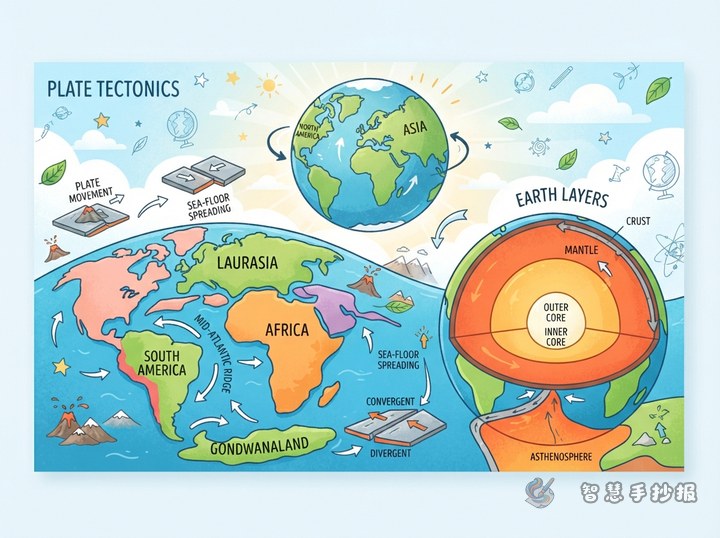
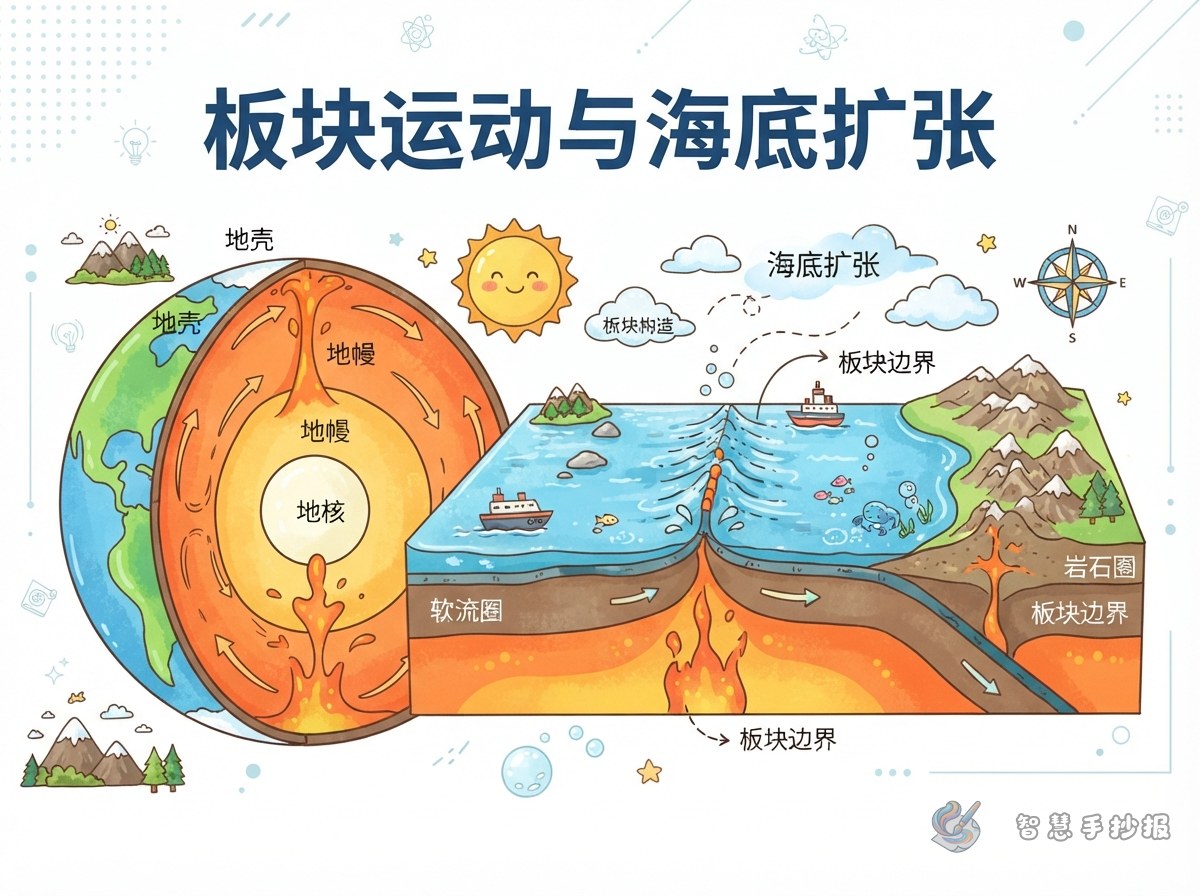
For a distinctive handwritten newspaper, place seafloor spreading at the center. Draw a mid-ocean ridge across the middle of the page, then add arrows pointing away from it to show magma rising and the seafloor moving outward. Use colored bands on both sides to show that new oceanic crust forms near the ridge and becomes older farther away.
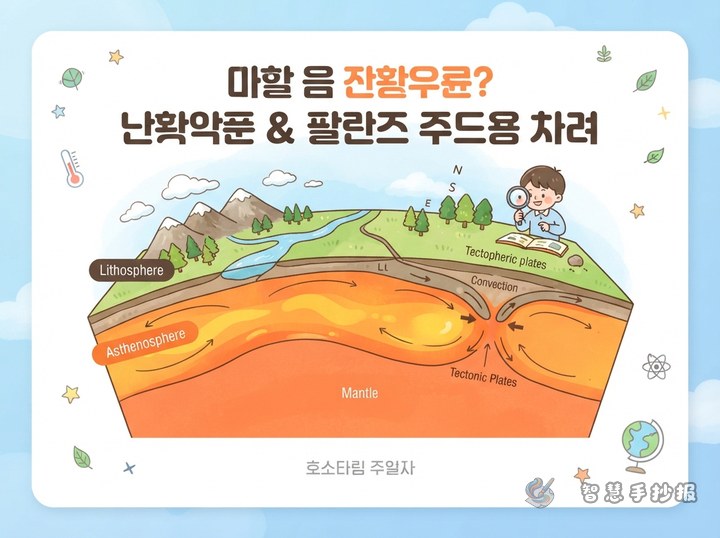
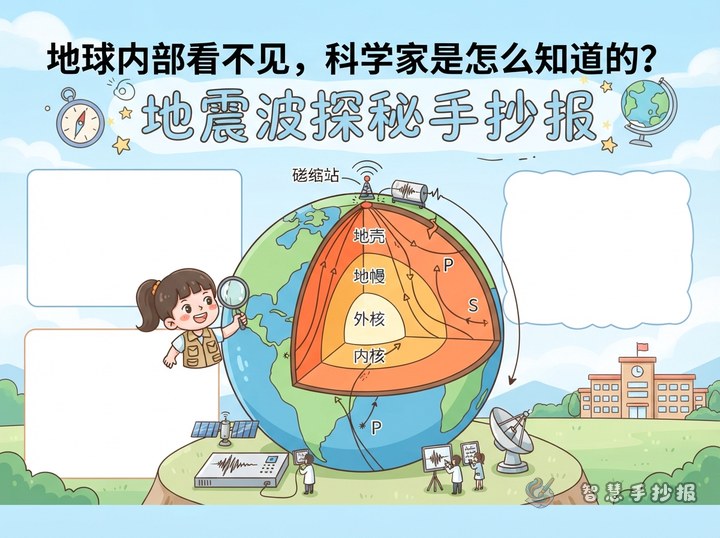
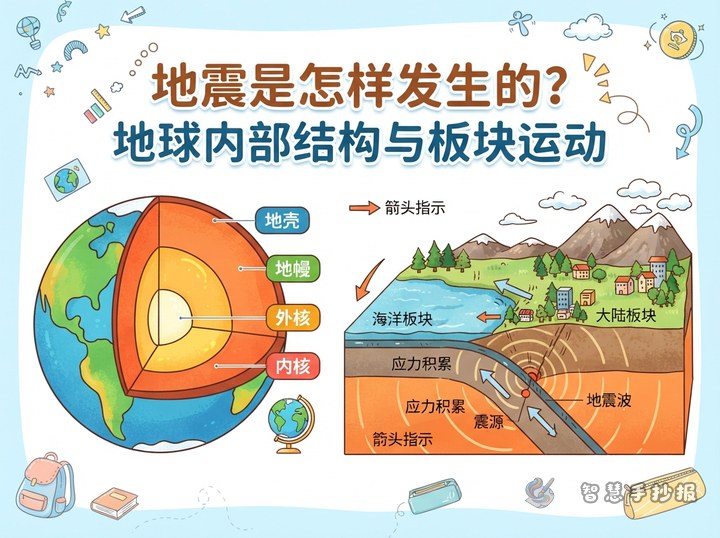
To connect the topic with Earth’s interior, add a small cutaway window below the seafloor drawing. Show the crust as a thin outer layer, the mantle in orange-red, and the core in yellow. A short note such as “Heat inside Earth helps drive movement” is enough. The interior diagram should support the main idea rather than become a separate lesson about layers.
Explain three plate boundaries with picture cards
Divergent boundary: plates move apart
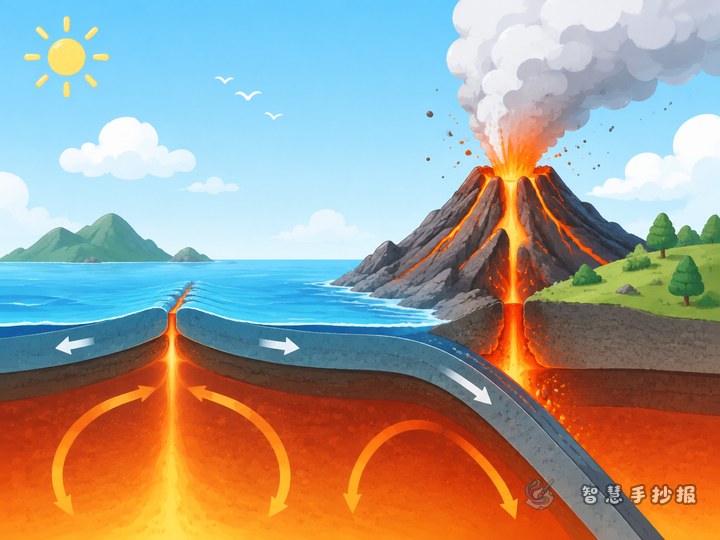
When two plates move away from each other, hot material rises from below, cools, and forms new oceanic crust. Seafloor spreading is a typical example of a divergent boundary. Use two outward arrows, rising red magma, and a strip labeled “new crust” to make the process easy to understand.
Convergent boundary: plates move together
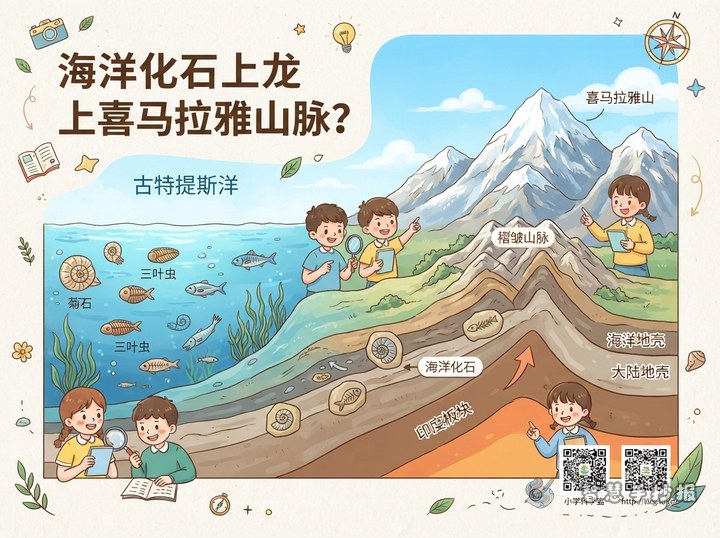
When plates collide, a denser oceanic plate may sink beneath another plate, or two continental plates may push upward and form mountains. Draw one plate bending downward and label it “subduction,” or show two landmasses squeezing together to create a mountain range.
Transform boundary: plates slide past each other
At a transform boundary, two plates move horizontally along the boundary. Crust is not directly created or consumed in the same way as at the other two boundaries. Two offset color bands with arrows pointing in opposite directions can show this motion clearly.
Add a science box about the forces behind movement
Write a short explanation in a bright information box: Earth still contains heat left from its formation, and radioactive decay also produces heat. Internal heat and several pushing and pulling forces influence plate motion. Ridge push and the pull from a sinking subducting plate are two useful examples. This is more accurate than simply saying that plates move because the mantle spins in a circle.
- Lithosphere: the rigid outer part of Earth divided into plates.
- Asthenosphere: a hot, slowly flowing zone beneath the lithosphere.
- Seafloor spreading: the formation of oceanic crust near a ridge and its movement away from the ridge.
Use a center-section and side-by-side layout
A horizontal page works well for this topic. Put the large seafloor spreading cross-section in the center. Place a small “heat inside Earth” section in the upper left and a three-boundary comparison in the upper right. Along the bottom, add “Where does new crust come from?” and “Plate motion keywords” as two short columns.
Use deep blue for the ocean, orange-red for heat and magma, green or brown for continents, and yellow for key arrows. Write the title in bold letters inside a wave shape or along a curved Earth outline. Keep each paragraph to two or three lines, and leave open space around drawings. Sketch the layout in pencil first, then outline the writing and add color.
A short conclusion to copy
Conclusion: Earth’s surface is not one unbroken shell. It is divided into many plates. Influenced by internal heat and several pushing and pulling forces, these plates move slowly and form divergent, convergent, and transform boundaries. Seafloor spreading shows that Earth’s surface is constantly changing.
If you want to adjust the title lettering, column positions, or color plan, continue creating the page in the WeChat mini program 智慧手抄报 to make the science layout cleaner and easier to finish.