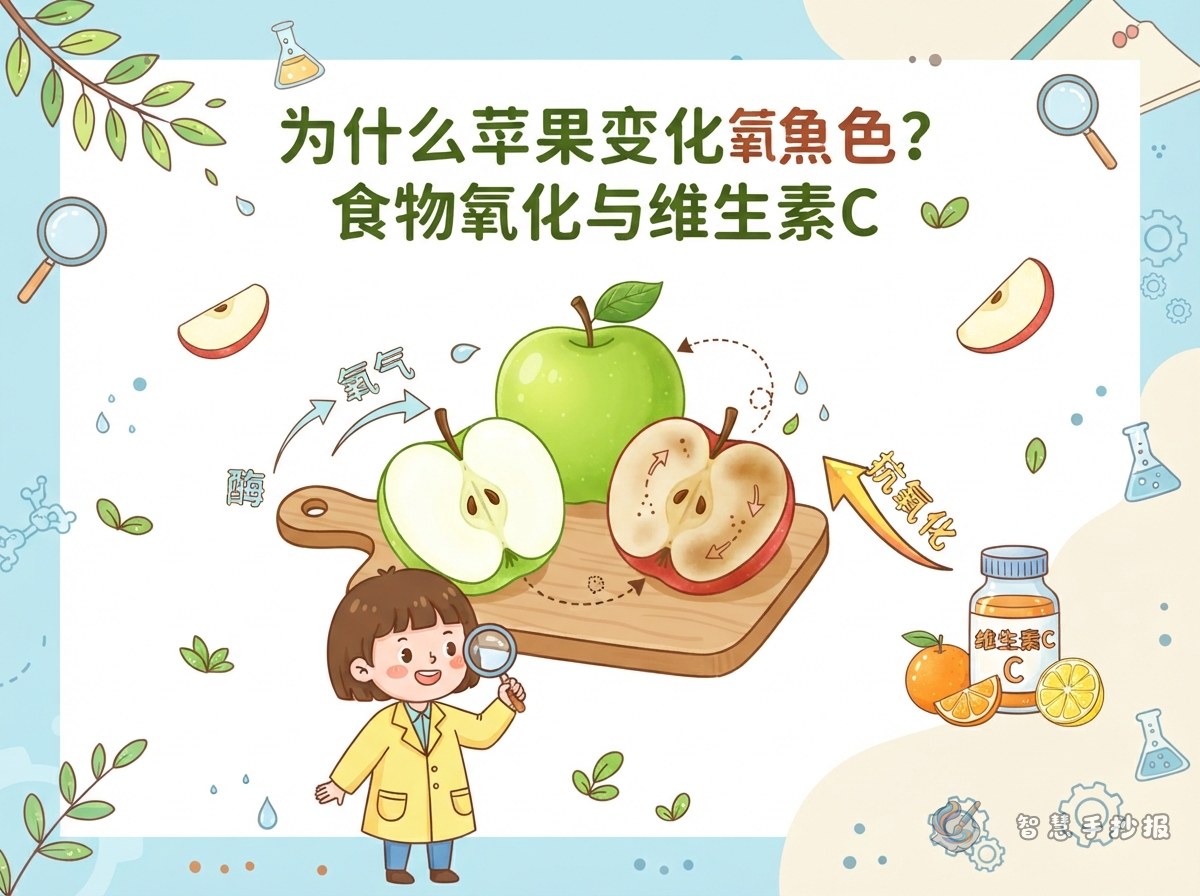
Start With the Everyday Surprise: Why Does a Cut Apple Change Color?
A freshly cut apple looks pale yellow or creamy white. After a while, the cut surface turns light brown and then darker brown. This does not mean the apple is suddenly rotten. It is a common process called enzymatic browning. On your handwritten newspaper, draw three small panels showing “before cutting,” “just cut,” and “after sitting for a while.”
The Science Behind It: Oxygen, Enzymes, and Polyphenols
Apple flesh contains polyphenols and an enzyme called polyphenol oxidase. In the whole apple, they are kept apart. Once you cut the apple, cells break open, the enzyme meets oxygen, and polyphenols are oxidized into brown substances. A simple sentence for your page is: Cutting lets the enzyme meet oxygen, and oxygen turns clear substances brown.
You can also add a note about vitamin C. Vitamin C is an antioxidant and can slow browning, which is why lemon juice or orange juice is often used on cut apples. A small arrow diagram works well: apple surface—lemon juice—slower color change.
A Simple Comparison Test for Your Handwritten Newspaper
A short experiment makes the page more interesting than facts alone. Prepare four similar apple slices on a plate and treat them differently. Observe after ten, twenty, and thirty minutes.
- Slice 1: leave it plain as a control.
- Slice 2: add a few drops of lemon juice.
- Slice 3: brush on a little vitamin C water.
- Slice 4: press plastic wrap onto the cut surface to reduce air contact.
Make a table with time across the top and the four slices down the side. Use words such as “no change,” “slightly yellow,” and “clearly brown.” Finish with a conclusion: reducing oxygen contact or adding vitamin C can slow down browning.
Text and Sections You Can Put on the Page
To make your handwritten newspaper feel complete, try these small sections:
- Everyday Question: Why does a cut apple change color?
- Science Behind It: enzymatic browning, oxygen, polyphenol oxidase, vitamin C.
- Experiment Record: a comparison table for four apple slices.
- Life Tips: use lemon juice, light salt water, or plastic wrap on cut apples.
- Think Further: do potatoes, bananas, and eggplants also change color after cutting?
Keep each section to two or three short sentences. For a primary school handwritten newspaper, short text with small drawings and arrows works better than a long paragraph.
Layout and Color Ideas That Make the Process Clear
Divide the page into four areas: a title in the upper left, a cut apple drawing in the upper right, a three-step browning diagram in the middle, and the experiment table plus life tips at the bottom. Good titles include “The Secret of Apple Browning,” “Little Chemistry After Cutting,” and “The Oxygen and Enzyme Relay.”
For colors, use pale yellow, light green, orange-red, and brown. Pale yellow can stand for apple flesh, brown for browning, green for leaves, and orange for lettering or borders. Add small apples, water drops, oxygen bubbles, and lemon slices around the border. If you want to save layout time, you can open the Smart Handwritten Newspaper WeChat mini program, choose a chemistry-in-life template, and fill in the experiment table and sections above.