Begin With the Question Everyone Asks
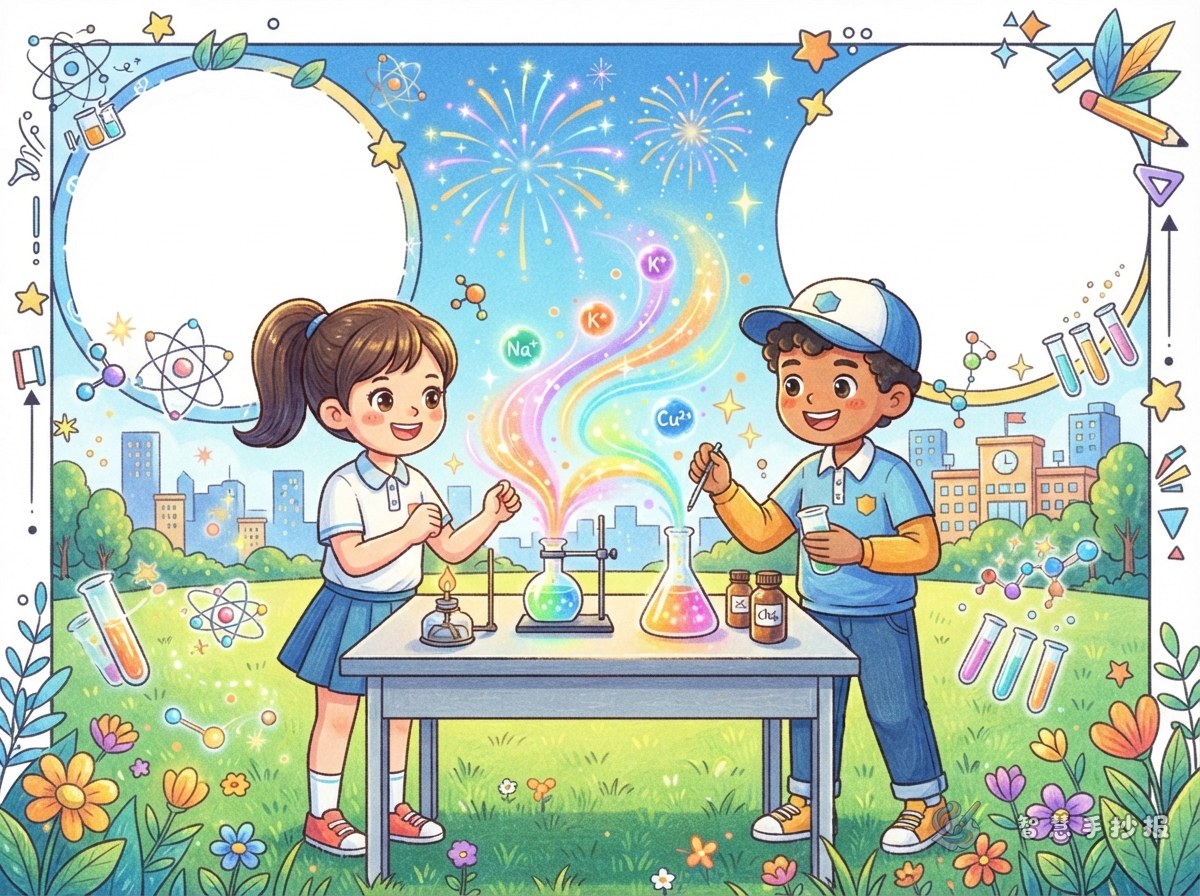
"Why are some fireworks red, some green, some yellow?" That question is a great opening line for a poster because it needs no complicated formula. One sentence carries the whole idea: the colors of fireworks come from different metal elements. Start with a short scene of a night sky, then hand the question to your reader.
Keep the theme on one clear path: firework colors, then metal elements, then the flame test, then everyday uses. A clear path keeps the layout from getting messy.
Explain the Flame Test in Plain Words
Build the main text around three points:
- What it is: certain metal compounds make a flame show a special color when they are heated.
- Why it happens: atoms of the metal take in heat, their electrons move to a higher energy level, and when they drop back they give out light of a certain color.
- What to remember: it is a physical change. No new substance is made; the light is simply announcing which element is there.
If you have space, add this line in bold: different elements give out different colors, and that is how fireworks get so many shades.
Element and Color Reference for Your Poster
Turn this part into a small chart, colored cards, or a row of paper fireworks, one element each:
- Sodium: yellow. Sodium is in table salt, and it also glows in old street lamps.
- Potassium: pale purple. The color is faint, so it is often viewed through blue glass.
- Calcium: brick red. Bones and shells contain calcium.
- Strontium: red. A common ingredient behind red fireworks.
- Barium: yellow-green, often used for green and yellow sparks.
- Copper: blue-green, the same element found in wires and copper pots.
Add a link to daily life: elements are not only in laboratories; they are in festival skies and household objects too.
Layout: Let the Colors Help, Not Overpower
This topic has bright colors and light text, so a center-radiating layout works well:
- Draw one big bursting firework in the middle as the focal point.
- Send four lines outward from the center, each ending in a colored block with an element name and its color.
- Reserve the lower left for a "How It Works" column and the right side for "Flame Colors Around Us".
- Use deep blue or purple for the night sky background and only a little bright color on top, so the words stay readable.
One rule is enough: keep the background calm and the element colors bold.
Column Names and Captions That Work
Playful column titles make the writing part more fun:
- "An ID Card for a Firework" for the explanation and element chart.
- "Who Gives the Color?" for the element-by-element section.
- "Glowing Beyond the Sky" for sodium lamps, salt and copper wires.
- "Little Flame, Big Care" for the safety reminders.
Two or three sentences per column is plenty. Short, clear blocks make the whole poster look tidy.
Safety Notes and Finishing Touches
The flame test involves an open flame, so give it its own small box: observe only with a teacher or parent, keep paper and curtains away, and never play with fire at home. At home, use research, coloring charts and paper fireworks instead. Those activities carry the same chemistry message safely.
End with a small summary line in a corner: every color is an element's signature. When you are ready to arrange the columns neatly, you can open the Smart Handwritten Poster mini program and pick a layout style to finish your poster faster.