Turn the experiment into a color mystery
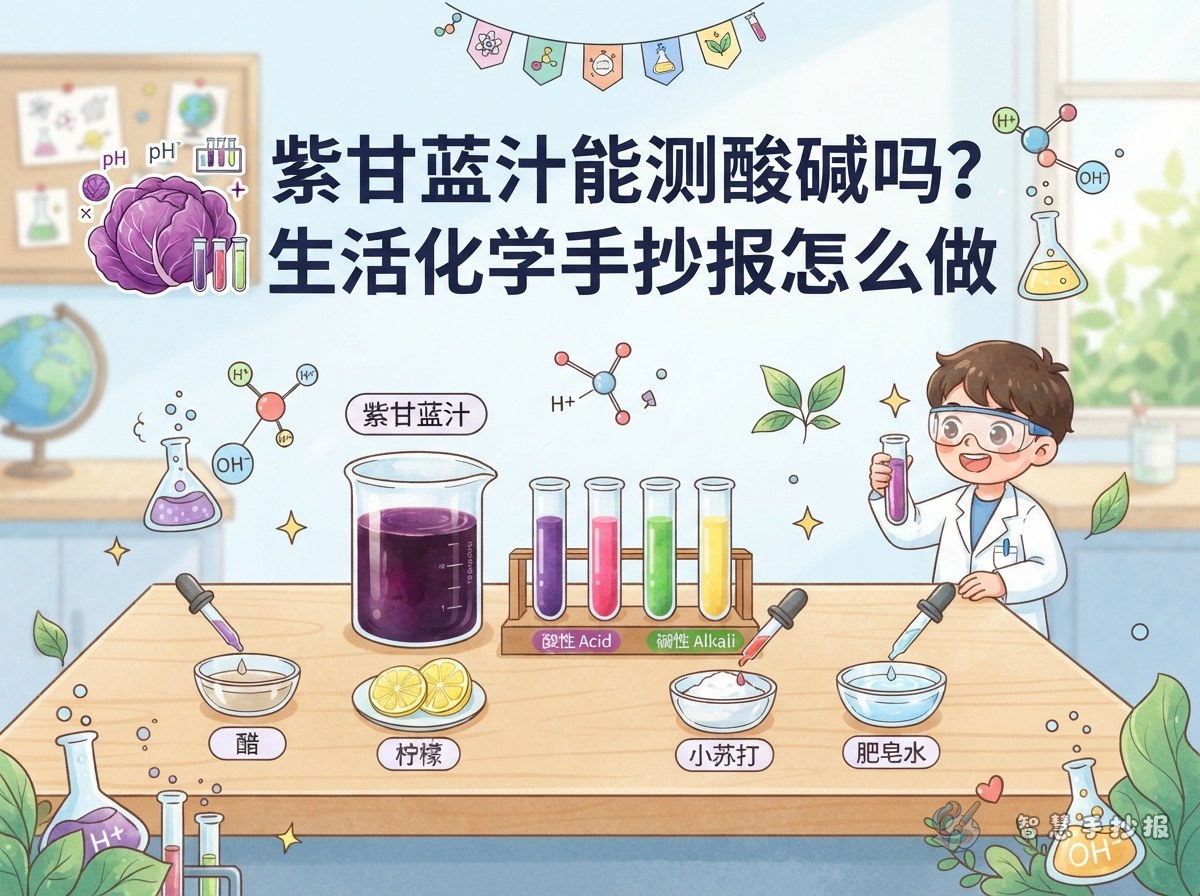
Build the school handout around the question “Can red cabbage juice test acids and bases?” Use “Seeing Acid-Base Changes in Everyday Life” as a subtitle so the topic feels both scientific and playful. A detective-style theme gives the page a clear story instead of a collection of disconnected facts.
- Main question: Why do different liquids make red cabbage juice change color?
- Test liquids: Lemon juice, vinegar, clean water, and baking soda water.
- Key terms: Acidic, alkaline, natural indicator, color comparison, and experiment record.
Make a simple color test
Prepare a few red cabbage leaves, warm water, clear cups, a dropper or small spoon, labels, and small amounts of lemon juice, vinegar, clean water, and baking soda water. Tear the cabbage into pieces, soak and gently crush it in warm water, then use the purple liquid as the indicator.
- Look at the original purple color before adding anything.
- Pour the indicator into labeled cups and add the test liquids.
- Record the results: acidic liquids often become reddish-purple or pink, clean water usually stays close to purple, and baking soda water may turn blue or blue-green.
- Draw the actual colors on a color map and note that concentration and the amount of liquid can affect the result.
A short science note to copy
Why does the juice change color? Red cabbage contains a natural pigment that changes color in different acid-base conditions. It can therefore help us make an initial observation about the properties of some everyday liquids.
Design the page like a lab record
Place the large title at the top. In the center, draw a row of clear cups containing purple, pink, purple, and blue-green liquids, with arrows showing “add liquid, observe change, record color.” Put the materials and steps on the left, a vertical color guide on the right, and two small boxes for “My Conclusion” and “Safety Notes” at the bottom.
- Color plan: Use purple as the main color, with pink, blue, and green to show changes. Write in a dark color for easy reading.
- Drawing ideas: Red cabbage leaves, droppers, measuring cups, a magnifying glass, question bubbles, and arrows.
- Record table: Liquid name, starting color, final color, and my observation.
Explain everyday chemistry carefully
Add a small section called “Acid and Base Friends in the Kitchen.” Lemon juice and vinegar have acidic properties, baking soda water is alkaline, and clean water can serve as a near-neutral comparison. Do not present the colors as absolute rules: concentration, the amount of cabbage juice, and lighting can all affect what you see. This makes the handout both attractive and scientifically responsible.
Finish with a safety corner
Draw a small shield near the bottom and write: “Observe, never taste; do not put the materials in your mouth; never mix cleaning products; ask an adult for help with warm water and scissors.” Before finishing, check the title, labels, color key, spacing, and conclusion. To arrange the sections and colors more quickly, continue designing in the WeChat mini program “智慧手抄报”.