Open with a Mystery: What Changed the Nail?
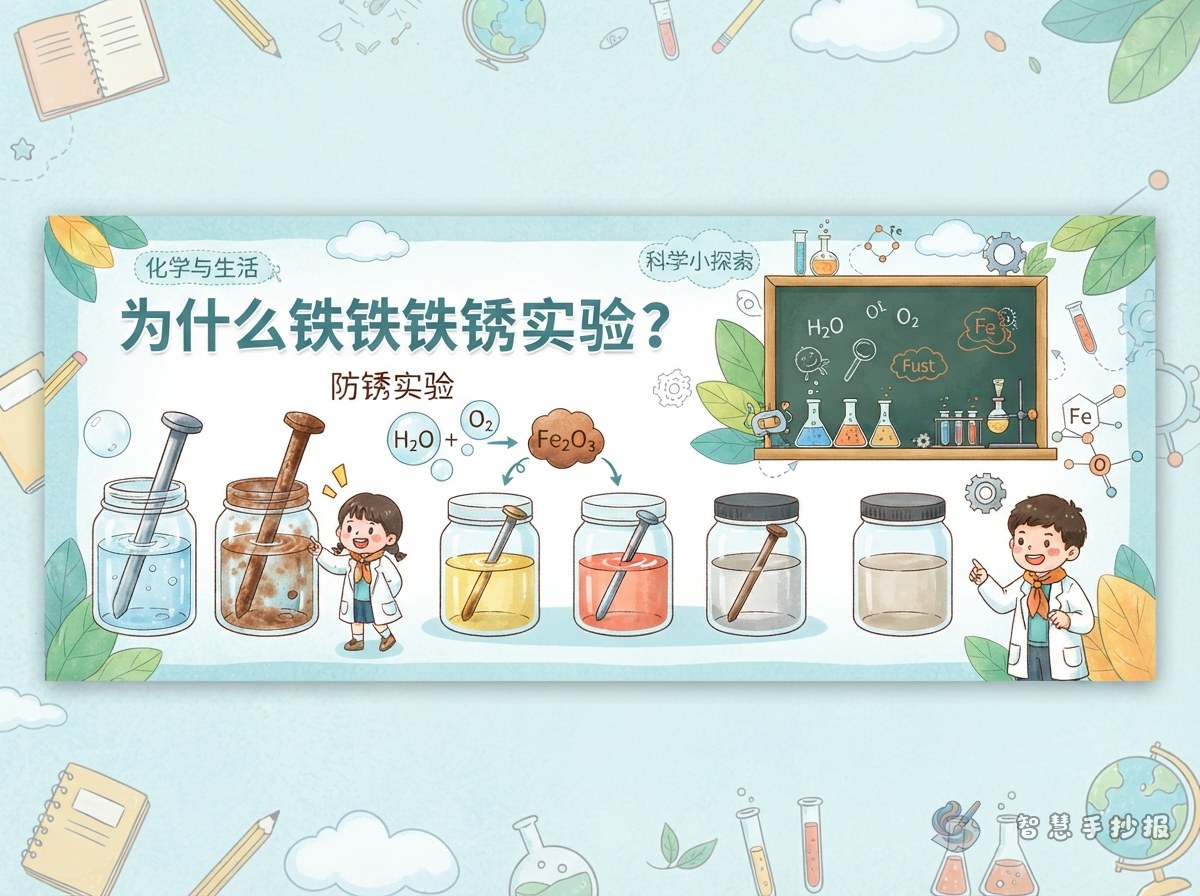
Begin with two simple drawings: a shiny nail and a nail covered with reddish-brown spots. Place the question “Why did one nail rust?” between them. A magnifying glass, water drops, and a small oxygen symbol can make the topic clear without crowding the title area.
Main idea: Iron is more likely to rust when water and oxygen are both present. Rust does not form a strong, sealed shell, so moisture and oxygen may continue reaching the metal underneath.
Build Three Clue Cards
The element clue
The chemical symbol for iron is Fe, and the symbol for oxygen is O. For an elementary-level poster, the relationship can be shown as “iron + water + oxygen → rust.” Add a note that rust is actually a mixture of iron-containing compounds rather than one simple substance.
The speed-up clue
Damp conditions supply the water needed for rusting. Salt water can make corrosion proceed faster, which is why metal objects near the sea or metal tools covered with salty sweat need careful cleaning and protection.
The protection clue
Oil, paint, dry storage, and protective coatings reduce contact between iron, water, and oxygen. Give each method a small everyday icon so readers can connect the chemistry with familiar objects.
Collect Evidence with a Nail Test
With help from a teacher or adult, prepare three clear cups and three clean nails that look alike.
- Place one nail partly in plain water as the basic observation group.
- Put the second nail in the same amount of salt water to examine the effect of salt.
- Cover the third nail with a thin layer of oil, then place it in the same amount of plain water.
- Observe the nails at about the same time each day and record changes in color, spots near the waterline, and the appearance of the water.
Create boxes labeled Day 1, Day 2, and Day 3. Light yellow, orange, and reddish brown can represent gradual changes. Results depend on time and local conditions, so students should record what they truly see rather than inventing a dramatic result.
Safety note: Never taste the liquids, do not handle sharp or rusty nails with bare hands, and ask an adult to clean up the materials.
Design It Like a Chemistry Detective Map
An S-shaped evidence trail can guide the reader across the page. Put the mystery question at the upper left, the three clue cards in the center, the experiment cups on the right, and daily rust-prevention scenes along the bottom. Use pale blue and warm cream for the background, with reddish brown only as an accent for rust.
- Title area: Use bold outlined letters and add a few rust-like dots to the word “rust.”
- Experiment panel: Keep all three cup drawings the same size and align their labels.
- Conclusion badge: Write “block moisture, limit oxygen, keep it dry” inside a shield shape.
- Decorations: Add a bicycle, gate, toolbox, or raindrops without covering the text.
End with Useful Habits
Close with the sentence, “Chemistry happens around us, and understanding rust helps us care for everyday objects.” Add actions such as drying a bicycle after rain, storing tools in a dry place, and asking an adult to repair damaged paint. After preparing the text, students and parents can continue in the Smart Handwritten Newspaper WeChat Mini Program to arrange sections, borders, and experiment notes more clearly.