Start by separating three easily confused terms
Many students begin with "insects can change colour" and then lose the thread. Open a small box in the top corner of your poster and pin down the three terms first, so your examples stay on track.
- Protective colouring: the body colour is close to the surroundings, so predators overlook the insect.
- Mimicry: the shape copies something else, such as a twig, a leaf or a bird dropping.
- Warning colours: bright, eye-catching markings that signal "I am toxic, stay away".
A useful one-line summary: protective colouring and mimicry are about hiding, while warning colours are about standing out. Put that line right under your title.
Choose a few master hiders for your poster
Two or three examples explained well are enough. Give each one a line about its appearance and a line about what the trick does for it.
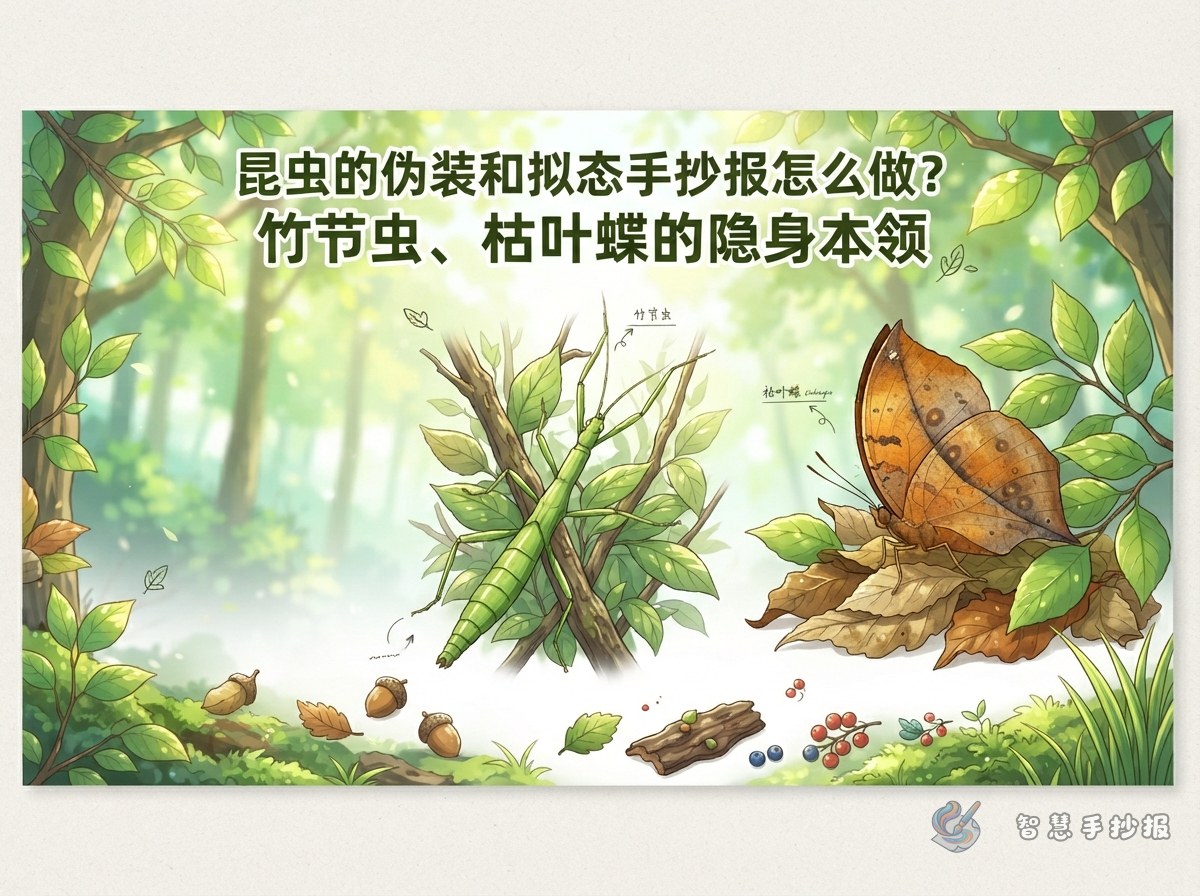
Stick insect: shaped like a thin twig
Its long body matches bark and dead wood, and even the legs look like small branches. It stays almost still during the day, which is part of the disguise. Add the line "staying still is also a kind of camouflage".
Dead leaf butterfly: a dried leaf when wings close
With wings folded, it shows vein-like patterns and small notches that look like tears in a leaf. Pair it with the stick insect so one example mimics a twig and the other mimics a leaf.
Orchid mantis: a hunter hiding among petals
Its pink-white body looks like a blossom, which hides it from predators and helps it wait for prey. Use this example under a short heading such as "camouflage is not only for defence".
Lay out the page so it stays clear
This topic does not need much text, so leave plenty of white space. The empty areas can even suggest the idea of hiding.
- Left column: three short definitions, each on a coloured patch.
- Middle column: draw one large leaf or branch and hide an insect silhouette inside, with your example notes beside it.
- Right column: what camouflage is for, split into avoiding predators and catching food.
- Bottom strip: an observation task or one sentence about protecting habitats.
For colours, use soft greens, browns and cream as the base, deep green or brown for headings, and save the bright colours for the warning colour box only.
Sentences to copy and an observation task
Short lines set out in a few rows look good and are easy to write.
- Hide well, live longer.
- Protective colouring blends an insect into its habitat; mimicry turns the insect into the habitat.
- Leaves, bark and leaf litter are nature's ready-made invisibility cloaks.
- Observation task: sit quietly beside a flower bed for five minutes and look for anything shaped like a leaf or a twig, then record what you find in a corner of the poster.
A small tip before you start writing
Sketch your column boxes on scrap paper first and count the characters before you write in ink. Keep headings larger than body text and limit each line to eight to ten characters so the page reads comfortably.
If you would like a tidier layout, open the Smart Handwritten Poster mini program, pick an insect-themed template, arrange your text and columns there first, and then copy the design onto paper without repeated erasing.