Why a seahorse and a mangrove island belong on the same page
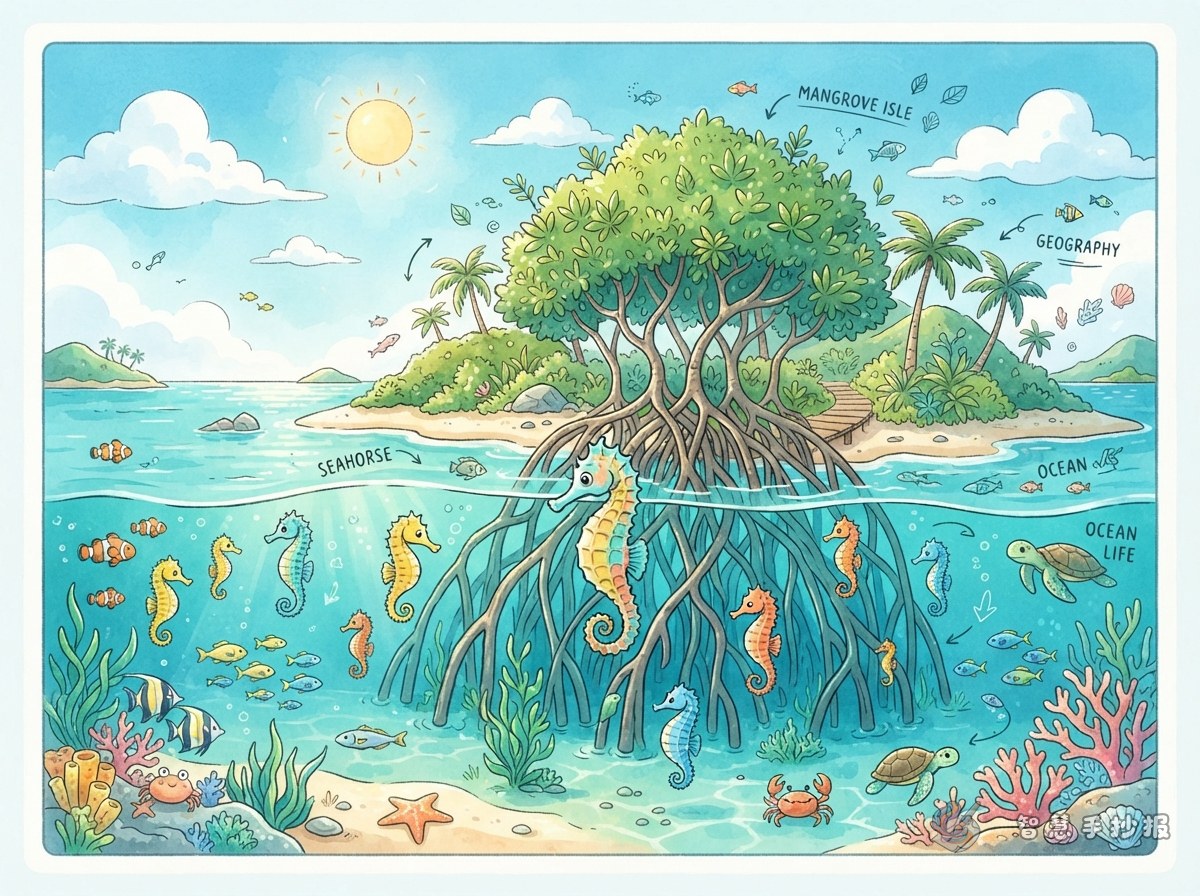
A seahorse is instantly recognisable with its curled tail and long snout, while the prop roots of a mangrove island look like a forest standing in water. Pairing the animal with its habitat makes a richer picture than a seahorse drawn on plain blue paper, and it gives the poster a clear theme: where seahorses live, what mangrove roots do, and how the island changes with the tide.
Split the page with one winding tidal channel
Draw a curving channel from the top left corner to the bottom right. It divides the sheet into two natural halves, and one horizontal line in each half gives you four or five boxes.
- Top left: the main title, in the largest box, with a curled seahorse underneath.
- Bottom left: a seahorse fact file of three to five short lines.
- Top right: the mangrove island, with a few prop roots and a stretch of shoreline.
- Bottom right: tide notes, using an upward arrow for high tide and a downward arrow for low tide.
- Bottom strip: one conservation reminder or a question you still want to answer.
Make the boxes different sizes. The title box should be the biggest and the rest should shrink in order, which gives the page a sense of rhythm.
Copy-ready lines for three columns
Seahorse column
- A seahorse is not a horse; it is a fish that swims upright by fluttering its dorsal fin.
- Its tail can curl around seagrass and mangrove roots so the tide does not sweep it away.
- The male seahorse carries the eggs in a pouch, and the young are born from the father.
Mangrove island column
- Some mangrove roots grow down into the mud while others arch above the water like pillars.
- Dense roots slow the waves and trap mud, which helps keep the shoreline in place.
- Small fish and shrimp hide between the roots, and seahorses are often found nearby.
Island geography column
- At high tide the mangrove roots are mostly under water; at low tide the mudflat appears.
- The water around an island is deep in some places and shallow in others, and more plants grow in the shallows.
- Muddy water and litter make life harder for both seahorses and mangrove trees.
Keep the drawings simple: three details are enough
Draw the seahorse as a long S shape, then add the snout, a small dorsal fin and the curled tail. For the mangrove, sketch only the prop roots: several slanted lines running from the trunk down into the water. Show the island with one soft curved line and a few small stones. Get those three details right and the scene reads clearly, leaving more time for writing.
Build it in this order
- Decide on the title and the four column names, then lightly pencil in the boxes.
- Copy the short lines into their columns, leaving a blank line between them.
- Draw the tidal channel, the seahorse, the mangrove and the island without covering the text.
- Add borders, wave lines and a pale blue background, keeping to three colours at most.
Four things to check before you hand it in
- The title is readable at a glance and clearly larger than the body text.
- Every box contains writing, with no empty space left over.
- The seahorse tail and the mangrove roots are both drawn, since they are the key features of this theme.
- If you want to swap the material or adjust the layout, open the WeChat mini program "智慧手抄报" and continue from a template.