Turn the Topic into an Ancient Wayfinding Mission
Instead of listing transportation tools, build the handwritten newspaper around an engaging question: how did people reach a destination before phone maps existed? Use “finding the way” as the main storyline. Readers can follow an ancient traveler from departure to arrival while learning about Chinese travel wisdom.
- Main question: How did ancient travelers judge direction and route?
- Key ideas: Nature watching, road signs, local knowledge, and the guide cart.
- Visual clues: Mountains, the sun, stars, roadside markers, and a guide cart.
Connect Four Wayfinding Methods Along One Journey
Begin with the sky and landscape
On a clear day, travelers could observe the sun’s movement to estimate direction. At night, stars offered another broad guide. Mountain peaks, rivers, woods, and villages also worked like a natural map. Draw a traveler beside a mountain path and add arrows labeled “watch the sun,” “recognize the landscape,” and “follow the river.”
Look for marks along the road
Travelers paid attention to direction signs, distance markers, roadside shelters, and familiar place names. Such clues helped them estimate how far they had gone and where the next stop might be. Add a small section called “Roadside Clues,” featuring three short tips: notice markers, ask about place names, and recognize crossroads.
Ask people who know the route
When traveling through an unfamiliar area, asking local residents, porters, merchants, or fellow travelers was an important way to find the road. This also shows the spirit of mutual help in ancient travel. Draw two people talking at a crossroads and add speech bubbles to give the page a lively story.
Meet the guide cart from ancient records
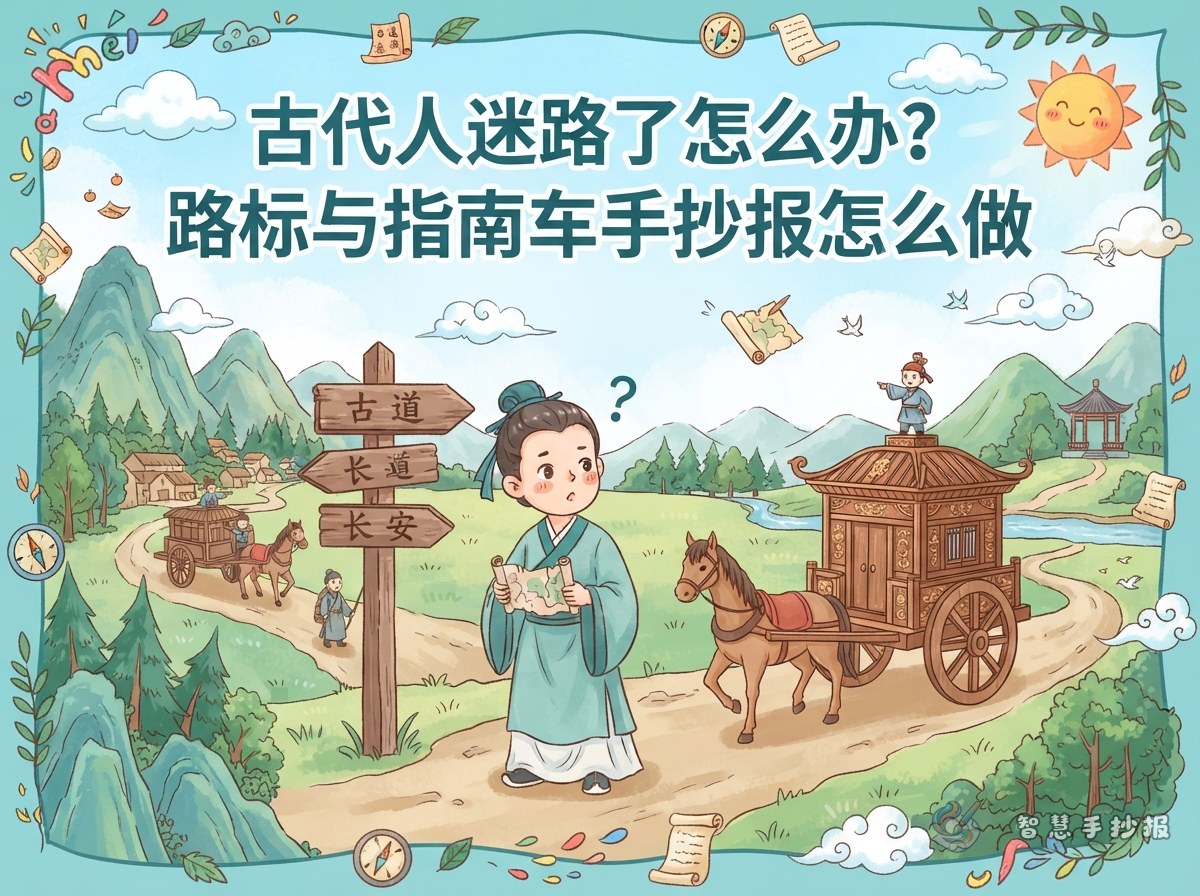
The guide cart is a mechanical device described in ancient Chinese texts. Its wooden figure was said to keep pointing south, and it is often presented as an example of ancient Chinese mechanical ingenuity. Use careful wording such as “described in ancient texts” and “introduced through later reconstructions.” Present it as a fascinating historical idea, not as a modern navigation device carried by ordinary travelers.
Ready-to-Use Text for the Handwritten Newspaper
Quick fact: Ancient travelers did not have electronic maps. They often judged direction by observing the sun, stars, mountains, rivers, and road marks, while also asking people who knew the route.
The guide cart: The guide cart is a mechanical vehicle described in Chinese historical texts. Its wooden figure was said to keep pointing south, showing ancient interest in direction, gears, and mechanical design.
A travel lesson: Finding the way requires more than a tool. It also depends on observation, memory, and communication. Ancient travel experiences reveal practical wisdom in everyday life.
Plan the Page as a Wayfinding Map
- Use “How Did Ancient People Find Their Way?” as a bold main title at the top or in the center.
- Draw a winding ancient route through the middle, linking mountains, rivers, markers, and villages.
- Place a “Nature and Direction” section on one side and a “Guide Cart File” on the other.
- Make the guide cart the main illustration, adding a south-pointing arrow, wooden figure, and wheel details.
- Reserve the bottom for a short “Travel Lesson” so the page ends clearly without becoming crowded.
Use Color and Details to Create an Ancient Travel Mood
Earth yellow, green, lake blue, and vermilion can suggest mountain paths, fields, and traditional vehicles. Borders may resemble a scroll, footprints, or repeated direction arrows, while thin lines can connect the sections into one route. Do not fill every space with text; highlight “wayfinding,” “direction,” “guide cart,” and “observation”. After planning the content, you can continue arranging the layout in the WeChat Mini Program version of Wisdom Handwritten Newspaper so the writing and illustrations work together.