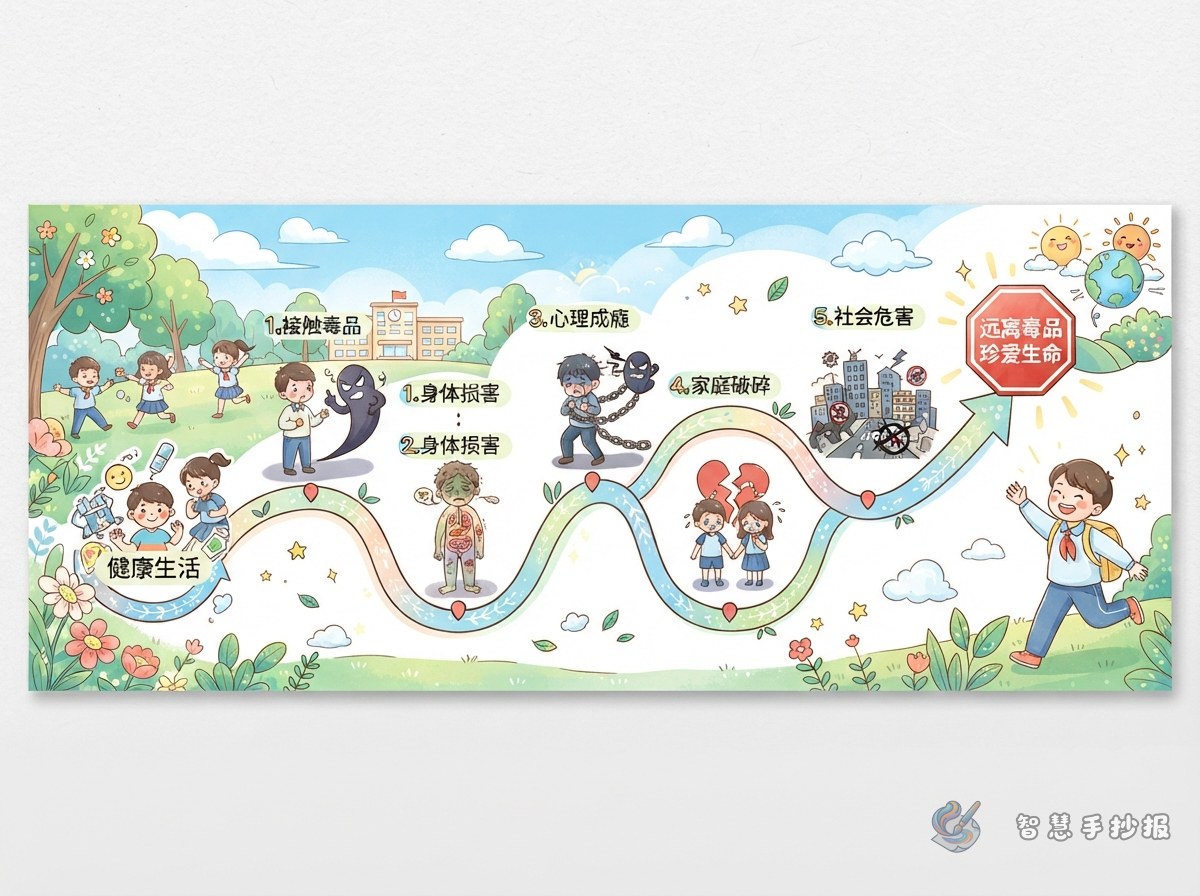
Why a Timeline Beats a Plain List of Dangers
A list of dangers reads like a manual. A timeline pulls the reader along: curiosity, first contact, dependence, losing control, then harm to the family. Each box marks a turning point, so readers see that drugs do not destroy a person all at once.
Four Boxes and What to Write Inside
Box one: the first moment of curiosity
Write about a friend offering something and saying one try is fine. Most danger starts with the words 'it will not matter'.
Box two: the body begins to depend
Write about wanting to stop but being unable to, and feeling bad without it.
Box three: life slips out of control
Write about falling grades, lying, taking money, and avoiding family members' eyes.
Box four: the harm spreads
Write about parents searching all night and a home that no longer sounds happy.
Short Warning Lines You Can Copy
- Never take the first try.
- Curiosity is fine; danger is not.
- One risky moment can cost a lifetime.
- Your body and your future belong to you.
- Stay away from drugs and finish your dreams.
How to Divide the Page
Use the paper vertically. Give the left third to the timeline, put key danger words at the top right, and place a promise box with a signature line at the bottom right.
- Colour: blue white or green white for clarity and life.
- Borders: connect the boxes with arrows or footprints.
- White space: leave a little room around each box.
- Hierarchy: small headings in coloured frames, body text in black.
Two Small Steps After Finishing
First, ask a parent or classmate to read it and summarise each box in one sentence. Second, write your most important reminder in the most visible spot, such as 'Cherish life: never take the first try.' If you want ready-made layouts and colour schemes, open the Smart Handwritten Newspaper mini program and continue arranging your drug prevention page there.