Why a Dynasty Timeline Works Better Than Ten Separate Blocks
China's ten famous paintings cover more than a thousand years, and trying to introduce each one separately soon fills the whole page. A single dynasty timeline solves that problem. Readers see the order at a glance, each painting only needs a line or two, and plenty of blank space is left for small drawings.
The Ten Works in Order, Ready to Copy
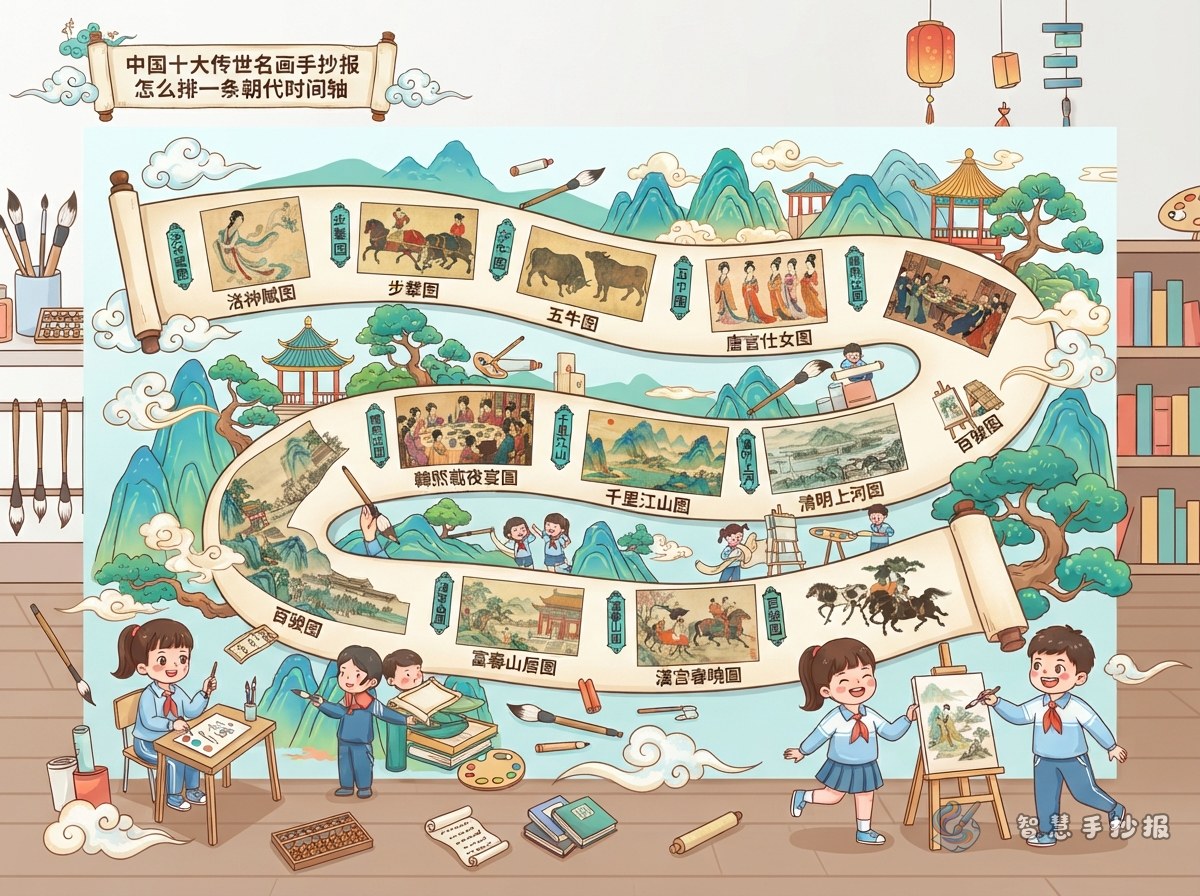
These paintings are often grouped together as China's ten great masterpieces. Put them on the timeline from oldest to newest:
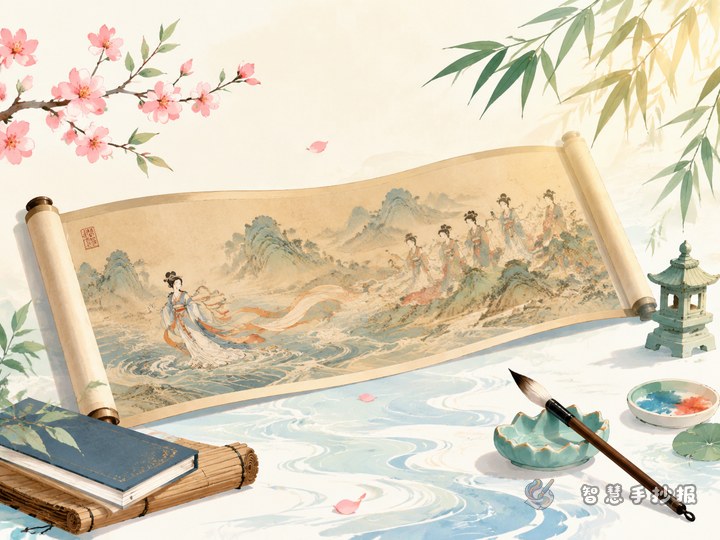
- Eastern Jin: Nymph of the Luo River by Gu Kaizhi
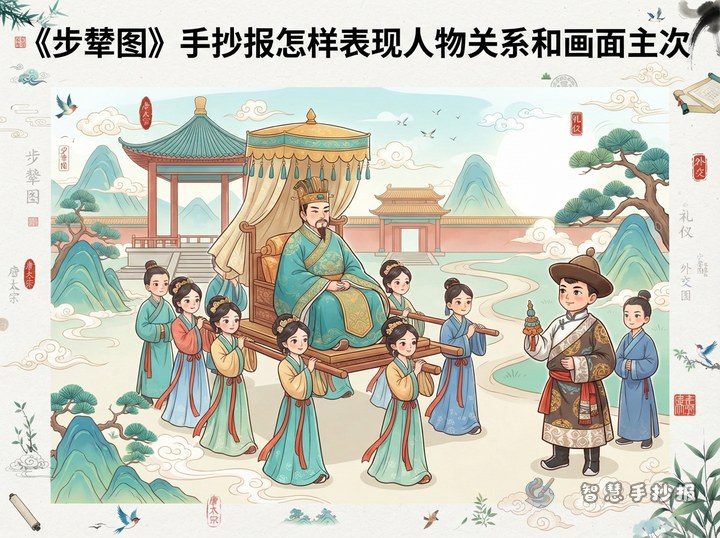
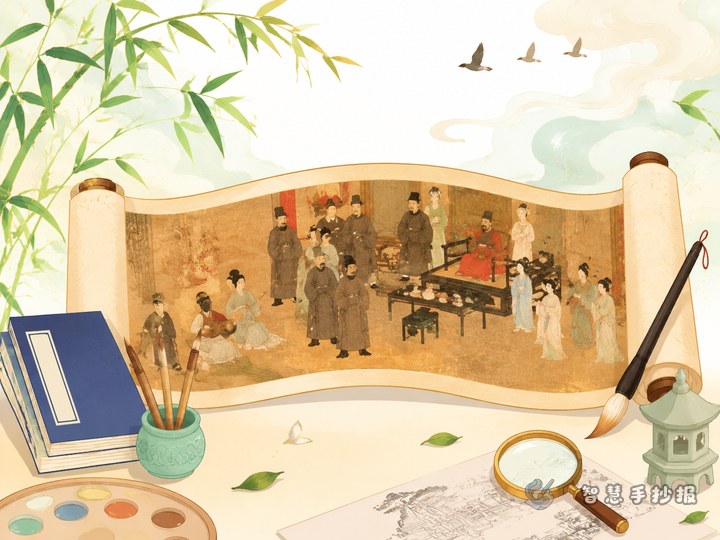
- Tang: Imperial Sedan Chair by Yan Liben
- Tang: Tang Court Ladies by Zhang Xuan and Zhou Fang
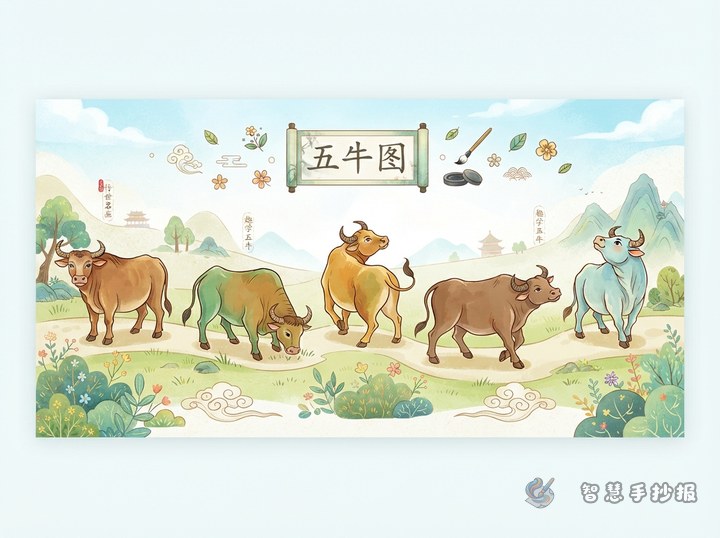
- Tang: Five Oxen by Han Huang
- Five Dynasties: Han Xizai's Night Revels by Gu Hongzhong
- Northern Song: Along the River During the Qingming Festival by Zhang Zeduan
- Northern Song: A Thousand Li of Rivers and Mountains by Wang Ximeng
- Yuan: Dwelling in the Fuchun Mountains by Huang Gongwang
- Ming: Spring Dawn in the Han Palace by Qiu Ying
- Qing: One Hundred Horses by Lang Shining
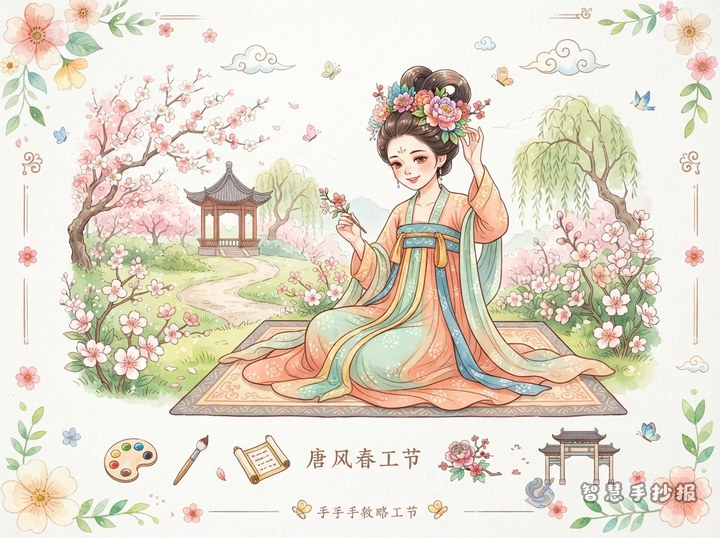
Tang Court Ladies is a group of Tang paintings on the same subject, so writing only one or two of them, such as Court Ladies Adorning Their Hair with Flowers or Court Ladies Preparing Newly Woven Silk, is perfectly fine.
Three Ways to Draw the Timeline
A straight ruler line
Draw one horizontal line across the middle of the sheet, mark ten evenly spaced dots, and write the dynasty above or below each dot in turn. It is the safest and most space-saving option.
A scrolling handscroll
Turn the timeline into an unrolling scroll or a gentle mountain ridge. Put the Tang stops on the upward slope and the Yuan, Ming and Qing stops on the way down, then join them with small arrows for an instant classical feel.
Folded page columns
Divide the sheet into three or four vertical columns, one dynasty per column, and read them from right to left like a traditional scroll. Write the dynasty in large letters at the top of each column and the painters below.
Short Captions You Can Reuse
A caption of a dozen words is far more effective than a long paragraph:
- Nymph of the Luo River: a legend of love hidden in a painting
- Imperial Sedan Chair: how the painter arranged his figures
- Tang Court Ladies: hairstyles and silk robes of the Tang court
- Five Oxen: five oxen, five different moods
- Han Xizai's Night Revels: a long scroll that reads like a comic strip
- Along the River During the Qingming Festival: busy market life along the river
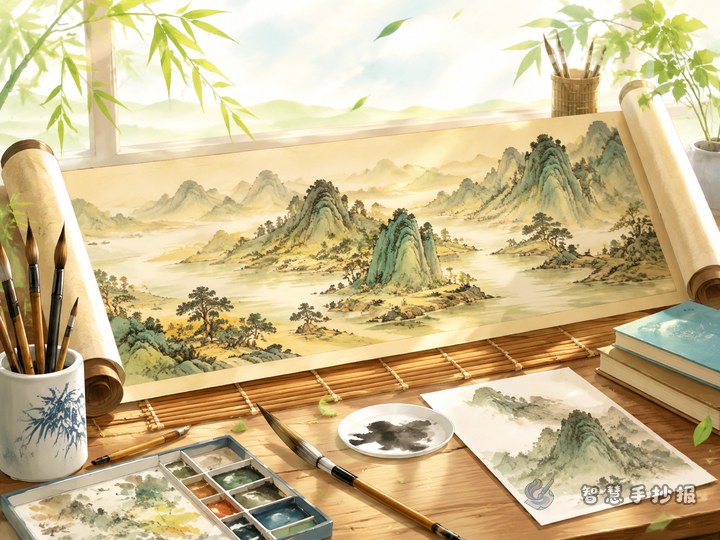
- A Thousand Li of Rivers and Mountains: brilliant blue-green landscape colour
- Dwelling in the Fuchun Mountains: the quiet mood of river and hills
- Spring Dawn in the Han Palace: daily life in a spring palace garden
- One Hundred Horses: horses galloping, standing and resting
Splitting the Page: Title, Timeline, Mini File
On an A3 or A4 sheet, divide the space roughly into three parts and sketch the areas in pencil first.
Top title area (about one fifth)
Write the main title, such as Ancient Chinese Paintings: A Dynasty Timeline, with your class and name in smaller letters below. Seals, cloud patterns and bamboo leaves make light decorations.
Main timeline area (about half)
This is the star of the page. Mark the ten stops lightly in pencil before writing and drawing. Simple icons work best: a scroll, a mountain outline, a figure silhouette, an ox or a horse.
Mini file box (about one third)
Choose one or two paintings you like most and note the dynasty, the painter, what the painting shows and what you like about it. A scroll, folding fan or book shape makes a clear border for this section.
Small Traps to Avoid Before You Start
- Limit yourself to three or four colours, such as ink black, rice-paper beige and blue-green, to keep the classical feel.
- Do not give all ten paintings equal attention. Illustrate two or three and simply name the rest.
- Check every dynasty, painter and title once you have finished writing.
- Leave a margin around the edge so no text touches the paper border.
If you would rather skip the measuring and layout work, open the WeChat mini program ZHI HUI SHOU CHAO BAO, pick a classical or handscroll template, and fill in the text from this page before adjusting the colours and drawings to your own taste.