Start by Cutting the List Down
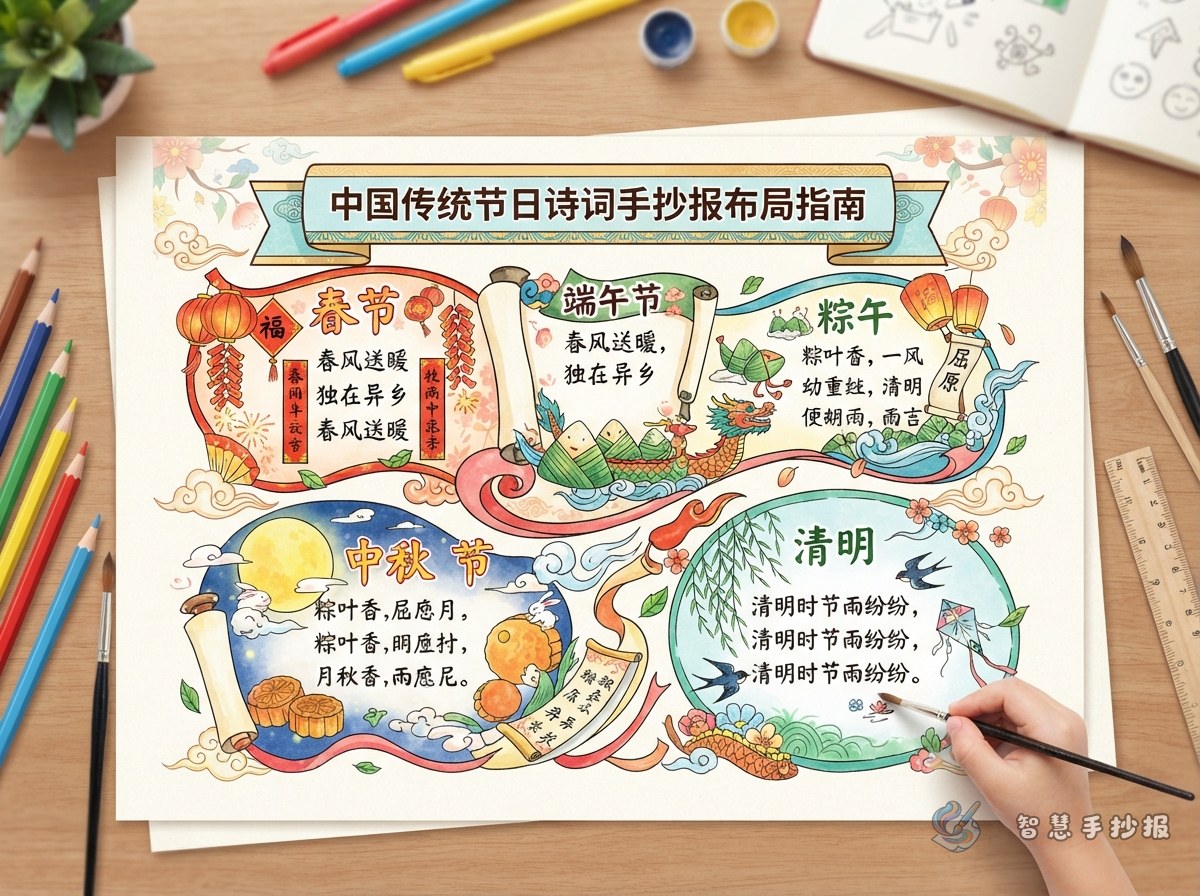
There are more than a dozen traditional festivals, but the sheet of paper is small. The reliable approach is to reduce the number of festivals first, then decide how to draw.
- Four festivals: good for younger students, with room for complete poems.
- Five festivals: good for older students and still gives a sense of the whole year.
- Six or more: write poems in the large boxes only, and let the rest appear as small labels on the timeline.
Spread the choices across the seasons, for example Spring Festival, Qingming, Dragon Boat, Mid-Autumn and Double Ninth, so the colors are easier to separate.
Make a Festival Timeline the Backbone
The biggest risk with several festivals is that each one stands alone and the order disappears. A timeline solves that.
- Draw a gently curved line across the upper third of the page, running from spring on the left to winter on the right.
- Mark evenly spaced dots on the line, write the festival name above each dot and the rough month below.
- Leave a box under each dot and connect it with a short line, so the boxes look like they hang from the timeline.
- Keep the bottom third for illustrations or a short summary so the page does not feel top-heavy.
The line does not need to be perfectly straight. A slight rise and fall looks more like a river and suits the classical mood. Willow twigs at one end and snowflakes at the other hint at a full year.
One Short Poem for Each Festival
Choose poems that are short and easy to picture. These lines are safe to copy.
- Spring Festival: Wang Anshi, New Year's Day, on firecrackers and spring wine.
- Lantern Festival: Ouyang Xiu, on last year's lantern night and bright flower markets.
- Qingming: Du Mu, on drizzle and quiet grief along the road.
- Dragon Boat: Wen Xiu, on the old story of Qu Yuan.
- Mid-Autumn: Wang Jian, on everyone watching the moon and wondering where longing settles.
- Double Ninth: Wang Wei, on being far from home and missing family on a holiday.
- Winter Solstice: Du Fu, on the return of longer days and coming spring.
- New Year's Eve: Gao Shi, on a cold lamp and a traveler's sleepless night.
One poem per festival is enough. For longer works, copy only the two best-known lines and end with an ellipsis.
What Else Belongs Inside the Boxes
Poems alone can look thin. Add two small items to each box and the page fills out.
- A plain-language line: explain the poem in one sentence, such as how it describes the noise of firecrackers and the warmth of holiday wine.
- A custom note: eating rice dumplings, watching the moon, climbing a hill, or putting up couplets, in one short sentence.
- A keyword: two or three characters that sum up the mood, such as reunion, longing, or welcoming the new, placed in a corner as a mini heading.
Keep body text one size smaller than the headings and leave generous line spacing so it stays readable. If drawing all those boxes and lines takes too long, open the WeChat mini program Smart Handwritten Newspaper, pick the festivals and layout, and write the content in by hand afterward.
Seasonal Colors and Matching Borders
Too many festivals invite color chaos. Coloring by season keeps it under control.
- Spring: soft green and pale pink for Spring Festival, Lantern Festival and Qingming.
- Summer: mugwort green and light blue for Dragon Boat.
- Autumn: orange yellow and moon white for Mid-Autumn and Double Ninth.
- Winter: light blue and grey violet for Winter Solstice and New Year's Eve.
Use the same border style everywhere, for example a rounded frame of equal thickness, and vary only the color. Follow the same rule for drawings: one main object per festival, no stacking. White space is part of the design, so there is no need to fill every corner.
A Quick Check Before Handing It In
- Is the title large enough that the theme is obvious at a glance?
- Does the timeline run left to right, with the festivals in the correct order?
- Did you include the poet and title for every poem?
- Are the boxes similar in size and the borders the same weight?
- Is any area too empty, or too crowded to write in?
Run through these five points and your festival poetry page will have order, verse, and pictures that hold together.