
A Math Diary Is Not an Essay
Many students hear the phrase math diary poster and try to fill the page with writing. The result looks like an essay notebook, and readers cannot see the math. The heart of this poster is recording one real moment through a mathematical lens: what time you got up, how many items you bought, how many skips you managed, how a cake was divided. One moment written well shows more thinking than five moments with one sentence each, and it is far easier to lay out.
Four Ways to Spot Math in an Ordinary Day
When you do not know what to write, hunt for material using these four lenses. One good find is enough to carry the main section.
- Time lens: How many minutes from waking up to leaving home? How long do homework, meals and television each take? A timeline shows instantly which one takes the biggest share.
- Quantity lens: How many milliliters of milk at breakfast, how many books in the schoolbag, how many skips in a row, how many trash bags the family uses in a week.
- Comparison lens: Compare your height, step count or skipping score with a classmate. Who has more, and by how much?
- Estimation lens: Guess how many candies are in a box or how long the walk to school takes, then count or time it to check. Being right or wrong is equally worth writing about.
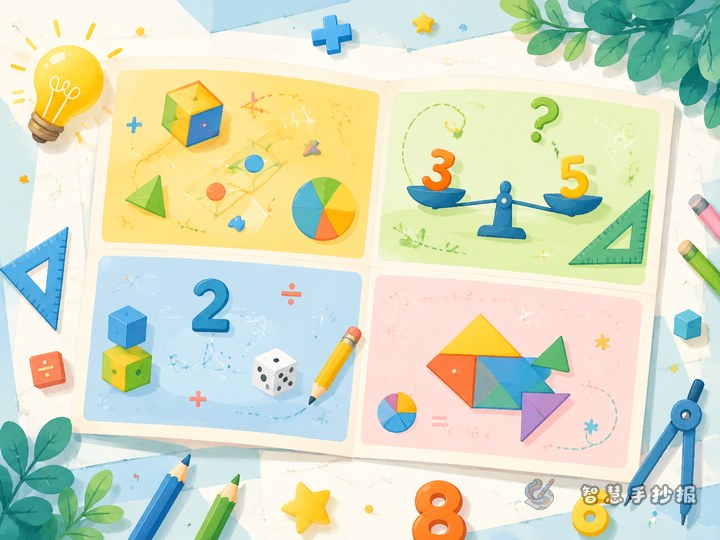
Three Sections That Give the Page a Rhythm
My Math Diary
The main section, written in the first person. Open with the time and place, put the numbers and the calculation in the middle, and close with one discovery of your own. Keep it to 150-250 characters, with short sentences and large numerals.
Little Number Discoveries
List three to five short facts from the day, such as "I went up and down six floors today, so that is 6 x 2 = 12 floors of stairs." Small boxes or labels in a row work well beside the main section.
The Start of a Problem
Turn a small question from the diary into a problem. Write only the question and the beginning of the reasoning, then hide the answer in a corner of the page so readers can try it themselves. This is the section classmates stop to read.
Make the Layout Look Like a Diary Page
To make the poster read as a diary rather than an essay sheet, try one of these arrangements:
- Timeline: Draw a line from the top left corner down to the bottom right and hang the morning, noon and evening moments along it, so the page reads like a day's journey.
- Open notebook: Split the paper into two pages, write on the left and draw grids, receipts, clocks or measuring cups on the right, leaving a narrow spine down the middle.
- Grid paper background: Use a pale grid as the base, write inside the squares and let numbers and number sentences pop out in bold, which looks mathematical and tidy at once.
Letter the title by hand and make it large, use no more than three colors, and leave a finger-width margin on all four sides so the page does not feel crowded.
How Much to Draw and How Much to Write
Aim for roughly sixty percent text and forty percent pictures. Choose drawings related to the content: clocks, shopping receipts, ruler marks, fraction pies and simple cartoon figures. Avoid filling large blocks with dark color, which costs time and smudges when photographed or copied. Numbers can be enlarged into decorations, for example shaping a 12 like a candle, but never trade readability for decoration.
A Short Checklist Before You Start Lettering
- Does the main section describe one concrete event instead of saying math is interesting?
- Are there at least three real numbers or number sentences?
- Can a reader understand each section title at a glance?
- Are you using three colors or fewer across title, text and decoration?
- Step back two paces: can you still read the main title?
If you want to save time on drawing grids and adjusting the layout again and again, open the Smart Handwritten Poster mini program in WeChat, choose a diary-style layout, place the section boxes and timeline first, and let your child fill in the handwritten numbers and story.