Why Dou Shou Qi Makes a Great Poster Subject
Among traditional board games, Dou Shou Qi has a low barrier to entry and a cast of characters children already enjoy. The eight animals are easy to draw, and the rules fit into a few short lines, so the page never turns into a wall of text.
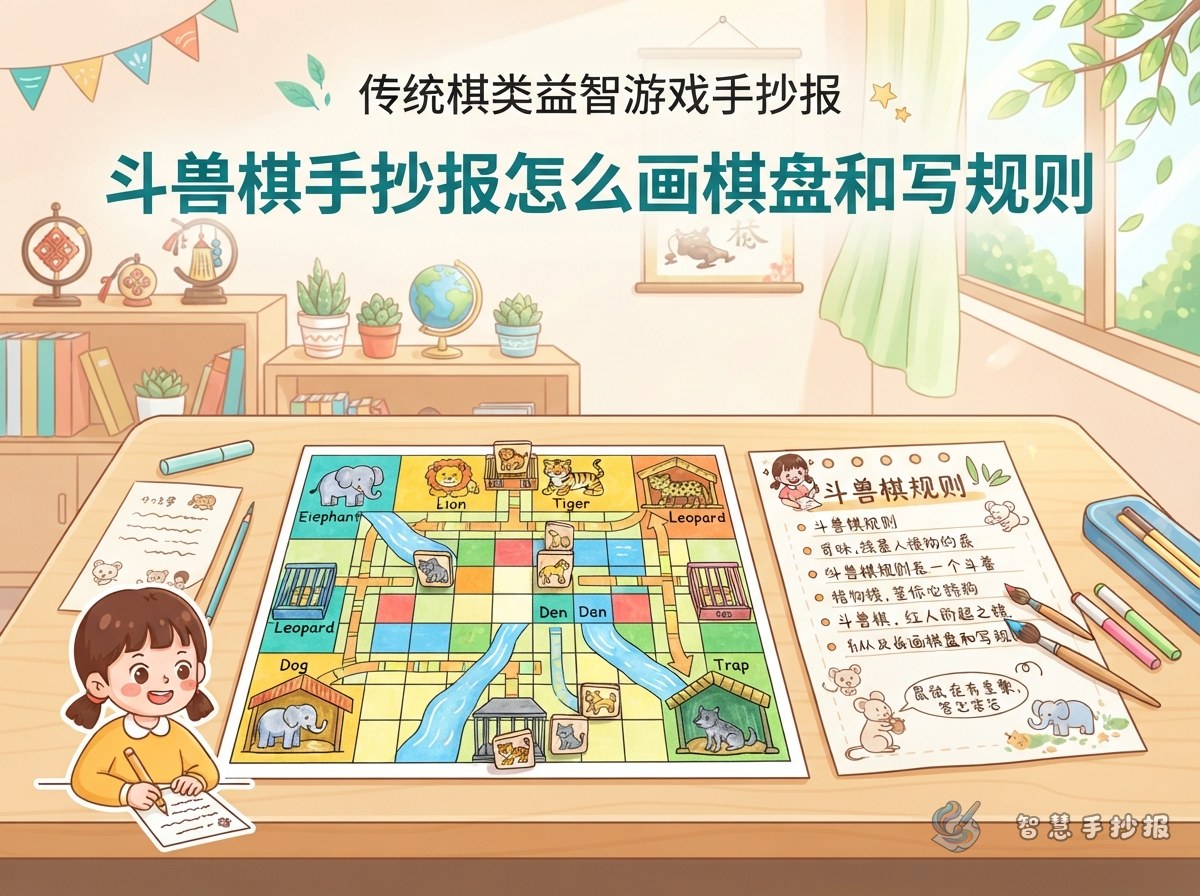
It also comes with a ready-made illustration: the board itself. Once the board is on the page, the poster has a focal point and the written sections only need to sit around it.
Step One: Get the Board Right
The board is what readers notice first, so clarity matters more than decoration. Practise once on scrap paper before working on the final sheet.
- Draw a rectangle in pencil and divide it into a grid, counting the squares before you go over the lines in pen.
- Mark the river across the middle with a wavy line or light blue hatching.
- Draw a den at each end, using a small house shape or a dot with a label.
- Add the three traps around each den as small crosses or pits.
- Check that both sides match, then ink the outline and erase the pencil marks.
If time is short, draw only half the board as a close-up and add a note saying the full board looks like this.
Step Two: Three Rule Points Are Enough
Show the capture order with arrows
Elephant beats lion, lion beats tiger, tiger beats leopard, leopard beats wolf, wolf beats dog, dog beats cat, cat beats rat, and rat beats elephant. A curved arrow chain takes less space than a paragraph and is far easier for younger pupils to follow.
Two special rules readers love
- Rats in the river: once a rat enters the water, no other animal can capture it except the opposing rat.
- Lions and tigers leap: these two pieces can jump straight across the river, unless a rat is in the water along that line.
The win condition in one sentence
Write that the first player to move a piece into the opponent's den wins. Add a short note explaining what the traps do.
Step Three: One Line for Each Animal
The animal profiles are the friendliest section on the poster. One sentence per piece keeps the reading light and the writing quick.
- Elephant: the strongest piece, afraid only of the tiny rat.
- Lion: can leap the river and roam a wide area.
- Tiger: jumps the water just like the lion, and often faces it head on.
- Leopard: fast on its feet and good at closing in on the enemy den.
- Wolf: a middle-ranking piece that holds the line.
- Dog: guards the traps and blocks bigger pieces.
- Cat: small, but able to take the rat.
- Rat: the only piece that swims, and the only one that can take the elephant.
Leave a small blank box beside each line so children can sketch the matching animal.
Step Four: A Layout That Breathes
A reliable arrangement is the board in the middle, text wrapped around it. Place the board centre-left, stack two or three small sections down the right side, and keep a horizontal strip at the bottom for a memory rhyme or summary.
- Title area: across the top, with one subtitle line beneath it.
- Board area: the largest element, with a finger-width margin all round.
- Rules area: arrows and short sentences, slightly larger than body text.
- Profile area: small rounded boxes dividing the eight lines.
- Colours: soft green or pale yellow for the background, brighter tones for the animal icons.
If you want a head start, the WeChat mini program Smart Handwritten Poster offers ready-made layouts you can fill in section by section.
A Small Touch That Makes It Playable
Turn part of the poster into a puzzle corner. Write a question such as "The rat is in the river. Can the lion jump across?" and print the answer upside down nearby. Readers will stop to check, and the poster becomes something to play with rather than just read.