Choosing Stories That Actually Fit on One Page
Plenty of honesty stories exist, but not all of them belong on a handwritten newspaper. Three simple filters help children pick wisely and keep readers engaged.
- Short plot: it can be told in two or three sentences without lengthy background.
- Clear contrast: someone lies or someone keeps a promise, and the difference shows.
- Easy lesson: the ending can be summed up in one line about why keeping your word matters.
Fables such as The Boy Who Cried Wolf, the tale of Zengzi killing the family pig, and the story of the wooden pole that earned a reward all pass these filters and suit a small story box.
Cutting a Story Down to Newspaper Size
Space is limited, so never copy a story out in full. The most practical method is the three-sentence pattern: cause, action, result. Keep the whole thing under sixty words so it reads like a neat story card.
Three ready-to-adapt examples
- The Boy Who Cried Wolf: A shepherd boy shouted that a wolf was coming when it was not true. When a real wolf appeared, nobody believed him and the sheep were lost.
- Zengzi and the pig: A child was crying, so the mother promised pork for dinner without meaning it. Zengzi insisted that a promise made to a child still counts, and the pig was killed.
- The reward for the wooden pole: A pole was set up with a promise of reward for anyone who moved it. One man did, he was paid, and people began to trust that words were kept.
Delete dialogue and inner thoughts, keep only who did what and how it ended. Children copy it faster and the page keeps breathing room.
A Story-Card Layout That Reads at a Glance
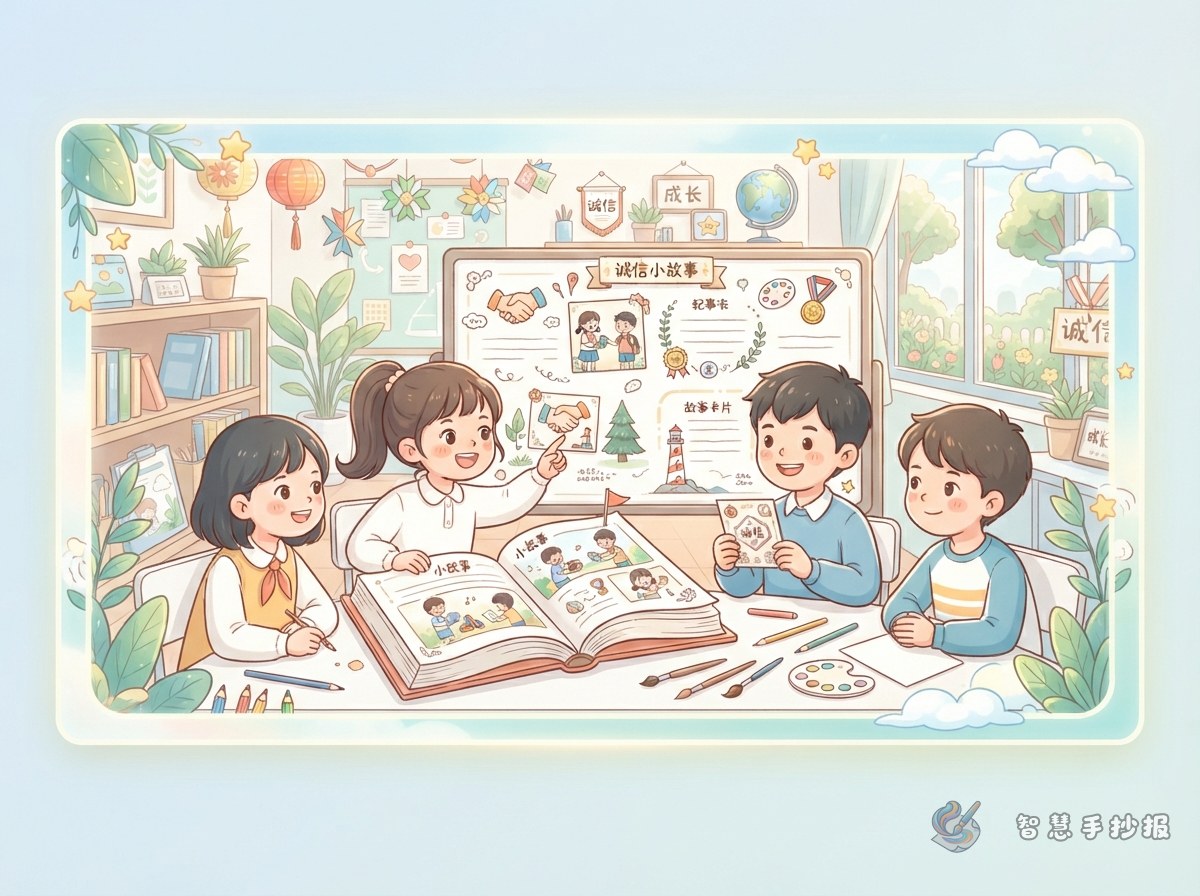
The biggest risk with a story-based page is a single solid block of text. Instead, divide the sheet into two or three story cards, each holding one tale. Cards can be rounded rectangles, clouds or open book shapes, but keep one consistent outline style so the page looks tidy.
- Sketch the layout on rough paper and decide the size and position of each card.
- Write the story name at the top of each card, slightly larger, with a coloured outline.
- Place the three-sentence story in the middle, with generous line spacing.
- Finish with one line of meaning at the bottom, such as keep your promises or one lie can cost a lot of trust.
On a landscape sheet, stagger the cards; on a portrait sheet, stack them and slip a quote strip between two of them for rhythm.
Filling the Gaps: Opening Line, Quotes and a Closing Note
After the stories are in place, corners usually stay empty. Instead of covering them with doodles, add a little more text that still serves the theme.
- Opening line: for example, open this page and read three short stories about keeping your word.
- Quote strip: one or two well-known sayings about trustworthiness and keeping promises.
- Closing note: two or three lines in the student's own words, such as honesty is not only about big things but about every small promise we make.
Colour, Lettering and Small Decorations
Honesty themes suit clean colours: cream, light blue and grass green as the base, with orange or red used only to highlight key sentences. Avoid covering the sheet in strong reds and greens. Draw the title in pencil first, outline it in a dark colour, fill with a light one, then underline with a wavy line or a block of colour.
Decorations should stay minimal: a few small leaves, a dotted border, a couple of dots as dividers. Keep every decoration in the same style and give all card outlines the same line weight and the page will look neat. If the content is ready but the layout is still unclear, open the Smart Handwritten Newspaper mini program in WeChat, pick an honesty-themed layout, drop the finished story text into it and copy the arrangement onto paper.