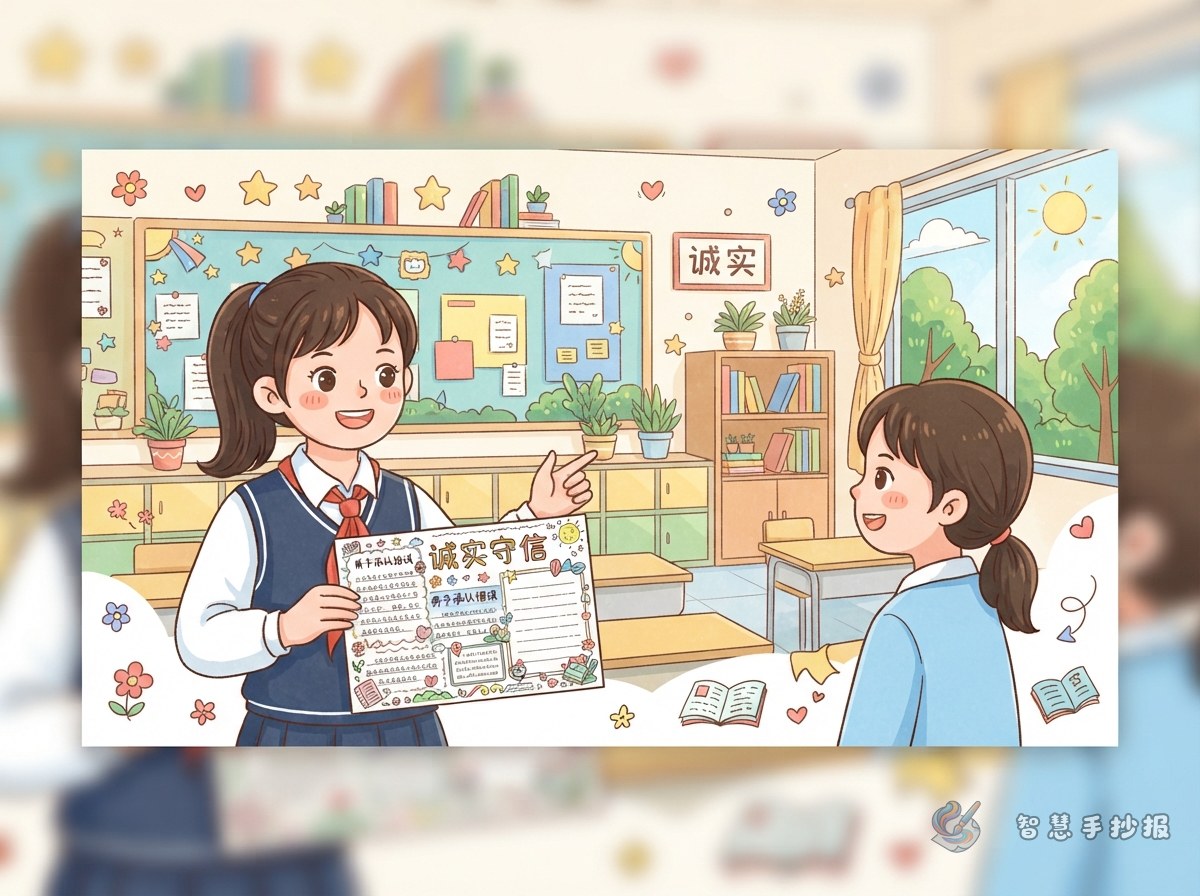
Choose One Clear Message Instead of a Broad Honesty Theme
Focus the handwritten newspaper on one practical question: What should I do after making a mistake? A useful central message is “Admitting a mistake takes courage, and correcting it shows responsibility.” This gives the page a clear character-education purpose while keeping it connected to children’s daily lives.
Possible titles include “Face Mistakes Honestly,” “I Take Responsibility,” and “Honesty Helps Me Grow.” Decorate the heading with an eraser, a small mirror, and a trail of footprints to represent noticing the problem, reflecting, and moving toward a solution.
Turn the Correction Process into Four Mini Features
The Mistake Magnifier
Before making excuses, stop and ask: What happened? How did my action affect someone else? Which facts should I explain honestly? Seeing the problem clearly is the first step toward taking responsibility.
Three Steps to Make Things Right
- Tell the facts: Do not hide the truth or blame someone else.
- Apologize sincerely: Say what you did wrong and show that you understand its effect.
- Take action: Repair the damage, complete the missed task, and decide how to prevent the same mistake.
Short Lines to Copy
Students may write: “A mistake does not disappear when it is hidden, but honesty and action can help correct it.” “Every honest admission is a step toward better character.” “A real apology includes both words and corrective action.”
Add a Choice-Based Situation
Draw a large speech bubble in the center and write: “I accidentally knocked over a classmate’s water bottle, and no one saw me. What should I do?” Add three choices: walk away quietly, pretend not to know, or explain what happened and help clean up. Mark the honest response with a green check and explain: “Choosing the truth even when no one is watching shows genuine integrity.”
Other useful situations include forgetting classroom duty, damaging shared property, or failing to complete something promised to a friend. Each example should lead to the same sequence: explain the facts, accept responsibility, and make amends promptly.
Design the Page as an Honesty Journey
A horizontal reading path works especially well. Put the main title at the upper left, show the mistake on the left, and connect three colored blocks labeled “Admit,” “Apologize,” and “Correct” with arrows or footprints. Reserve the right side for a reflection called “What I Learned.” A narrow strip along the bottom can hold reminders and a personal plan.
- Use blue for sincerity and orange for courage and action.
- Shape text boxes like sticky notes, speech bubbles, or open notebook pages.
- Keep each section to one short paragraph or three bullet points.
- Use simple figures showing reflection, honest conversation, and reconciliation.
Finish with a Personal Action Card
Create a small “My Make-It-Right Plan” in the lower corner with four prompts: “What I need to admit,” “Who needs my apology,” “How I will make amends,” and “How I will avoid repeating it.” This turns the handwritten newspaper from a collection of moral sayings into a practical activity.
After drafting the text, students and parents can continue in the Zhihui Handwritten Newspaper WeChat Mini Program to choose a page layout, arrange the sections, and keep the title, writing, and illustrations visually balanced.