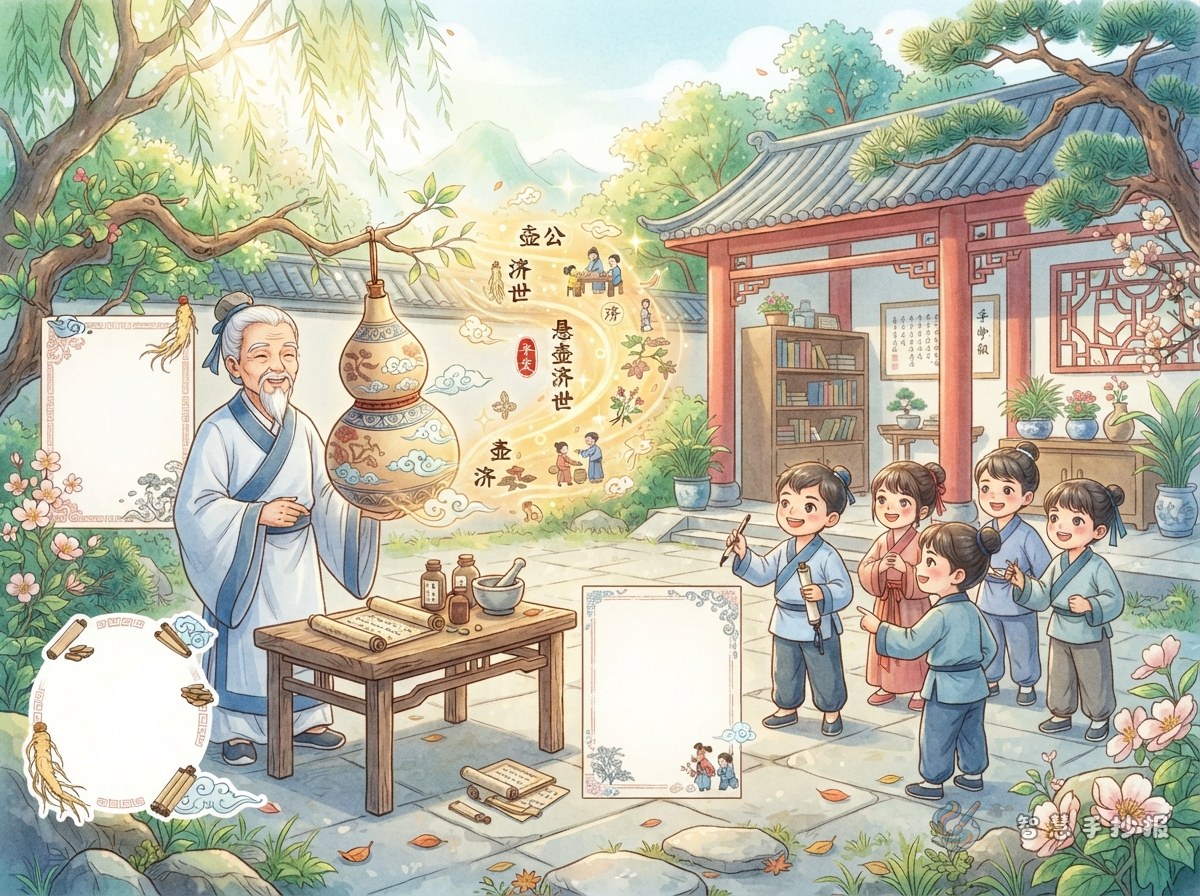
What “Xuanhu” Really Means
Xuanhu Jishi is a common phrase in traditional Chinese medicine culture. Xuanhu means hanging a gourd outside a shop or stall as a sign of medical practice. Jishi means helping people in need. Once students understand these two words, the story is much easier to retell on a handwritten newspaper.
Three Pictures to Remember the Story
- Picture 1: In a busy market, an old medicine seller hangs a medicine gourd in front of his stall.
- Picture 2: When the market closes, he jumps into the gourd to rest. Only Fei Changfang sees him from a nearby building.
- Picture 3: Fei Changfang asks to learn from the old man, studies medicine, and later helps people who are ill.
Copy-Ready Text for Your Page
Short Retelling
Long ago, an old medicine seller hung a gourd outside his stall every day. After the market closed, he would jump into the gourd. A man named Fei Changfang was amazed and asked to learn from him. The old man taught him medicine, and Fei Changfang later became a healer who helped many people. Since then, xuanhu has meant practicing medicine, and Xuanhu Jishi praises doctors who use medicine to help the world.
Word Bank
- Xuanhu: hanging a medicine gourd outside, later meaning to practice medicine.
- Jishi: helping the world and people in need.
- Hu Gong: the old medicine seller in the story.
- Medicine gourd: a classic symbol of traditional Chinese medicine.
A Layout with One Big Medicine Gourd
A center-and-around layout works best for this topic.
- Center: draw a large medicine gourd and write Xuanhu Jishi on it.
- Top left: the story box, titled “Hu Gong and Fei Changfang.”
- Top right: four small word cards for xuanhu, jishi, Hu Gong, and medicine gourd.
- Bottom left: a short note on TCM nicknames such as Xinglin, Jujing, Qingnang, and Qihuang.
- Bottom right: my thoughts, with two or three short sentences.
Use bold regular script for the title and wide line spacing for the body text. If you want a ready-made frame, open the 智慧手抄报 mini program in WeChat, search for Xuanhu Jishi or TCM stories, choose a layout you like, and fill in your own writing.
Add a Few TCM Nicknames
These old names can make the page richer without taking up too much space.
- Xinglin: a common name for the medical profession.
- Jujing: linked to a story about healing water and orange leaves.
- Qingnang: a doctor’s cloth bag for medical books, later meaning medical skill.
- Qihuang: from the questions and answers of Qibo and the Yellow Emperor, often used for TCM learning.
Common Slips to Avoid
- Do not write xuanhu with the wrong characters. Check the word before copying.
- Do not stop the story at “he jumped into the gourd.” Add how Fei Changfang learned medicine and helped people.
- Do not explain Xuanhu Jishi as “hanging a gourd can cure illness.” It means practicing medicine to help others.