Start With the Chain, Not the Drawing
The most common problem with an idiom chain handwritten newspaper is not handwriting, it is having too many scattered idioms with no visible thread. Draft the chain on scratch paper before touching your good sheet.
- Begin with easy, familiar idioms so readers immediately understand the idea.
- Allow same-sound connections to give yourself more choices, but explain the rule in one short line.
- Keep the chain to about 10 to 16 idioms, long enough to fill the page but short enough to finish.
- After each idiom, check again that the next one really connects.
Chain examples you can copy
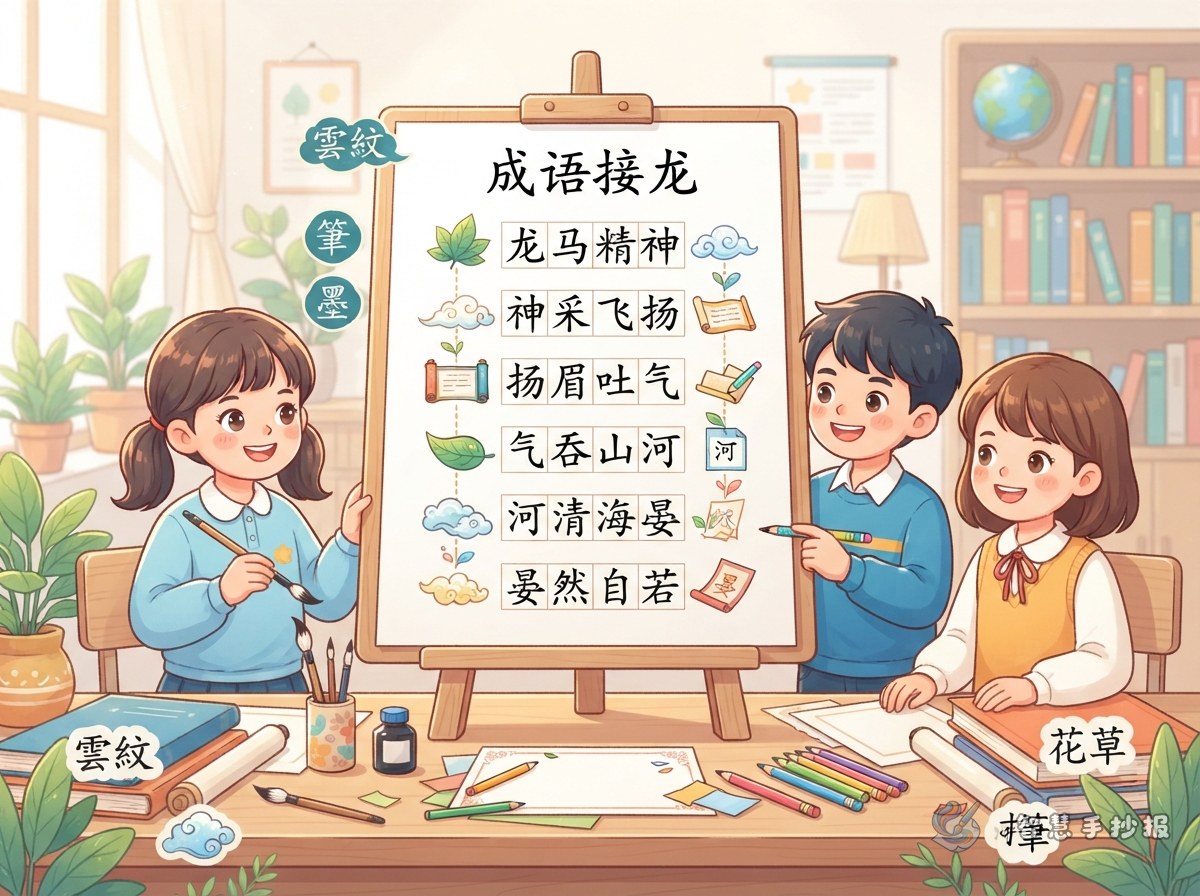
A tidy option moves from “wholehearted” to “spirited” to “carry forward” to “grand plans”, and on to “discover the truth”, “well-informed”, “make good friends”, and “fish for the moon”. Every link joins properly and the chain looks even on the page.
For younger students, a shorter chain of five or six familiar idioms starting with “spring returns to the earth” is easier to write and leaves more room for decoration.
Three Layouts That Keep the Chain Readable
Snake-fold line
Best for landscape pages. The idioms travel back and forth along horizontal lines, with a small arrow at the end of each row pointing down to the next. Leave generous space between rows so the arrows do not crowd together.
Spiral
Best for square pages. Start at the centre and wind outward, making the characters slightly larger as you go. It looks the most like a dragon, but draw faint concentric guide arcs first or the writing will drift.
Staircase
Best for portrait pages. Each idiom sits on one step climbing upward, with the last one at the top. Steps can be drawn as bricks, books or small hills, which also reminds you which idiom comes next.
Small Side Columns That Add Depth
A single chain can leave the page looking thin. Add two or three small columns, all still related to the theme of connecting ideas.
- Idiom profile: pick your favourite idiom from the chain and explain its meaning in one sentence.
- Tricky characters: list easily confused pairs you used in the chain.
- Same sound, different meaning: show two or three characters that sound alike but mean different things.
- Your turn: leave a small space inviting classmates to continue the chain with two more idioms.
From Draft to Finished Page
- Write the chain on scratch paper and confirm every link connects, then count the total.
- On the real sheet, divide the space: the top third for the title, the middle for the chain, the edges for side columns.
- Draw faint guide lines in the layout you chose, then write the chain first and the side columns second.
- Add borders and simple patterns such as clouds, bamboo leaves or a scroll edge.
- Erase leftover pencil lines, check for missing or wrong characters, then colour the title.
Details That Are Easy to Forget
- Give the page a real headline instead of just “idiom chain”, so it reads like a small newspaper.
- Limit yourself to three colours: one for the chain, one for the columns, one for accents.
- Write a little larger than usual and leave a finger-width gap between idioms.
- If time is short, shorten the chain to ten idioms and spend the extra minutes on colouring and outlining.
Once the chain, the idioms and the layout are settled on scratch paper, the final version goes much faster. If you would like more chain material and ready-made column ideas, open the WeChat mini program and search for the Smart Handwritten Newspaper library to pick a layout, then copy it onto paper.