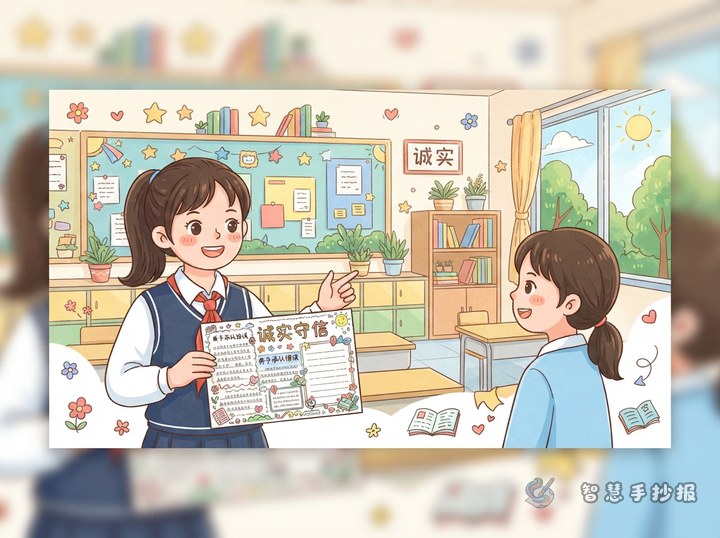
Turn Honesty into a Visual Journey
Instead of filling the poster with general rules, begin with a situation children recognize. A student might accidentally knock over a plant, feel worried, tell a family member what happened, and then help clean up. Four small scenes can show how telling the truth leads to responsible action and personal growth.
A strong heading is No Lying—Be an Honest Student. A smaller line such as “Truthful words have strength” can sit below it. Speech bubbles, footprints, or steps moving upward will reinforce the idea of learning from a mistake.
Add Sections That Invite Thought
Make the Honest Choice
Show two possible responses to one problem and ask readers which is better. For example: “If I forgot my homework, should I invent an excuse or explain honestly and arrange to finish it?” Add one sentence explaining why the truthful choice is responsible.
Respectful Ways to Tell the Truth
- I damaged this by accident, and I am ready to help fix the problem.
- What I said earlier was not accurate, so I want to explain what really happened.
- I have not completed the task yet, but I will make time to finish it.
- I should not blame someone else. Please give me a chance to correct my mistake.
My Daily Honesty Checklist
- Do not pretend to know something when you do not.
- Explain what happened before looking for a solution.
- Do not exaggerate your achievements to gain praise.
- Clear up misunderstandings patiently without inventing details.
Ready-to-Use Writing for the Poster
Honesty takes courage: Everyone makes mistakes. Real courage means telling the truth and accepting responsibility instead of hiding a problem. An honest explanation may feel difficult at first, but it helps solve the issue and preserves trust.
Make truthfulness a habit: Honesty appears in ordinary moments—whether homework is complete, how something was damaged, or how much of a task has been done. Speaking accurately and refusing to shift blame builds dependable character.
Four steps after a mistake: Calmly remember what happened, explain the facts clearly, apologize for your part, and suggest a realistic way to make things right. Admitting the truth is the beginning; improvement completes the lesson.
Use Layout and Color to Support the Message
Divide the page into four areas: a short introduction, a situation with dialogue, an action checklist, and a reflection. Connect them with a path or staircase. An honesty tree also works well: write “truth, courage, responsibility” near the roots and place honest actions among the leaves.
Blue, green, and orange make a bright, balanced palette. Blue can suggest sincerity, green can represent growth, and orange can highlight the title. Keep decorations simple with pencils, books, magnifying glasses, and friendly faces. Short paragraphs of three to five lines will keep the page easy to read.
Sketch Before You Start
- Mark the title and section positions lightly in pencil.
- Choose two or three situations rather than adding too many examples.
- Write the main text before drawing characters and decorations.
- Check spelling, balance the colors, and fill only the necessary empty spaces.
To refine the sections, title style, and amount of text for your paper size or grade level, continue creating in the 智慧手抄报 WeChat Mini Program.