Start With One North-to-South Route
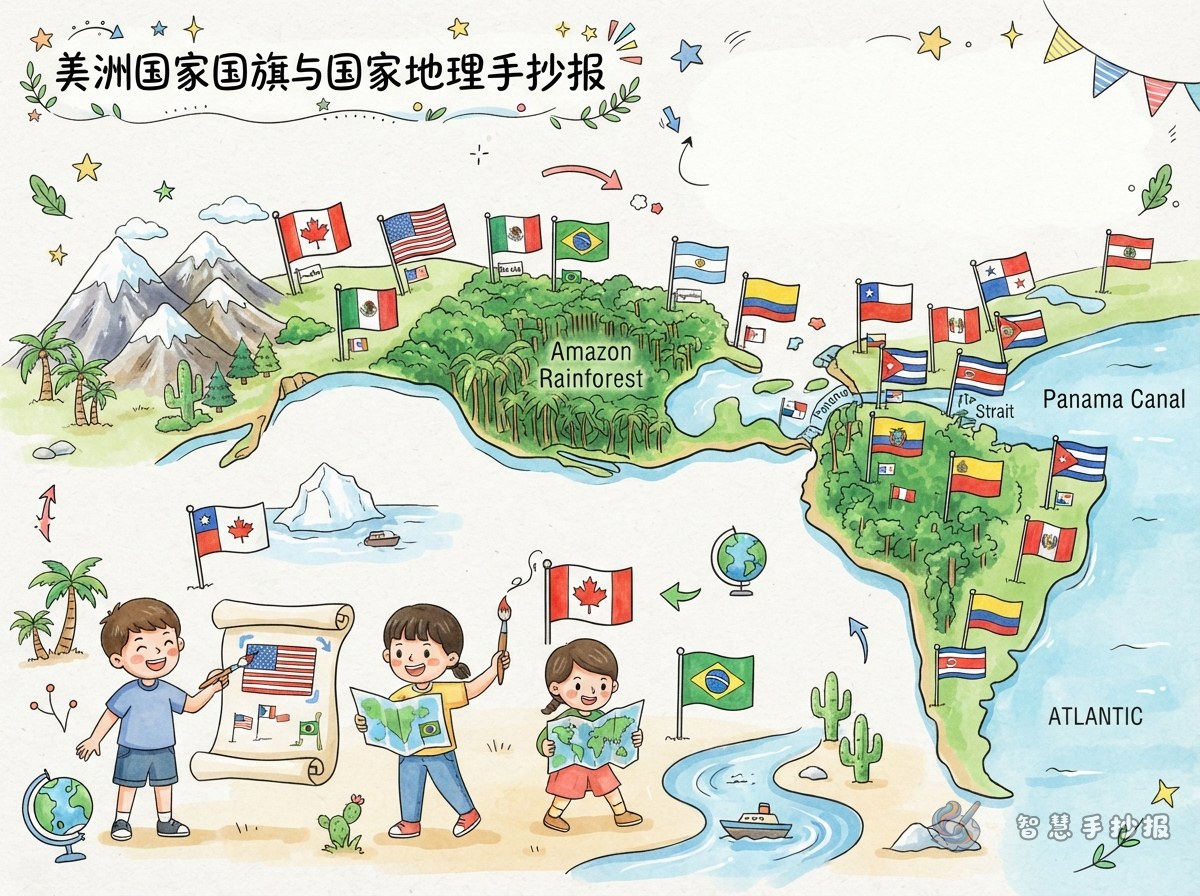
The Americas stretch a long way from north to south, from cold Canada down to the southern tip of the continent. If you simply scatter every flag across the paper, the page looks messy. A clearer approach is to draw one vertical route and let it divide the page into three bands: North America at the top, Central America and the Caribbean in the middle, and South America at the bottom.
This line works as a section divider and as the reading order at the same time, so readers can follow it downwards and connect each country with its flag and geography.
- Top band: maple leaf, great lakes, coniferous forest
- Middle band: cactus, volcanoes, canal
- Bottom band: rainforest, mountains, grassland
Match Each Flag With One Geography Word
You do not need every country in the Americas. Choose six to eight flags with clear colours and simple patterns, then leave three short lines under each flag for the country name, the capital and one geography fact.
Pairings that work well
- Canada: red maple leaf, linked to temperate forest and maple trees
- United States: stars and stripes, linked to a very wide land area
- Mexico: eagle and cactus, linked to high plateau and desert
- Panama: blue, red and white quarters, linked to the canal
- Brazil: green and yellow, linked to the Amazon rainforest
- Argentina: blue and white stripes with a sun, linked to the pampas grassland
- Chile: white, red and a single star, linked to the long Andes country
- Peru: red and white stripes, linked to highlands and ancient culture
When you draw the flags, accurate colours matter more than complicated details. Measure the stripes with a pencil first, and simplify any small emblem so it is still recognisable from a distance.
Five Sections You Can Copy Straight Onto the Page
- Title area: place it at the top, with a smaller line for your name and class.
- Route map: sketch a simplified outline of the Americas down one side and mark the Panama Canal and the Andes.
- Flag file: under each flag write the country, the capital and one geography fact, all in the same format.
- Geography cards: give rainforest, mountains, grassland and volcanoes a short paragraph each, with a small symbol.
- Question box: add two or three questions, such as “Why is the Panama Canal important?”
Separate the sections with dotted lines, waves, leaves or clouds. Repeating the same decoration keeps the whole page looking tidy.
Short Sentences You Can Write on the Paper
A school poster does not need long paragraphs, but every sentence should carry information. Choose from these ready-made lines.
- The Americas stretch from the cold north to the warm tropics, so the natural environment changes a great deal.
- The Amazon rainforest is huge, and most of it lies inside Brazil.
- The Andes run along the western coast of South America and form the longest mountain range in the world.
- The Panama Canal joins the Atlantic and the Pacific, so ships no longer have to sail around the southern tip of the continent.
- The Mexican plateau is high above sea level, and cactus and volcanoes are common symbols of the region.
- The pampas grassland of Argentina has rich grass and is well suited to farming and herding.
- Canada has large areas of coniferous forest and many lakes, and the maple leaf is a well-known national symbol.
Build Order, Colours and a Few Small Tips
- Lightly pencil in the zones for the title, map and flags.
- Draw the route and the map outline first, then the flag frames.
- Write the body text before the title, so the heading does not get squeezed into a corner.
- Use cool colours for the north, warm oranges for the middle and greens for the south.
- Finish by outlining the frames and the title with a darker pen and erasing spare pencil lines.
Keep a clear size order: the biggest letters for the title, medium for section names and the smallest for body text, with even line spacing. If you want to see how a layout fits together first, open the Smart Handwritten Newspaper WeChat mini program, look at a world geography layout for reference, then draw your own version.