Start With Three Facts, Not a Whole Province
This poster does not need to cover everything about your province. It needs three facts: the province name, its one-character abbreviation, and the capital city. Check all three in an atlas or textbook, write them on a scrap sheet, and let every other box grow from them.
- Province name: the full name, used for the title and the top of the card.
- Abbreviation: one character, the visual center of the page.
- Capital city: the city name plus one sentence about how you picture it.
Three Ways to Explain One Character
It comes from the full name
Some abbreviations are simply a character taken from the province name, so the sound and shape feel familiar and are easy to remember.
It comes from a river or mountain
Others are tied to water or hills inside the province. A small wave line or a simple peak drawn beside the character makes the connection visible.
It comes from an older place name
A few trace back to historical names. Give these a small labeled box and turn them into a knowledge note on the page.
Remember: confirm which one applies before writing. Ask a teacher or check an atlas together rather than guessing.
A Layout Built Around a Province ID Card
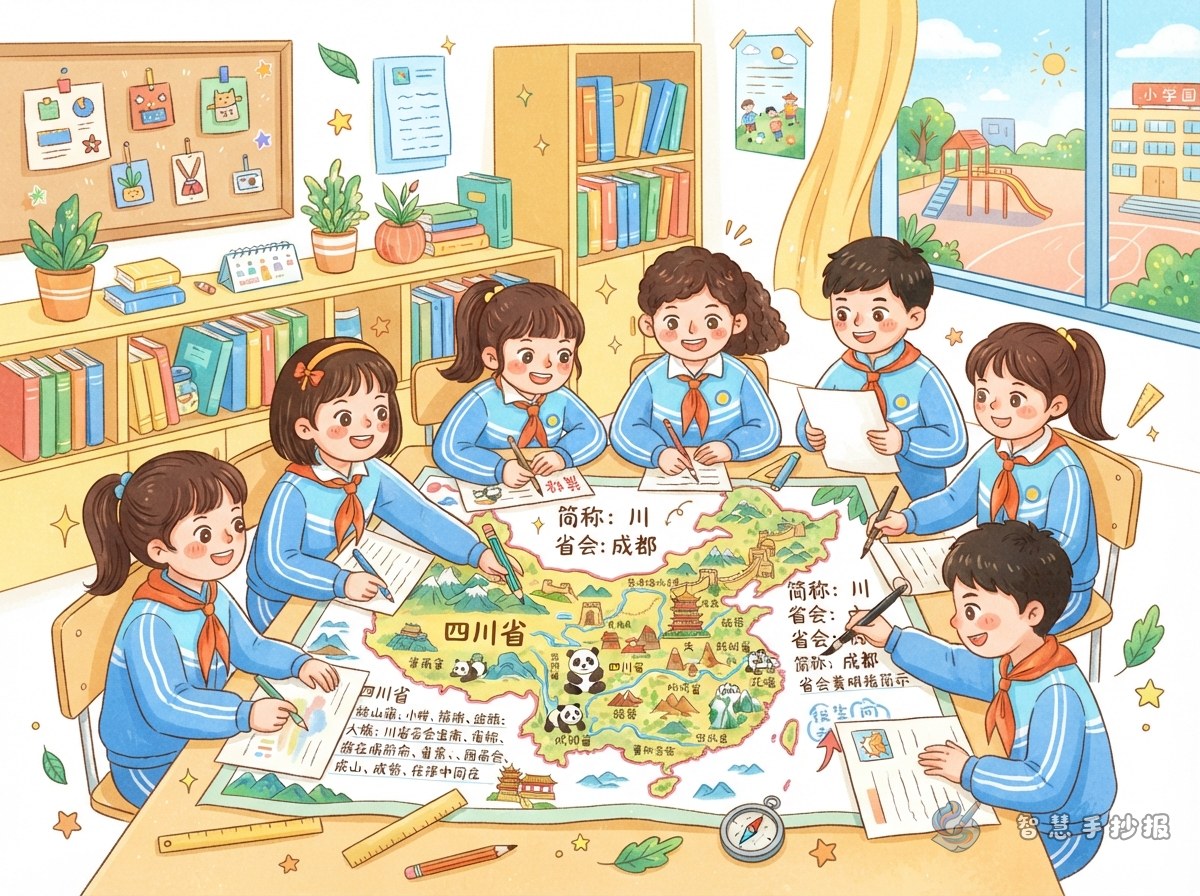
Draw a tall rectangle slightly left of center and treat it as the province ID card.
- Top of the card: province name in a horizontal line, with a thin rule underneath.
- Center: the abbreviation, enlarged, inside a circle or square frame.
- Bottom: the capital city and one personal sentence.
- Right of the card: two narrow stacked boxes, one on the abbreviation's origin, one with three capital-city keywords.
- Edges: a thin border or a row of small icons to close the page.
Keep the card to about a third of the page and leave plenty of white space so the text stays readable.
Short Sentences You Can Copy Right Away
Long paragraphs are hard to read on a poster. Short lines work better and are easy to adapt.
- My hometown is in ____ Province, abbreviated ____.
- This abbreviation comes from ____.
- The capital, ____, is a city I would love to visit.
- A river here is called ____.
- If I had to describe my hometown in one character, I would choose ____.
Three Small Touches That Make It Feel Local
Color-code the information
Use one color for the province name, a stronger contrast for the abbreviation, and a lighter tone for the capital. Readers instantly see what matters most.
Give the character its own card
Place the abbreviation in a small square or circle and add a tiny motif in one corner, such as a grain stalk, a wave, or a hill, to echo its origin.
Sketch a rough outline
Draw a simple province outline in a corner. It does not need to be exact, just recognizable, with a dot marking the capital.
From Draft to Finished Page
- Write the three facts on scrap paper and double-check the spelling.
- Divide the page lightly in pencil: card area first, text areas second.
- Write the title and the abbreviation, largest and steadiest.
- Fill the small boxes with text before adding any decoration.
- Outline everything in one color family and erase the pencil lines.
If you want a different layout or a few extra boxes, open the WeChat mini program Smart Handmade Poster, choose a China geography template, and drop your checked facts straight into the design.