Build the Theme Around Lingnan Flowers and Birds
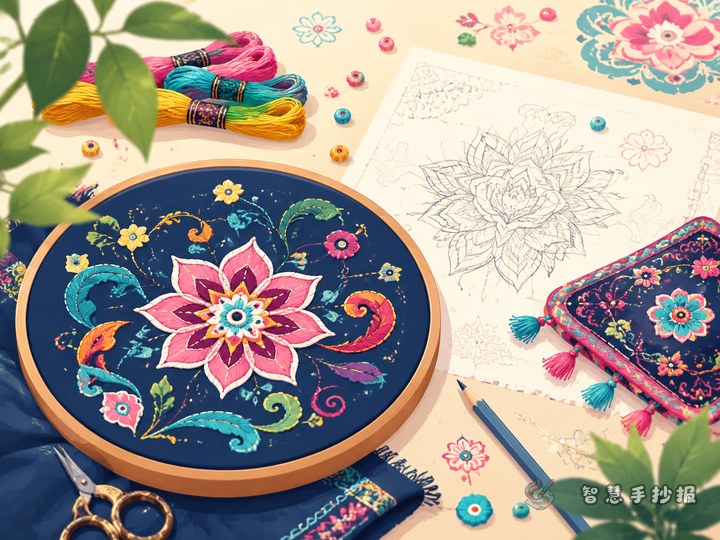
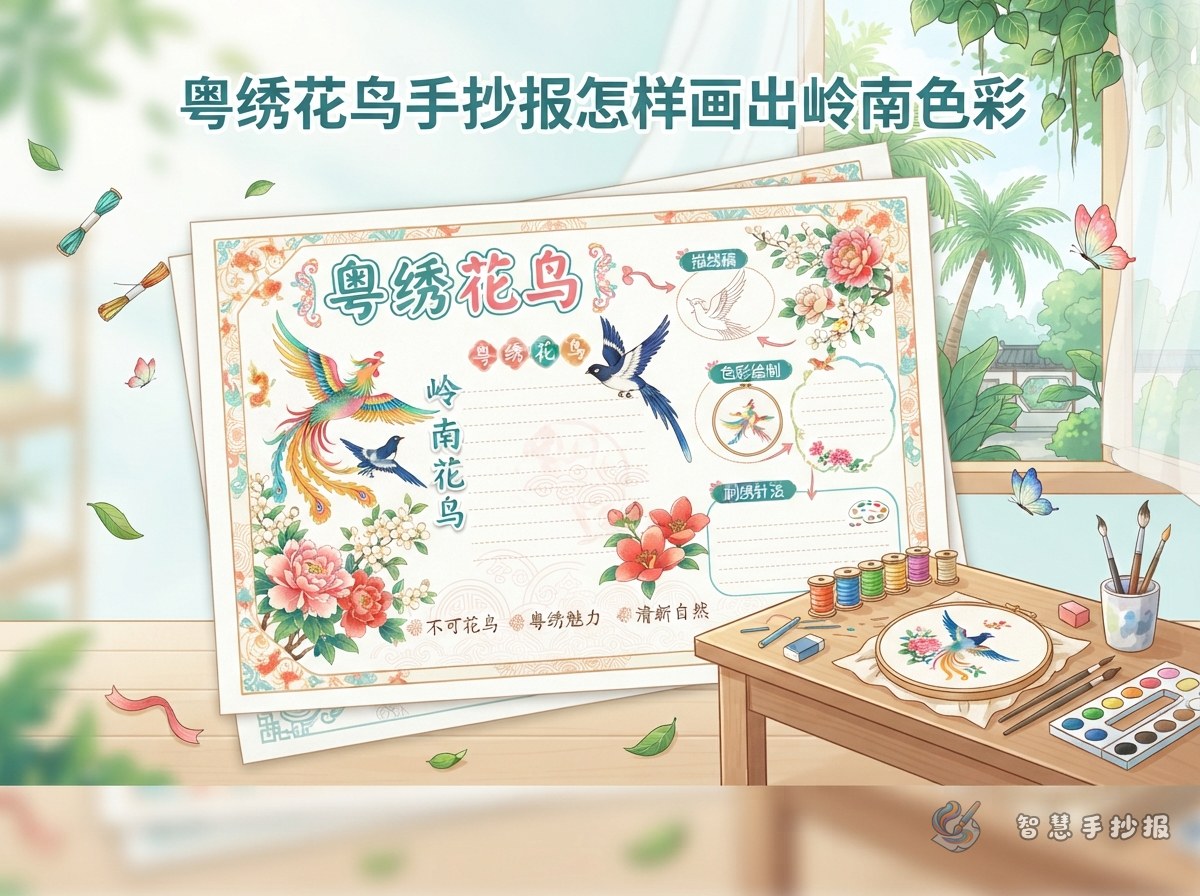
Use the idea of “flowers and birds on brocade” as the visual focus. A blooming flower, spreading leaves, and a lively bird can form the main illustration. Bright red, gold, orange, and emerald green help create the rich and festive look associated with Cantonese embroidery. Possible headings include “Lingnan in Every Stitch” and “Flowers and Birds on Silk.”
There is no need to copy a complicated embroidered work. Simplify petals, feathers, and leaves into clear shapes, then add short strokes, curved lines, and dotted textures to suggest the direction of silk threads.
Choose Four Clear Content Boxes
- Meet Cantonese Embroidery: Explain that it is a major Chinese embroidery tradition and that Guangzhou embroidery and Chaozhou embroidery are representative forms within it.
- Meanings in Nature: Introduce peonies, kapok flowers, phoenixes, magpies, or peacocks and explain how traditional motifs can express positive wishes.
- From Pattern to Stitch: List simple stages such as studying the design, selecting colors, outlining shapes, and filling areas with texture.
- Keep the Craft Alive: Share ways students can observe traditional patterns, respect patient handwork, and introduce heritage crafts to classmates.
Short Passages Ready for the Poster
A Quick Introduction
Cantonese embroidery is admired for its rich colors and detailed decoration. Flowers, birds, auspicious animals, and traditional patterns can become layered and vivid through careful stitching. When looking at an embroidered work, notice not only the picture but also the direction of the threads across petals, feathers, and leaf veins.
Patience in Every Stitch
A refined embroidered picture takes patience and concentration. The maker adjusts thread direction, spacing, and color to create depth on a flat surface. A school poster deserves the same thoughtful approach: arrange each section carefully and use neat handwriting to show respect for the craft.
What I Can Do
Preserving a traditional craft can begin with studying one embroidered flower or learning the meaning of one motif. Students can visit exhibitions, record crafts from their hometowns, draw embroidery-inspired patterns, and share what they discover with classmates.
Arrange the Page Like an Embroidered Screen
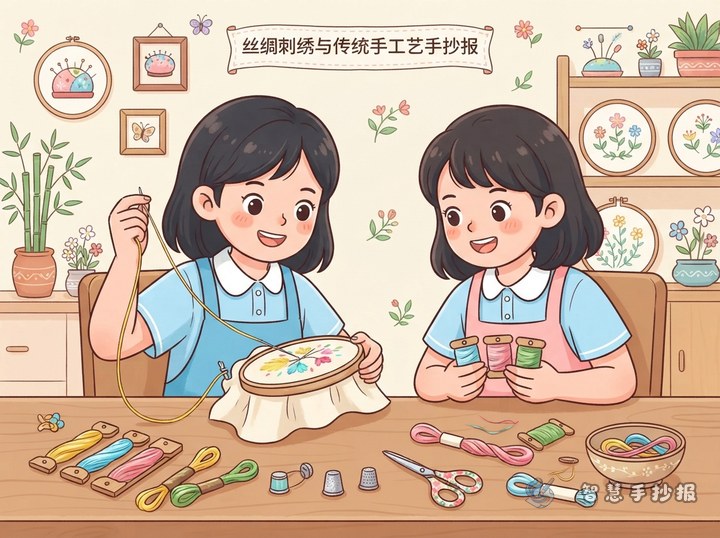
Try a central flower-and-bird illustration surrounded by four text boxes. Place the title at the top, draw a flowering branch diagonally across the center, and balance larger and smaller sections on both sides. A final action box can sit near the bottom. Fan-shaped, embroidery-hoop, or scroll-shaped frames work well, but they should remain thin enough to leave room for writing.
- Limit the main palette to three or four colors and use gold only as an accent.
- Add small key patterns, petals, or repeating leaves in the corners rather than filling every gap.
- Write body text in a dark color and reserve brighter colors for the title, borders, and illustrations.
- Turn the bird and flowers toward the center to guide attention back to the topic.
Create the Look of Thread with Pens
Draw fine lines radiating outward across each petal. Curve feather lines in the direction of the bird’s body, and place short strokes along the veins of each leaf. Changing line direction from one area to another produces a more convincing embroidered texture than coloring every shape solidly. After checking the title, facts, handwriting, and blank space, continue refining the layout in the Smart Handwritten Poster WeChat Mini Program.