
A Very Short Story, but the Reason Matters
The story of Lu Xun carving the character for “early” into his desk is short enough to fit in one corner of the page. Before writing, decide what readers should understand: he did not carve it for fun, he carved it as a promise to himself.
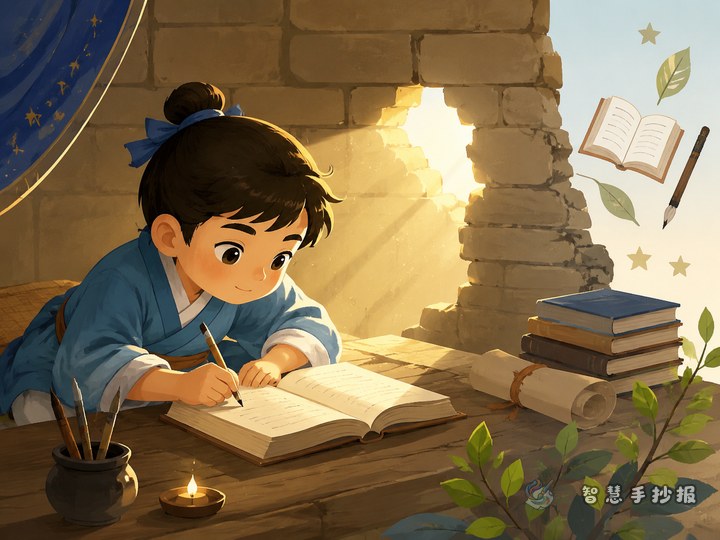
A simple order works well. He was studying in a traditional school, arrived late because of something at home, and was criticised by his teacher. Instead of arguing, he went back to his seat and cut a small “early” character into the corner of the desk. After that he came earlier each day.
Do not invent extra details such as a precise year, the teacher's exact words, or how long the carving took. The short version is enough if the chain of “late — carved a reminder — changed his habit” is clear.
Three Text Blocks That Keep the Page Balanced
A page with only the story feels thin. Splitting the writing into three blocks gives each part a purpose without adding much copying work.
- Story block: three to five short sentences, written plainly, not as an essay.
- Quote block: two or three short sayings about time or keeping promises, one per line, in slightly larger writing.
- Action block: three small things you can actually do, such as packing your bag the night before or setting the alarm ten minutes earlier.
Together these usually stay under about 150 characters, and younger children can halve that. Fewer words leave room for the title and drawings, which is an advantage, not a weakness.
Make the Character the Centre of the Page
The best visual element for this topic is the character itself. It should be the centre of the design, not a small mark in a corner.
Place it in the upper middle or on the left third and let it take roughly a quarter of the page. There are three ways to draw it: outline the character and colour it in, write it boldly with a thick marker, or enlarge it on squared paper and trace it. A square or rounded frame around it, or a small wood-grain border, can make it look carved into a desktop.
Surround it with three or four simple elements: a tilted desk, a stack of books, a small alarm clock, and a little morning light or an early bird. Keep the drawings simple; a clear page beats a busy one.
Dividing Columns So Nothing Looks Cramped
Most weak pages fail because everything is squeezed together, not because the content is poor. Draw faint pencil guide lines first.
- Mark the title area across the top, with the main title in thick strokes and a smaller subtitle beneath.
- Mark the area for the large character, upper middle or left third.
- Divide the rest into two or three boxes: story, quote and action, with a finger-width gap between them.
- Finish the four corners with simple patterns or small drawings so they do not look bare.
Keep at least thirty percent of the page as blank space. Extra spacing between lines makes the writing easier to read from a distance and looks better in a photo.
Adapting the Page for Different Grades and Group Work
The same topic does not need to look identical in every class.
Lower grades: more pictures, fewer words
A main title, three sentences of story and one sentence of reflection are enough. Use a large outline character to colour in and fill the space with a desk, an alarm clock and a sun. Children can handle the colouring and the big letters while an adult draws the guide lines.
Middle and upper grades: add a time-planning column
Add a small “my morning timetable” box listing a few times, plus one or two sentences about someone you know who is always punctual. Because there is one more column, shorten the other blocks so the page stays comfortable to look at.
Group work: clear jobs beat fancy drawing
Agree who writes the title, who draws the large character, who copies the story and who decorates the corners. Use one colour for all body text and a different colour for drawings so the page does not look messy. At the end, check together for misspelled characters and smudges.
If you are unsure about the layout, sketch a small draft the size of your palm first, placing the title, the character and the three blocks. You can also open the Smart Handwritten Newspaper mini program to pick a page style and continue building the design with the text you have already written.