Choose one shape theme before you draw
Shape posters often end up as a few scattered drawings with no clear message. Pick a theme you can explain in one sentence, and every column will have a job.
- Shapes that change: focus on combining and splitting shapes, such as what two triangles can become.
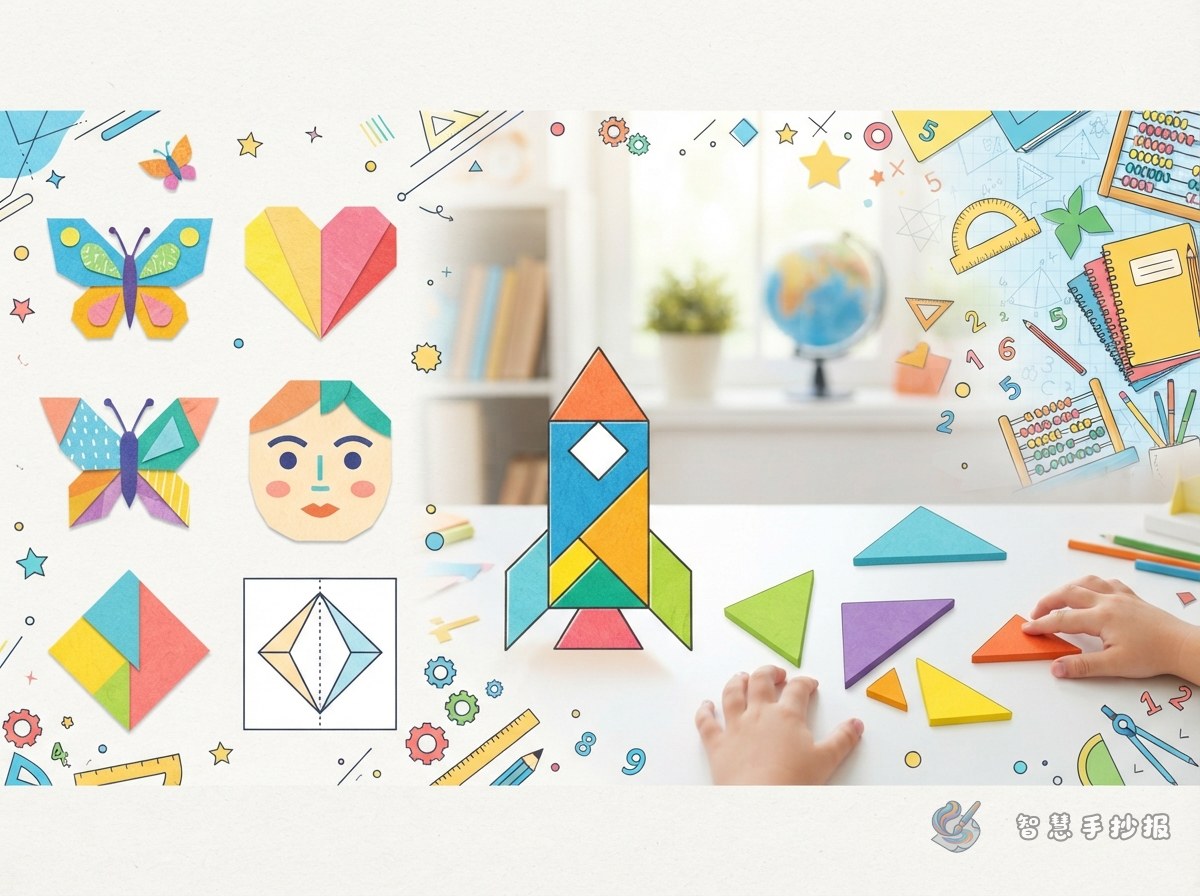
- The world of symmetry: focus on lines of symmetry found in butterflies, paper cuts and window grids.
- The power of seven pieces: focus on the names of the tangram pieces and the figures you can build.
Once the theme is set, choose content that supports it and the page will feel unified.
Ready-to-use shape content for your poster
Lines of symmetry and mirror shapes
Explain what a line of symmetry is, then give examples: a square has four, a rectangle has two, and a circle has countless. You can draw half a shape and invite readers to imagine the other half, with the answer written nearby.
Tangram building
List the seven pieces clearly: two large triangles, one medium triangle, two small triangles, one square and one parallelogram. Add two or three simple figures such as a house, a boat or an animal, and note which pieces you used.
Tessellation and shape counting
Tiles, honeycombs and fish scales are all tessellation examples. Draw a small patch and add the sentence "the shapes leave no gaps and do not overlap". Then add a counting question, such as how many triangles you can find, with the answer in a corner.
Turn the layout itself into a shape design
For a shape-themed poster, the sections can be built from shapes instead of plain rectangles.
- Use a large hexagon for the title area and write the title in the middle.
- Use triangles or trapeziums for small sections and stagger them rather than lining them up.
- Keep a long narrow strip at the bottom for "what I noticed".
- Rule all outlines with a ruler and keep the line weight the same for a tidy look.
Colour, line and handwriting tips
- Choose two or three main colours, such as blue with yellow or green with orange, and fill shapes with light tones.
- Outline each shape in fine black pen and colour lightly so the text stays readable.
- Use three text sizes: largest for the title, medium for column names, smallest for body text.
- Sketch in pencil first, then colour and write once the positions look right.
Two hands-on shape challenges
Challenge one: fold and find the lines
Fold a square sheet several times and draw each crease on the poster, labelling the lines of symmetry. See how many you can find altogether.
Challenge two: swap two pieces for one
Use the two small tangram triangles to make a square, then think about what other shapes they can form and draw your answers in the "build it" section.
From rough sketch to finished poster
Once the sketch is settled, the rest is writing, inking and colouring. If you need layout references or text ideas, open the WeChat mini program and browse shape and symmetry poster styles, then replace the column names and content with your own before copying the arrangement onto paper.