Why Huizhou Houses Suit a Handwritten Newspaper
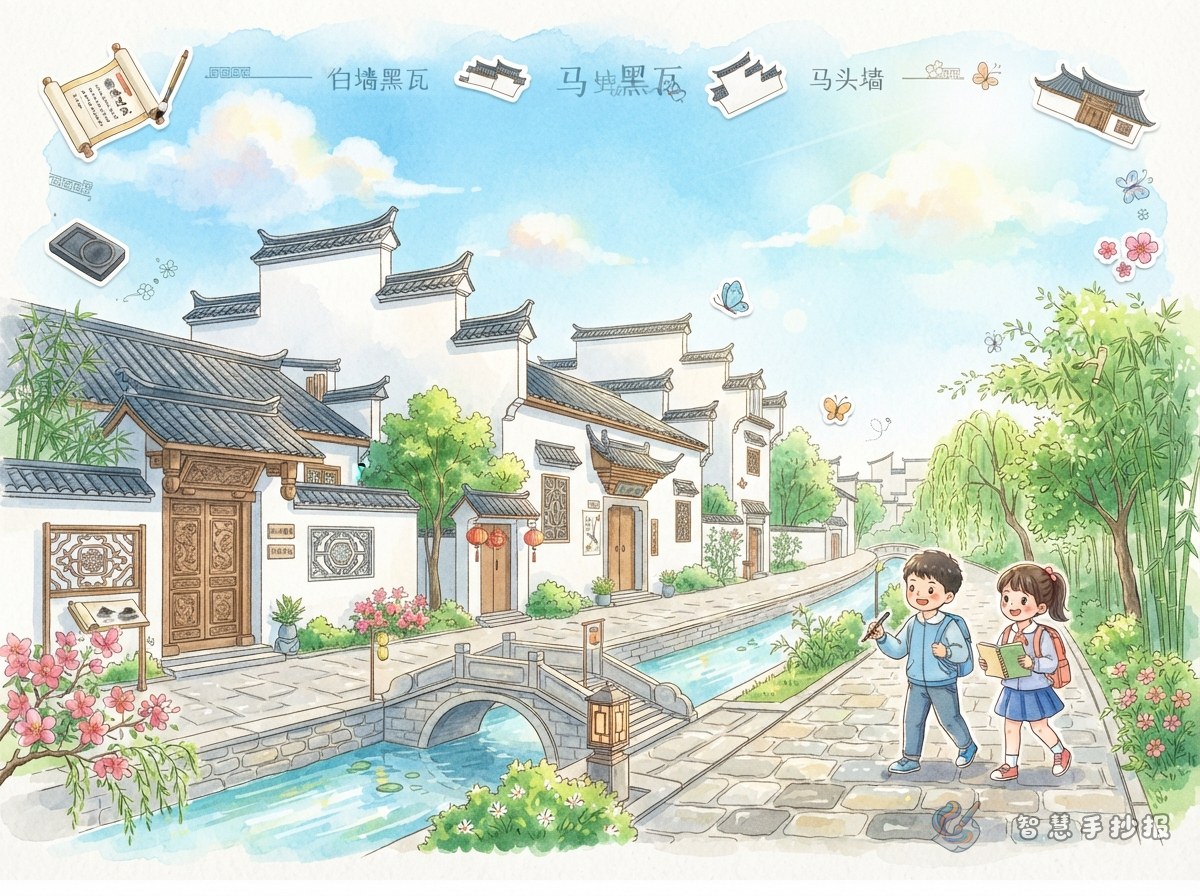
Most handwritten newspapers go wrong when the page becomes crowded with colours and shapes. Huizhou architecture solves that problem at once: its palette is almost entirely white walls, dark tiles and grey stone. Draw one horse-head wall well and the whole page finds its focus.
The shapes are friendly too. A horse-head wall is a set of simple steps, roofs are straight slanted lines, and windows are plain squares or circles, so no complicated perspective is needed.
Four Content Ideas That Are Never Boring
The horse-head wall and why it is so tall
Also called a fire wall, it rises above the roofline to stop flames from spreading between neighbouring houses. Its stepped outline looks like a raised horse's head, which is where the name comes from. A neat line to copy: “The wall stands above the roof, and wind and fire go around it.”
The sky well and the idea of returning water
An old Huizhou house usually has a small open courtyard in the middle. Rainwater from all four roof slopes runs into it, an idea often described as “four waters returning to the hall”. The sky well also brings daylight, fresh air and a cool breeze indoors. Draw a square from above with four arrows pointing inward.
Brick, wood and stone carvings
Doorways, beams and railings are often decorated with carved brick, wood and stone. Patterns usually show flowers, birds, landscapes or stories. You do not need fine detail on a handwritten newspaper, just one small framed sketch with the caption “Every brick and beam has a meaning.”
Old villages such as Hongcun and Xidi
If there is still space, add a short paragraph about village life. Villages sit between hills and water, lanes are narrow and deep, and there is usually a pond or old tree at the entrance. Try: “The pond in Hongcun is like a mirror, holding the white walls and dark tiles in its water.”
Building the Page
- Top section: place the main title across the page with a row of wall silhouettes rising or falling beside it to create rhythm.
- Middle three columns: one column each for the horse-head wall, the sky well and the three carvings, each with a small heading and three or four lines of text.
- Bottom strip: a short paragraph about a village, your own thoughts, or a line of tiny houses used as a border.
- Leave space: keep at least a third of the paper uncoloured, so the white genuinely reads as a whitewashed wall.
Colour and Small Details
Use black, dark grey and white as your base, with a thin grey line along the roof ridges. Windows, lanterns, drying chillies and tree trunks may bring a small amount of brick red or warm yellow, but keep the total area tiny. For texture, shade a few faint vertical strokes on the white walls, then add a branch leaning over the top of a wall to bring the picture to life.
Short Sentences You Can Copy
- White walls and dark tiles are the quietest colours of Huizhou.
- The horse-head wall stands high and keeps the wind and rain outside.
- A small open courtyard catches the light and rain of every season.
- Flowers bloom on brick, stories live in wood, and even the stone speaks.
- The old houses say nothing, yet they keep hundreds of years of daily life.
Read your page once more and cut any repeated sentence so only the most vivid lines remain. Sign your class and name at the bottom and add a small seal-shaped box as a finishing touch. If you would rather not draw everything by hand, search for 智慧手抄报 in WeChat Mini Programs, choose a traditional architecture template and swap in your own text.