Imagine a Postcard Traveling Around the World
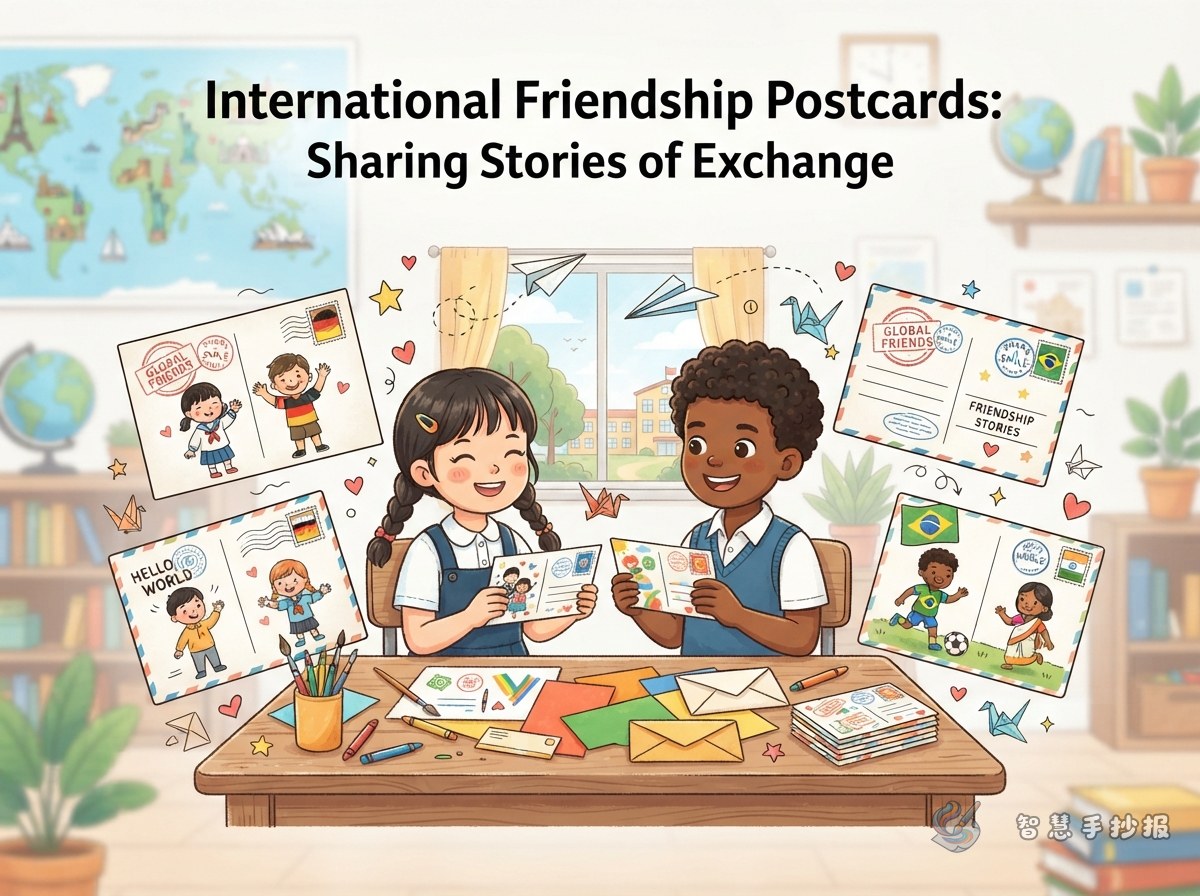
Instead of using only a large globe, build this international friendship poster around a set of friendship postcards. Imagine one postcard leaving a child’s hands and traveling to different places with greetings, cultural sharing, and wishes for peace. The idea shows that communities may have different traditions while children can still learn about one another and get along kindly.
A Short Message for the Center
Write “Send a friendship postcard, share a wish for peace” below the main title, or use “Let friendship travel around the world.” Keep the sentence short and place it inside a large postcard or envelope so the theme is clear at first glance.
Four Small Cards for the Main Ideas
Divide the writing into four cards of different sizes. Each card should carry one clear idea, making the page easier for children to write and arrange.
- Greeting Card: Add friendly words such as “Hello,” “Have a happy day,” and “I am glad to meet you.” This section shows the value of polite communication.
- Culture Share Card: Introduce a festival, food, piece of music, sport, or craft that you know well, and add the idea that understanding should come before respect.
- Things We Enjoy Card: Write about reading, drawing, playing sports, or caring for nature to show that children in different places can learn and cooperate together.
- Peace Stamp Card: Use short lines such as “Friendship brings us closer,” “Respect makes the world warmer,” or “May every greeting be received with care.”
Draw a Mail Route to Give the Page a Story
Use a curved mail route from the lower-left corner to the upper-right corner and connect the four postcards along the way. Draw an open envelope at the starting point and a postcard flying toward the distance near the top. Dots, short lines, and small arrows are enough to show the direction without making the page too busy.
A Simple Layout Plan
- At the top: place the main title, a stamp-shaped decoration, and one central peace message.
- In the middle: put two larger cards for culture sharing and common interests.
- Along the sides: use small envelopes, postmarks, stars, and hearts to fill open spaces while holding the greeting and peace sections.
- At the bottom: write three or four sentences about listening, respect, cooperation, and inclusion.
Use Easy Postcard Symbols for the Illustrations
You can draw envelopes, stamps, postmarks, colorful mail routes, hands reaching toward each other, children reading together, and ribbons around the page. The people do not need complicated details. Similar sizes and natural poses can suggest equal and friendly communication. For stamp designs, choose books, leaves, musical instruments, and sports equipment instead of filling the page with too many national symbols.
Try sky blue, leaf green, warm yellow, and a small amount of orange-red. Blue suggests peace and openness, green suggests hope, and yellow gives the postcards a welcoming feeling. Let each card have a different border color, but use a dark, consistent color for the writing so everything remains easy to read.
Finish the Poster in Four Steps
- Sketch the mail route, envelopes, and four cards in pencil, checking that the title and writing areas have enough room.
- Decide how many words each section needs and place longer text on the larger cards.
- Write the title and body text before adding borders and drawings so decorations do not cover the words.
- Finally, outline and color the page, then add small details to the stamps, postmarks, and arrows.
Before finishing, ask three questions: Can the theme be seen quickly? Are all four sections connected with international friendship? Do the words show respect and peace? If you would like to try more postcard layouts, color combinations, and borders, continue designing in the 智慧手抄报 WeChat mini program.