Begin with a cosmic route for the Little Prince
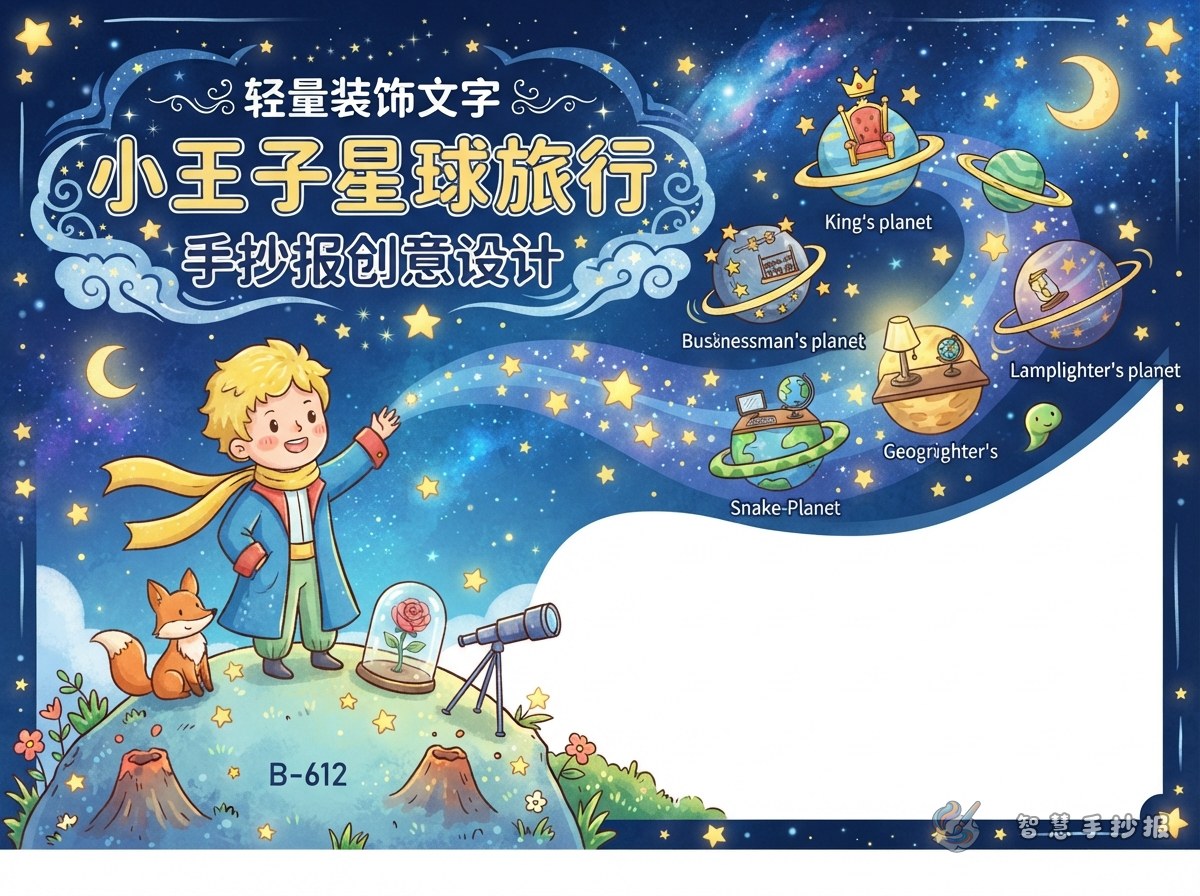
A Little Prince handwritten newspaper does not have to use ordinary rectangular columns. Turn it into a travel map that begins on a small asteroid. Place the Little Prince and his rose near the center, then connect each section with curved orbital lines so readers feel as if they are following a spaceship. The main title can suggest a journey through the stars, followed by the book title and the author Antoine de Saint-Exupéry.
Before drawing, choose one central idea, such as valuing friendship, learning responsibility, or paying attention to the feelings behind everyday life. A focused message will make the page clearer than trying to include every plot detail.
Turn the story into small planets with different jobs
Each planet can hold one section. This makes the writing easier to organize and gives the page a playful fairy-tale atmosphere.
- Story Planet: Summarize in three to five sentences how the Little Prince leaves his asteroid, travels, and eventually reaches Earth.
- Character Planet: Introduce the Little Prince, the rose, the fox, and the pilot, explaining their relationships and the lessons they give him.
- Quote Planet: Choose one or two favorite short lines and add a simple explanation in your own words instead of copying without reflection.
- My Earth Station: Connect the reading to school life by writing about a friend, a family member, or a responsibility that matters to you.
Short ideas for the theme section
You can write about friendship and responsibility with ideas such as these: what truly matters is often felt with the heart; understanding someone takes time and care; a relationship that has become special deserves to be valued and protected. Choose only one or two ideas, then explain them in your own words to make the page sound personal.
Use the characters as reading landmarks
Place the Little Prince on the central asteroid, holding a small flower or star. Put the rose in a warm red area to suggest care and affection. Place the fox in an orange or golden area beside words about friendship and companionship. The pilot can stand near the Earth section and connect the plot summary with your personal response. The drawings do not need to be complicated. Simple faces, clear lines, and recognizable actions are enough for younger readers.
Useful decorative elements include stars, moons, shooting stars, telescopes, paper airplanes, and asteroid rings. Decorations should help separate the sections rather than fill every empty space, so the writing still has room to breathe.
Arrange the page along orbital lines
- Draw the main title and the largest central planet near the upper middle of the page.
- Place the story, character, and quote planets along a curved route from the upper left toward the lower right.
- Put the personal reading response at the bottom or lower right as the final stop of the journey.
- Leave some open space around each section. Use black or dark blue for body text, and mark key words with warm yellow or red.
For a small sheet, keep only three sections: plot summary, characters and theme, and my response. On a larger sheet, add a short author note and a list of favorite words. This keeps the amount of writing manageable while making the layout feel complete.
Finish the fairy-tale mood with a controlled color palette
Light blue, cream, or pale purple can suggest the night sky and distant planets. Use dark blue around the title, golden yellow for stars and orbital lines, and a little red to highlight the rose. Before finishing, check that the title stands out, every section is easy to find, and the writing stays inside its borders. If you want to try several layouts quickly, continue designing in the 智慧手抄报 WeChat mini program and adjust the details to match your drawing level.