Turn the Page into a Friendship Web
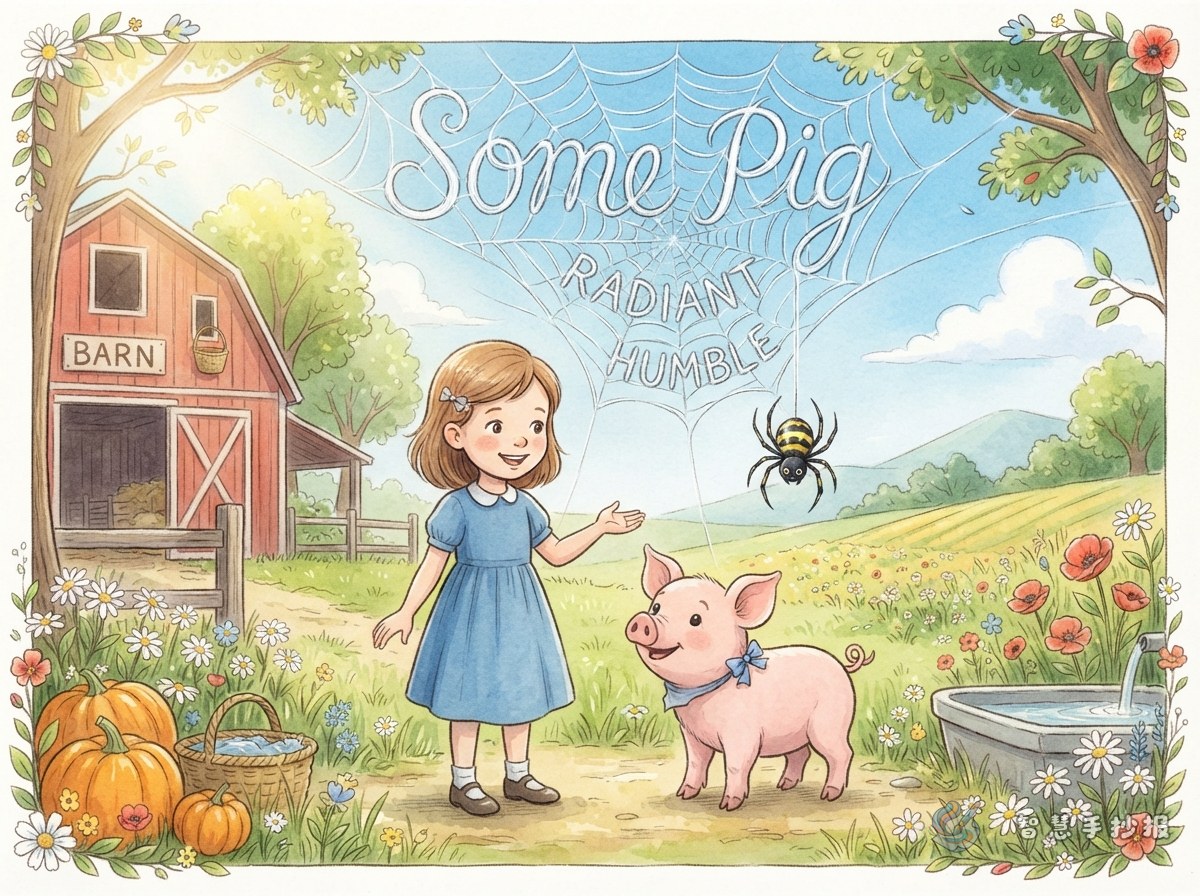
Instead of using ordinary columns, build a Charlotte’s Web school poster around a spider web. Place a round theme box in the center with “Charlotte and Wilbur’s Friendship,” then connect it to character notes, plot points, themes, and personal thoughts. The web becomes both a decoration and a guide that helps readers follow the main ideas.
Add a small author card in the upper-left corner: “E. B. White: an American children’s writer known for warm, clear stories about friendship and growing up.” Keep it to two or three lines so the main space remains available for the story and illustrations.
Four Character Cards for the Main Section
- Charlotte: Write that she is clever and kind, and uses her own way to help a friend.
- Wilbur: Show how he grows from a lonely, worried pig into someone who learns to value friendship and face life bravely.
- Fern: Introduce her care for animals and the kindness she shows at the beginning of the story.
- Templeton: Briefly explain that although he is greedy and somewhat selfish, he also helps move the story forward.
Draw the four characters as small circular cards at different points on the web. Connect each card to the center with a thin line. Simple icons such as a spider, pig, girl, or barn will make the information easier for younger readers to scan.
Tell the Plot in Three Short Stages
- Meeting and worry: Wilbur arrives at the barn, makes friends, and begins to worry about being taken away.
- Help and change: Charlotte uses her intelligence to help Wilbur. Her plan gives him hope and makes the people at the farm notice the special pig.
- Goodbye and continuation: The ending invites readers to think about gratitude, growing up, and how Wilbur carries the friendship forward.
Keep each stage to three or four lines and connect them with arrows or small footprints. Rather than copying a long passage, organize the plot around three questions: What happened? Who helped whom? What did I understand?
Make the Web a Readable Materials Area
Create a “theme-word web” on the right or lower part of the poster. Put words such as friendship, courage, kindness, gratitude, and growth inside five small web knots. In the center, add a personal thought such as “A true friend gives us hope when times are difficult.” Students can rewrite the sentence in their own words.
- Word cards: Choose words such as companionship, help, protection, and appreciation, then give each a simple explanation.
- My recommendation: Write two sentences explaining why you would recommend the book to a classmate.
- Drawing ideas: Prepare a spider web, barn, haystack, apple tree, cornfield, and little pig footprints.
Keep the Colors Calm and the Steps Simple
Use pale cream or light blue for the background. Draw the web in blue-gray or muted purple-gray, and highlight key words with warm yellow, orange, or brick red. Use large outlines and simple details for the drawings so the text stays easy to read.
- Sketch the central theme, web lines, and four main sections with a pencil.
- Fill in the author card, character cards, and three plot stages, checking that the text is not crowded.
- Add the barn, leaves, and footprints, then use one consistent color for the main headings.
After finishing the sketch, you can open the “智慧手抄报” WeChat mini program to arrange the sections and decorative elements more quickly. Then revise the wording with your own reading thoughts so the children’s literature poster feels both informative and personal.