Pick One Main Angle Before You Start
Hail is rare enough to feel exciting, and it gives a weather poster a strong visual image: white ice pellets dropping out of a dark sky. Decide first what your page is really about, then build everything around it.
- Tell the process: use “the life of a hailstone” as the main storyline and follow how it grows inside a cloud.
- Focus on safety: show where to shelter and what to avoid, which suits younger students.
- Record an observation: describe the sky, wind, and ground before, during, and after a hailstorm.
The Life of a Hailstone: Your Main Story Panel
A simple step-by-step route, drawn with arrows, lets readers understand the science without long paragraphs.
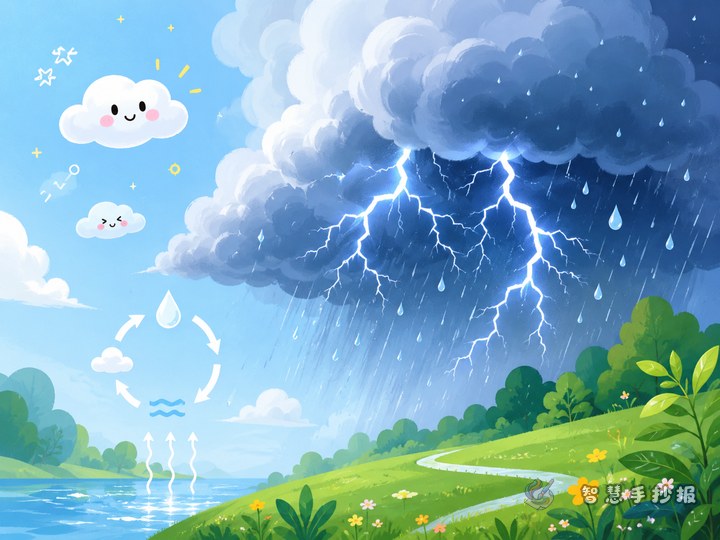
- On a hot summer afternoon, warm, moist air rises quickly and builds a tall, thick storm cloud.
- Strong updrafts carry water droplets high into the cloud, where the cold turns them into tiny ice pellets.
- The pellets tumble up and down, meeting more supercooled droplets that freeze onto them, so they keep growing.
- When they become too heavy for the updraft to hold, they fall to the ground as hail.
Add a small note here: hail forms inside powerful thunderstorm clouds, so it often arrives together with thunder, gusty wind, and heavy rain. That is exactly why safety tips belong on the same page.
A Size-Comparison Column Readers Can Instantly Understand
Hailstones come in very different sizes. Comparing them with everyday objects makes the difference clear.
- Pea-sized: taps loudly and quickly on umbrellas.
- Marble-sized: bangs clearly on metal roofs and carports.
- Ping-pong-ball-sized: can already damage leaves and flowers.
- Egg-sized: dangerous, so stay inside a solid building.
You do not need realistic drawing here. A few white circles of different sizes with labels beside them are enough, and the empty space around them keeps the page clean.
Write the Safety Section in Short Lines
Short, punchy sentences are easier to read and remember than a long block of text.
- When clouds darken, the wind picks up, and thunder gets closer, go home or into a sturdy building.
- Do not shelter under trees, billboards, walls, or temporary sheds.
- Indoors, close the windows and doors, and stay away from glass and balconies.
- If you are caught outside, cover your head and neck with your arms, turn away from the wind, and crouch low.
A short rhyme at the top of this column, such as “hail starts to fall, get indoors and stand tall,” makes the message stick.
Layout and Colors: Show Both the Cold and the Urgency
Cool colors set the mood, while one or two bright accents raise the alert level.
- Paint a deep blue-to-purple sky across the top to create depth.
- Use white dots or plain paper space for hail, in different sizes and positions.
- Add one or two yellow lightning bolts or orange symbols as eye-catchers.
- Make the title big and bold, and keep text blocks clearly separated.
If the page looks empty, draw one thick storm cloud in the corner using two shades of blue rather than filling the whole sheet.
Two Extra Touches That Make the Poster Worth Reading Twice
- Save a corner for a “weather question,” such as “Why is hail more common in summer?” to spark curiosity.
- Add a small observation task asking readers to notice the sky color and wind changes before hail begins.
If time is short, you can bring your finished columns and text into the WeChat mini program “智慧手抄报,” choose a layout style, adjust fonts and colors, and then print it out to trace and decorate. It saves a lot of erasing and redoing.