Build the Page Around a Clear Journey: From Hearing to Believing
The allusion “Three Men Make a Tiger” works especially well when presented as a clear story journey. Its message is that a claim with no reliable basis may begin to sound true when it is repeated again and again. Design the whole handwritten newspaper around the idea that repetition does not turn a rumor into a fact.
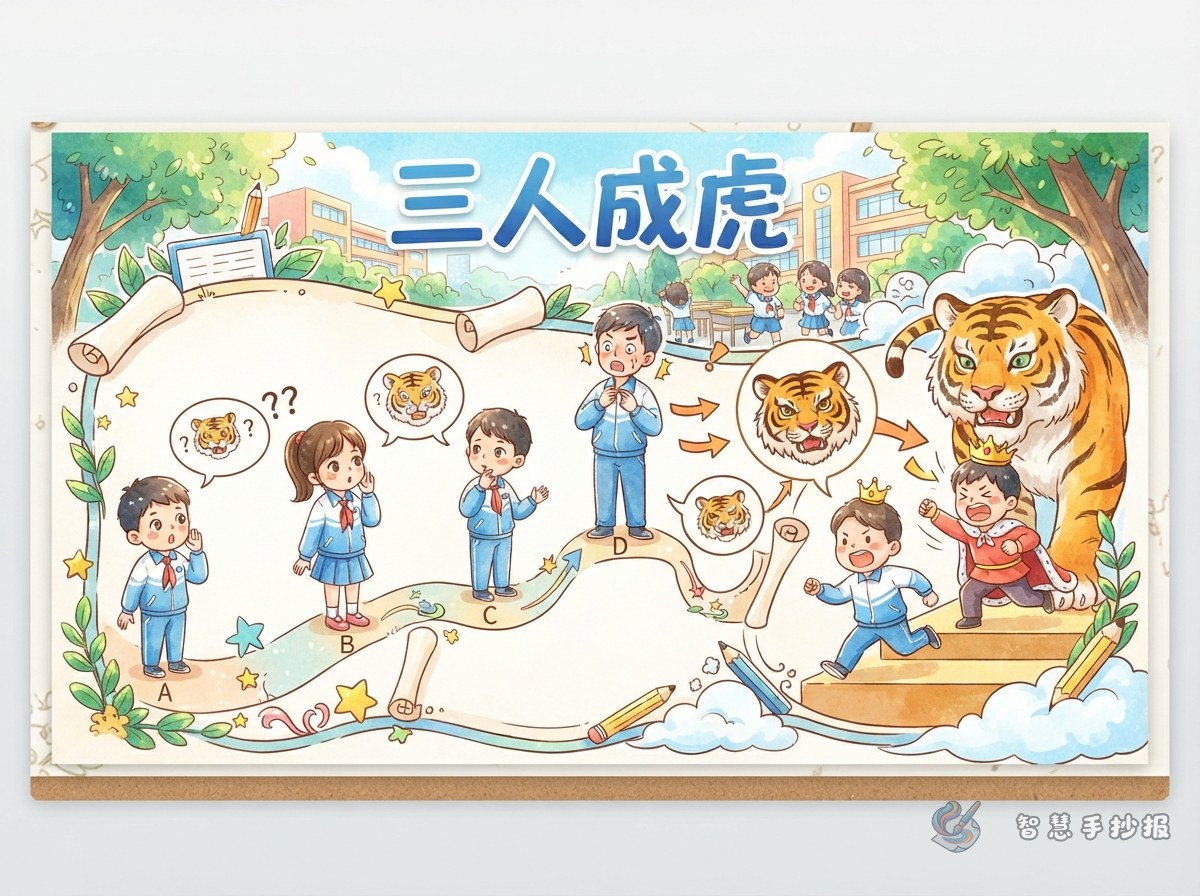
Tiger footprints, speech bubbles, and directional arrows can serve as visual clues. They help readers see how a message moves from one person to several people and gradually affects a judgment.
Tell Pang Cong’s Question in Four Panels
Turn the story section into a four-panel comic. Give each panel one or two short sentences so the allusion stays clear and easy for elementary students to draw and color.
- Panel one: Ask the question.During the Warring States period, Pang Cong was preparing to accompany the prince of Wei to Handan. He asked the king whether he would believe someone who reported that a tiger had appeared in the marketplace.
- Panel two: One person spreads the message.The king said he would not believe it because a real tiger could not be wandering through the marketplace. Draw one person hurrying in to report the news.
- Panel three: Two people repeat it.When a second person gave the same report, the king began to feel uncertain. Place two overlapping speech bubbles in the scene to show the rumor growing.
- Panel four: Repetition creates a false judgment.When a third person repeated the message, the king believed it. Draw the king thinking carefully and add the line, “Hearing it often does not make it true.”
Close the story with a short reminder: when we hear the same message repeatedly in daily life, we should still check it through observation, questions, and evidence.
Keep the Text Light: Three Ready-to-Use Sections
Brief Allusion
“Three Men Make a Tiger” comes from a story about the Warring States period. Pang Cong used the imaginary report of a tiger in the marketplace to show the king that a claim without evidence can still lead to a wrong judgment when many people repeat it.
Meaning of the Idiom
The idiom reminds us not to judge a claim by how many times we have heard it. We should ask whether it has trustworthy evidence, think independently, and avoid passing along unverified information.
Everyday Reminder
When you hear news at school, at home, or online, ask: “Who said it?”, “Is there evidence?”, and “Could there be another explanation?” Check the details before reaching a conclusion.
Make the Layout Look Like a Rumor’s Route
- Title area:Write “Three Men Make a Tiger” in the upper center. Add a simple cartoon tiger or a question mark, with the subtitle “Even after hearing it three times, check first.”
- Story area:Connect the four panels with a horizontal path or a curved route. Keep the dialogue short instead of turning the story into a long composition.
- Thinking area:Place “Meaning” and “What I Learned” in two small boxes on the right, decorated with a magnifying glass, a book, or a light bulb.
- Reminder area:Design the bottom as an information-check card with three steps: “Check the source, find evidence, then decide.”
Try orange, yellow, and light blue for the color scheme. Use orange and yellow for the tiger and key headings, light blue for the background and text boxes, and dark brown for borders. This creates a lively story mood without making the page crowded.
Check These Three Details Before You Submit
- Does the page include the story, the meaning of the idiom, and an everyday reminder instead of only a tiger drawing?
- Are the four panels connected by arrows, footprints, or speech bubbles so the reading order is obvious?
- Have you left enough white space, and are the title and key sentences more noticeable than the ordinary explanation?
If you want to arrange the sections, title, and decorative elements more quickly, continue in the 智慧手抄报 WeChat mini program and adjust the text to suit your grade and drawing style.