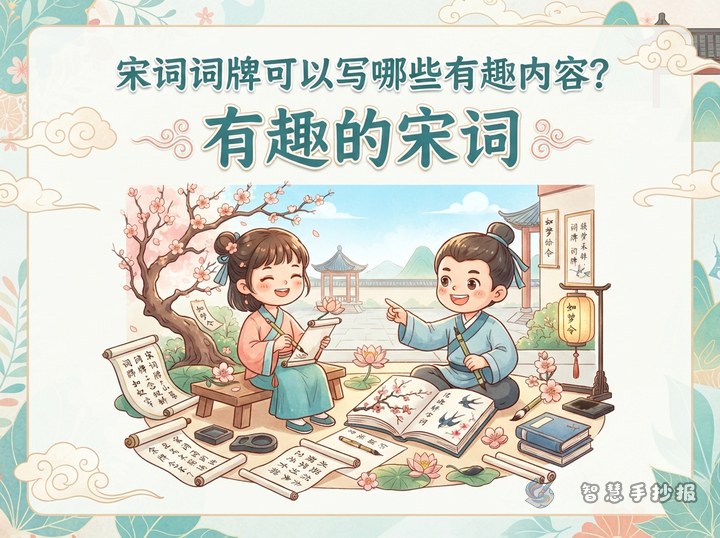
Choose a clear theme: Song Ci and Yuanqu on one page
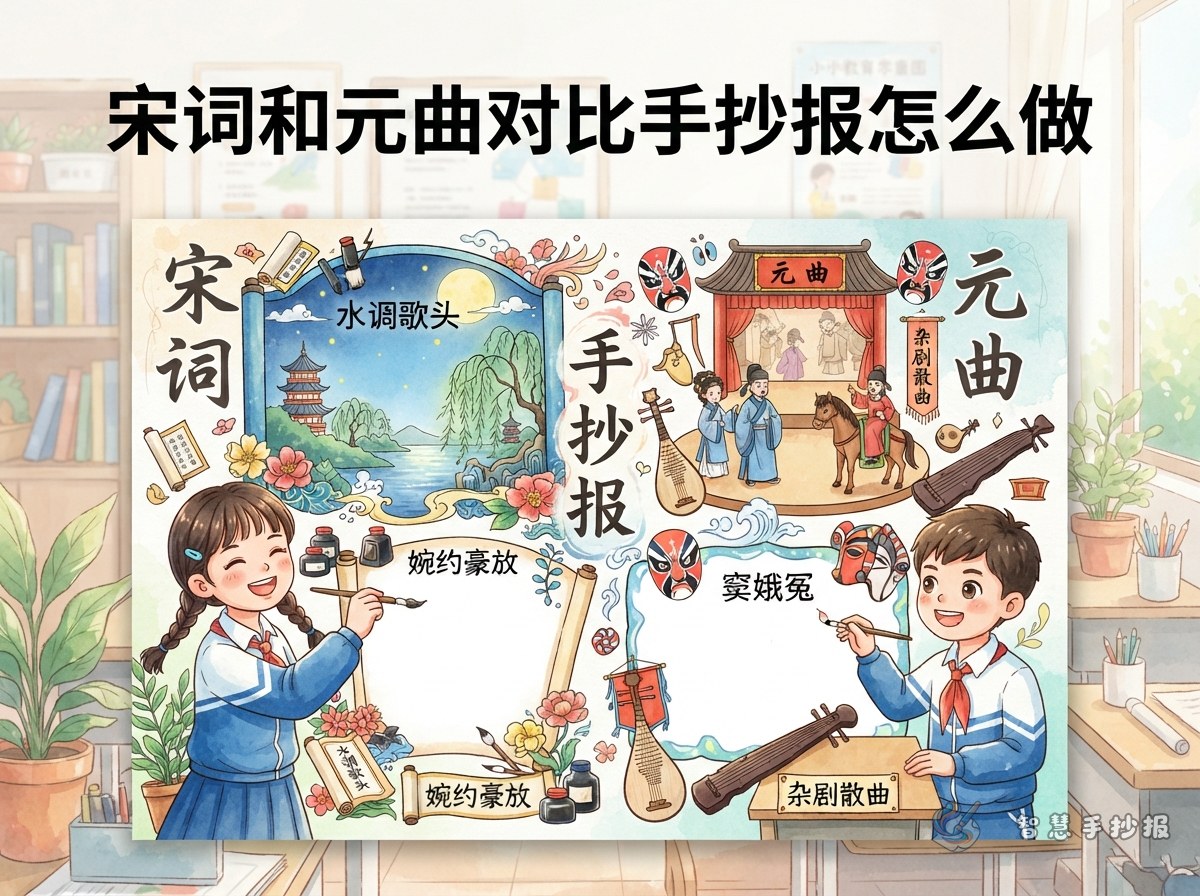
This handwritten newspaper can focus on the question of how Song Ci and Yuanqu express feelings differently, rather than listing too many writers and works. A good theme is a comparison of their styles: show the graceful and restrained mood of Song Ci on the left, and the lively, direct character of Yuanqu on the right. Connect both sides with an illustrated classical scroll.
You can begin with this introduction: “Song Ci is like a cup of tea, gentle and full of musical feeling; Yuanqu is like a fresh breeze, lively and close to everyday speech. Together, they reveal different voices in classical Chinese literature.”
Design the page as two contrasting scenes
A horizontal sheet works well with two columns. Give the left column the title “The Mood of Ci” and decorate it with moonlight, lotus flowers, window frames, or musical strings. Give the right column the title “Life in Qu” and add a street scene, a paper umbrella, a tavern banner, or stage curtains. In the center, draw an open scroll labeled “Song Ci · Yuanqu” to connect the two sections.
- Top: Write the main title in a brush-style font and add clouds, seals, or small traditional patterns.
- Left: Introduce the features, emotions, and reading experience of Song Ci.
- Right: Explain the flexible language and lively atmosphere of Yuanqu.
- Bottom: Add a “What I noticed” section for a personal response.
Use short, readable text for both columns
Song Ci section
Song Ci developed together with music. Its lines vary in length, and it often uses scenery to express longing, homesickness, remembrance, or reflections on life. Three useful keywords are “uneven lines,” “blending scenery and emotion,” and “restrained expression.” You may add this explanation: “The poet often uses the moon, wind, flowers, or rain to carry feelings, allowing ordinary scenery to become emotionally rich.”
Yuanqu section
Yuanqu includes sanqu and zaju. Its language is often flexible, lively, and closer to the way people speak. You can introduce it with “vivid spoken language,” “distinct characters,” and “a strong sense of daily life.” A short paragraph could say: “Yuanqu does not only describe distant landscapes. It also presents the joys and troubles of ordinary people, making its rhythm feel friendly and immediate.”
Add a “same image, different style” activity
To make the page more than a collection of definitions, create a comparison box. Choose one image, such as the moon, an autumn wind, or parting. Write one sentence in a Song Ci-like mood and another in a Yuanqu-like mood. The first can be quiet and indirect, while the second can sound more direct and include a sense of action. The goal is not to imitate a famous line, but to help readers feel the difference in tone.
- Shared image: the moon.
- Song Ci mood: use moonlight to express longing in a quiet, indirect way.
- Yuanqu mood: let a character speak to the moon in a more conversational and vivid voice.
This section shows personal thinking and prevents the page from becoming a wall of dense definitions. It is also suitable for children to complete with help from a teacher or parent.
Let the colors show two different moods
Limit the whole page to three or four main colors. Use light blue, ivory, or pale purple for the Song Ci section, and vermilion, warm yellow, or ink black for the Yuanqu section. A parchment-colored scroll in the center can unify the page. Borders can stay simple, using water-wave lines, window patterns, folding-fan shapes, and small seals.
Leave enough open space around each section. Use black or dark brown for the main text and colored pens for key words. Make headings large and clear, while presenting facts as short paragraphs or cards. After sketching the layout, you can continue arranging the sections in the Zhihui Shouchaobao WeChat mini program for a smoother making process.
End with one sentence that brings the theme together
At the bottom, write: “Song Ci moves us with feeling and musical grace, while Yuanqu brings the energy of everyday life; together, they create the rich sound of classical Chinese literature.” Finish with an open book or a small seal to echo the main theme and give the page a complete ending.