Start with a Simple Definition
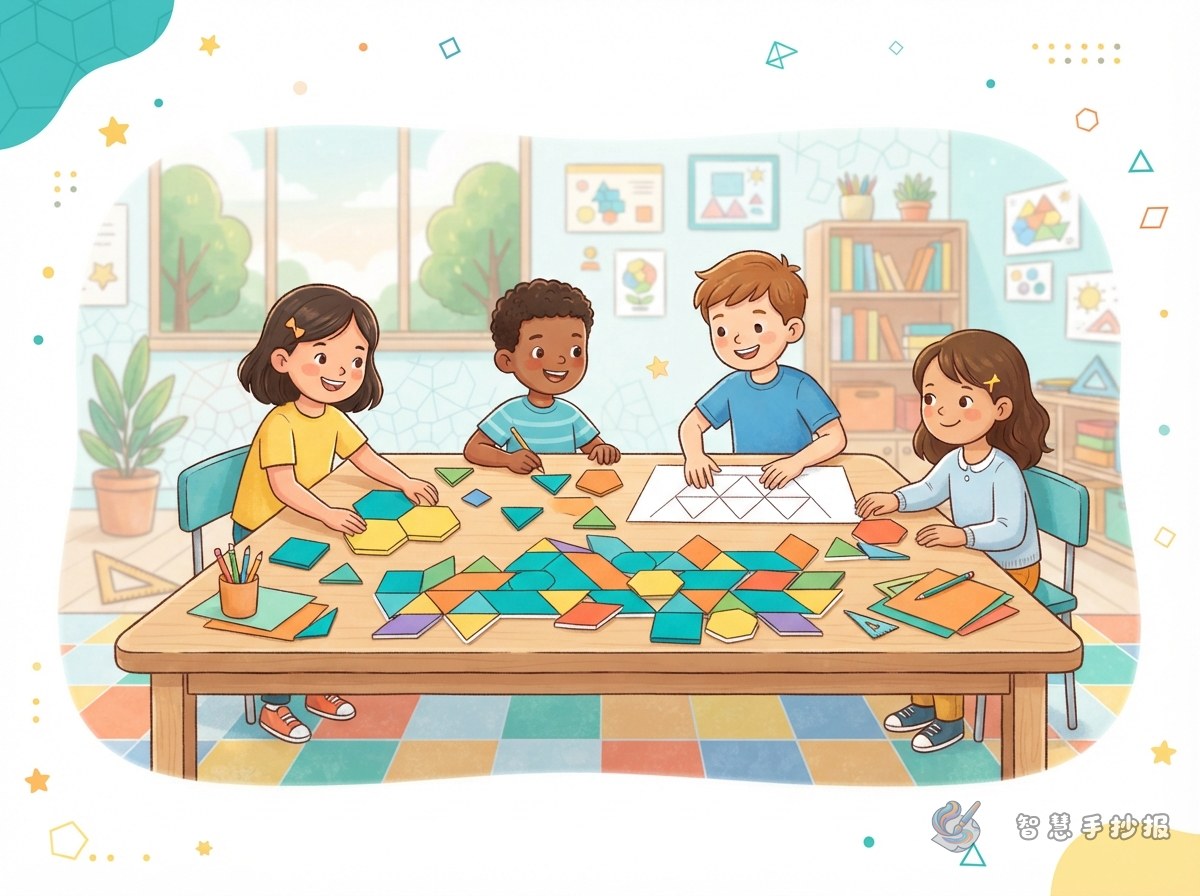
Open your page with an easy sentence: tessellation means covering a flat surface with shapes that are the same, with no gaps and no overlaps. The two key words are “same” and “no gaps”.
Beside the sentence, draw three small boxes in a row: one with gaps between shapes, one with shapes overlapping, and one neat pattern that truly tiles. Readers will understand the idea at a glance.
Which Shapes Cover a Flat Surface by Themselves
Triangles and quadrilaterals always work
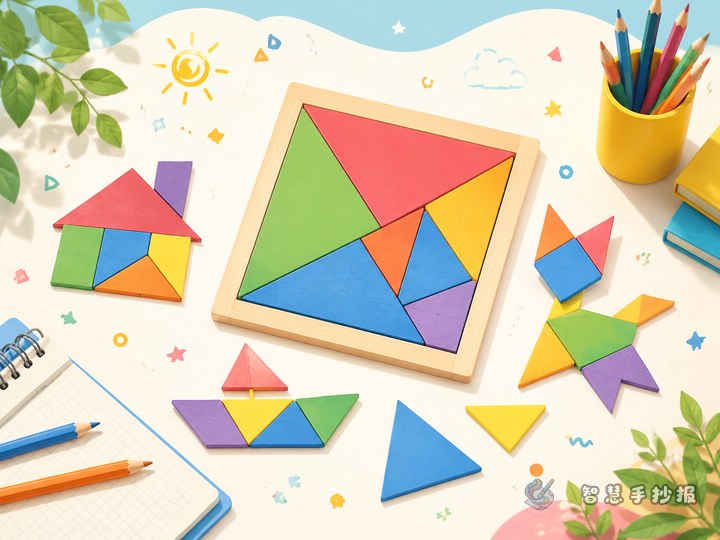
Any triangle can be copied again and again to tile a surface, and so can any quadrilateral. “Any” really means any — even a long, thin or lopsided one. Colour one triangle in three different colours and repeat it across a small area, then write: any triangle and any quadrilateral can tile.
Only three regular polygons tile alone
- Equilateral triangle: each angle is 60°, and six of them make 360°.
- Square: each angle is 90°, and four of them make 360°.
- Regular hexagon: each angle is 120°, and three of them make 360°.
A regular pentagon has 108° angles, so no whole number of them adds up to 360°. It cannot tile by itself. A simple “can / cannot” table makes this clear.
The 360° Rule at a Corner
In a tessellation, several corners meet at one point. A full turn around that point is 360°, so the angles must add up to exactly 360° if the shapes are to fit perfectly.
- Equilateral triangle: 60° × 6 = 360°.
- Square: 90° × 4 = 360°.
- Regular hexagon: 120° × 3 = 360°.
Put these number sentences in a narrow column on one side of your page, like a solved puzzle, so the reason is easy to remember.
Real-Life Patterns That Make Your Page Look Better
Floor tiles, honeycombs, fish scales, woven mats and hexagonal wall decorations all show tessellation. Choose three and draw them small: squares for floor tiles, hexagons for the honeycomb, slanted quadrilaterals for a woven mat. Add a short caption under each, such as “a honeycomb uses hexagons, saving material and staying strong”.
You can also mention mixed tessellation. Two kinds of regular polygons can work together, for example a square and two octagons (90° + 135° + 135° = 360°), or three triangles and two squares (60° × 3 + 90° × 2 = 360°). You only need to draw one repeating unit to make the point.
Layout Ideas: Let the Patterns Do the Decorating
- Border: repeat small triangles or squares to make a geometric frame instead of a wavy line.
- Centre picture: draw a large tiling pattern and leave a small blank space for the word “tessellation”.
- Two columns: put the definition and results on the left, the number sentences and examples on the right, and finish with a short “did you know?” box.
- Colour: use one colour family for each shape so the page stays tidy instead of becoming busy.
To keep patterns even, sketch a light grid of squares or triangles first, repeat the shape along the grid, and only then copy it onto the final sheet. This draw-then-trace method works well for any tiling pattern.
Short Sentences You Can Copy
You do not need long paragraphs. A few clear lines can fill a whole column:
- “No gaps, no overlaps — that is tessellation.”
- “Any triangle and any quadrilateral can tile.”
- “Among regular polygons, only the equilateral triangle, square and regular hexagon tile alone.”
- “A full turn around a meeting point is 360°.”
When your page is finished, you can add a small note at the bottom: to try a different layout, colour scheme or printable template, open the WeChat mini program “智慧手抄报”, rearrange the sections and patterns, and then copy the result onto paper.