Build the Newspaper Around a Family of Angles
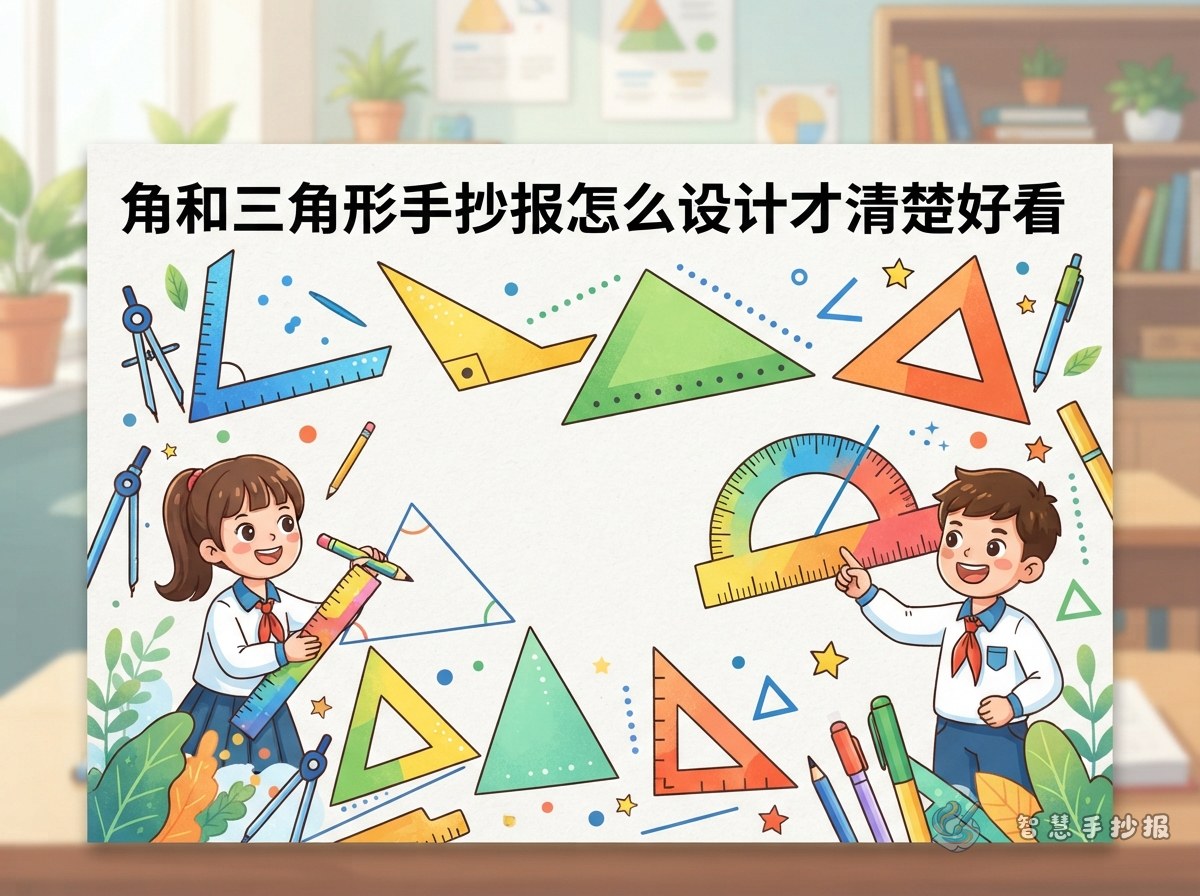
This handwritten newspaper can use angle size and triangle classification as its main idea, turning mathematics into a small journey of shape discovery. Begin with the sentence: “Angles give direction to shapes, while triangles make flat designs stable and interesting.” Place a protractor in the center and connect it to acute, right, and obtuse angles, as well as equilateral, isosceles, and scalene triangles.
Let the Angle Clues Guide the Layout
Use a central diagram with four surrounding sections. Put “Three Common Angles” in the upper left, “Triangles by Their Sides” in the upper right, “Triangles by Their Angles” in the lower left, and “Measure It Yourself” in the lower right. Rays can work as dividing lines, with small shapes at their ends. Use colorful lines, arcs, and triangles in the title, while keeping one main color for each section.
Math Facts You Can Write Directly
Three Common Angles
- Acute angle: An angle smaller than 90 degrees that looks sharp.
- Right angle: An angle exactly 90 degrees, like the corner of a book or a grid square.
- Obtuse angle: An angle larger than 90 degrees but smaller than 180 degrees.
Two Ways to Classify Triangles
- By sides: An equilateral triangle has three equal sides, an isosceles triangle has two equal sides, and a scalene triangle has three different sides.
- By angles: An acute triangle has three acute angles, a right triangle has one right angle, and an obtuse triangle has one obtuse angle.
Add a small diagram beside each explanation and mark the important sides or angles. Short definitions, examples, and one observation are easier for children to read than long paragraphs.
Turn Measuring into a Small Challenge
In the “Measure It Yourself” section, draw several angles of different sizes. Ask readers to guess which one is larger and then check with a protractor. You can also add a challenge: find three places in the classroom that are close to right angles and sketch them. Include this reminder: “Place the center of the protractor on the vertex and align the zero-degree line with one side of the angle.”
Drawing and Crafting Details
When drawing an angle, use a ruler for two rays and add an arc to show its size. When drawing triangles, keep the sides and vertices clear. A border can repeat small protractors, set squares, compasses, and grid symbols. Use bold lettering for headings, short sentences for the body, and circle key words in red or orange. Before finishing, check that every label matches the correct angle or triangle.
Continue Creating in the Mini Program
After choosing the sections and text, open the “Zhihui Handwritten Newspaper” WeChat mini program to continue arranging the title, colors, and layout elements. You can also use its layout ideas as a reference, then complete your own geometry handwritten newspaper with a ruler, protractor, and watercolor pens.