Decide the one message first
The story is short, but a page that only retells it feels empty. Before drawing anything, ask: what should a reader remember after looking at this page? The answer is not 'someone drew a snake quickly', but 'a job already done can be ruined by one extra step'.
Use that sentence as the centre of the page. The story explains it, the illustration emphasises it, and the real-life example proves it. Once the centre is fixed, the layout will not fall apart.
Title and central sentence
Title ideas
- Drawing a Snake and Adding Feet: One Step Too Many
- He Won the Race, Then Lost It with Two Little Feet
- Know When to Stop: The Lesson of the Extra Feet
Write the title large at the top or top left, and outline it in a contrasting colour so it stands out at a glance. A smaller subtitle such as 'An Idiom Poster' works well underneath.
Put the central sentence where eyes land first
Give it its own small box or cloud shape and write something like 'One step too many ruins the work' or 'Knowing when to stop is a skill'. Keep it short and write it neatly, because this line is the eye of the whole page.
A three-block layout that always works
- Top block: main title plus the central sentence, about a quarter of the sheet.
- Middle left: the story in a few sentences, with a simple line drawing of the snake.
- Middle right: a fact box with the meaning, similar idioms and one example sentence.
- Bottom strip: a real-life example and a one-line conclusion.
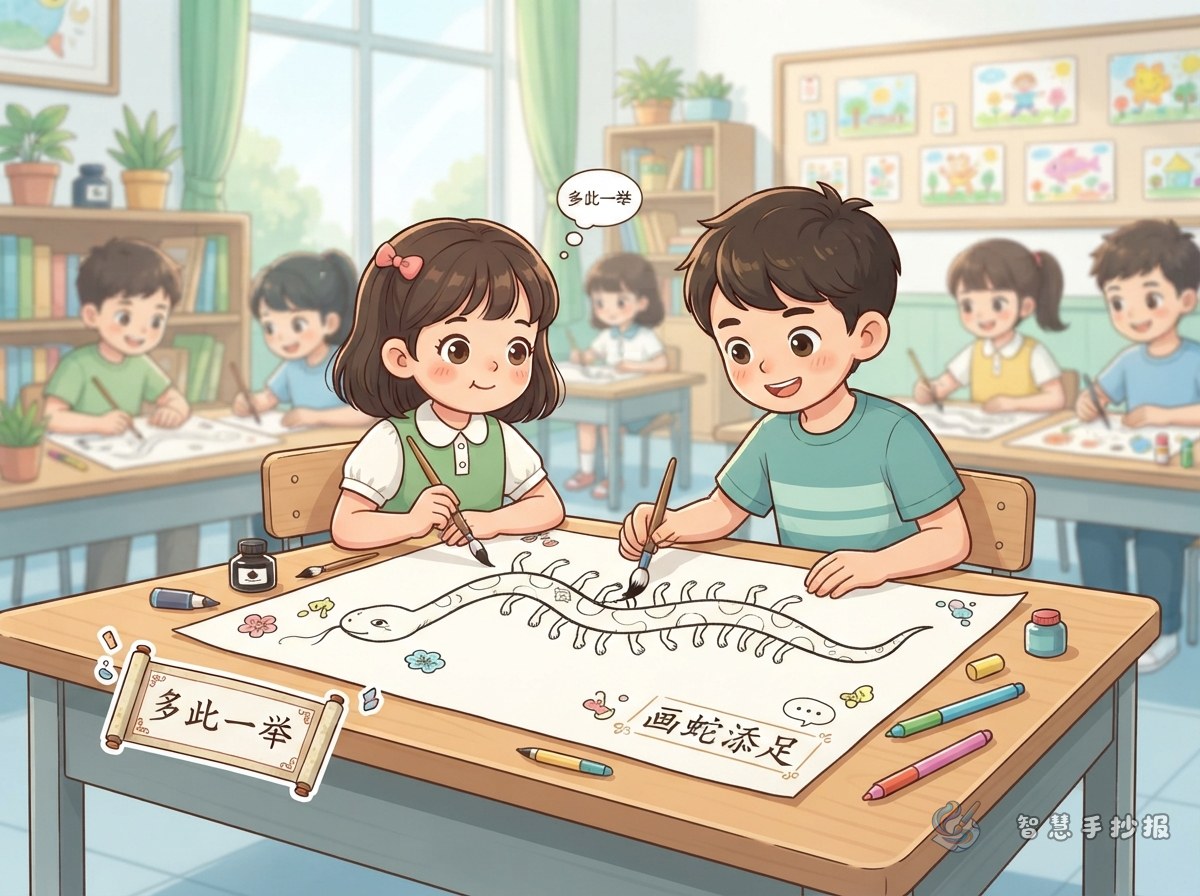
Draw the snake only once. Place it where the top block meets the middle left, and let its curved body act as a divider, which saves space and looks tidy.
Three text sections you can copy and adapt
The story in a nutshell
Several people once shared a pot of wine and agreed that whoever finished drawing a snake first would drink it. The quickest one finished early, felt proud, and added feet to the snake. Another person finished and pointed out that a snake has no feet, so the drawing was no longer a snake, and took the wine.
Idiom fact box
Drawing a snake and adding feet: doing something unnecessary that spoils a good result rather than improving it. Similar ideas include 'a superfluous action' and 'trying to be clever and making it worse'; the opposite idea is 'just right, no more, no less'. List them one per line.
Real-life examples
A dictation answer is already correct, but the writer changes two strokes and turns it into a mistake. A handmade card is finished, then extra decoration is added and it tears. Write two or three examples like these, then close with 'finish it well, and stop'.
Small details that cost points
- A title that is too small or hidden in a corner.
- Walls of text with no boxes or dividing lines.
- An illustration so large that the writing is squeezed to the edge.
- More than five colours, which makes the page look noisy.
- Scribbles, wrong characters, or content running past the border.
Read the whole page once before handing it in, then check the border and the name line. If layout takes too long, open the WeChat mini program '智慧手抄报', choose an idiom-story template, replace the text with your own writing, and add hand-drawn details after printing for a neater result.