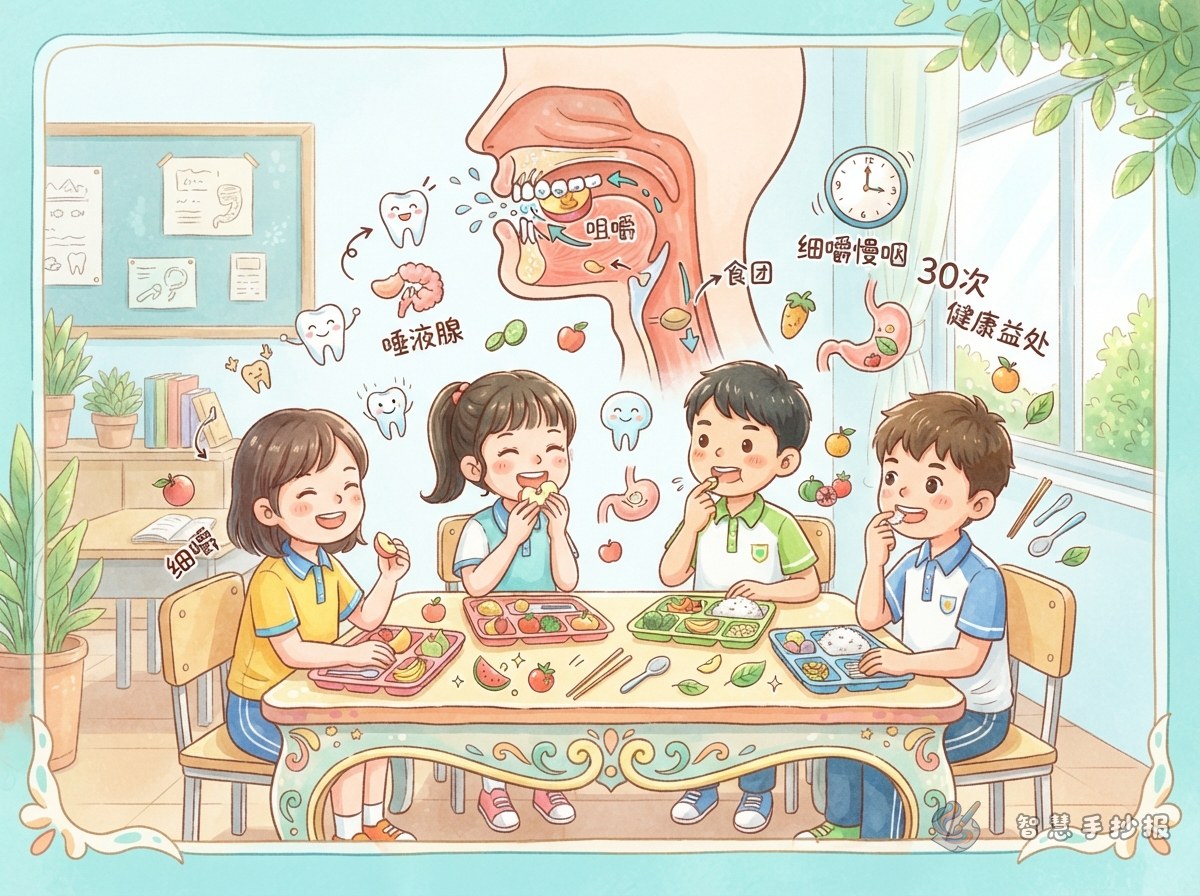
Why chewing slowly makes a good poster theme
Children are often told to eat more slowly, yet the reason is rarely explained. Making the mouth the centre of the poster keeps everything simple: teeth, tongue and saliva can all be drawn as friendly characters, and there is no need to squeeze the whole digestive tract onto one sheet of paper.
Compared with a broad theme like the journey of food, this narrower idea is easier for younger students to finish on their own.
Three sections worth writing on the page
The different jobs of the teeth
- Incisors bite off a piece of food.
- Canines help tear food that is tough.
- Molars grind and crush food into smaller pieces.
What the tongue and saliva are doing
The tongue stirs and moves food between the teeth, while saliva makes it wet and slippery so it slides down easily. The more thoroughly food is chewed, the closer it gets to a soft paste and the lighter the work left for the stomach.
Where the food goes next
After swallowing, food travels down the oesophagus into the stomach. Chewing slowly is therefore not only about the mouth, it is the preparation stage for the rest of digestion.
A layout that is easy to fill
- Top band: a large title plus a question, for example 'How many times should one bite be chewed?'
- Middle band: a horizontal route from lips to oesophagus, joined with arrows and short captions.
- Bottom band: two boxes side by side, one for mealtime tips and one for the child's chewing record.
Curved arrows look livelier than straight ones, and keeping the palette to three or four colours stops the page from becoming messy.
Short lines you can copy straight onto the poster
- Put the toy down first and really taste the food.
- Chew each mouthful a little longer before swallowing.
- Soup is not a substitute for chewing.
- Well-chewed food means less overtime for the stomach.
- Even on a busy morning, save a few minutes to eat slowly.
Add one small activity box to bring the poster to life
Leave a corner box titled 'My chewing record'. Over three days, ask a family member to count roughly how many times the child chews each bite. The box needs very few words, but it turns the poster into something the child has observed and tested personally.
If arranging the boxes is tricky, the 智慧手抄报 WeChat mini program offers borders and layouts that can hold these short lines, ready for a little hand-drawn finishing touch.