Pick Three Buildings You Can Actually See
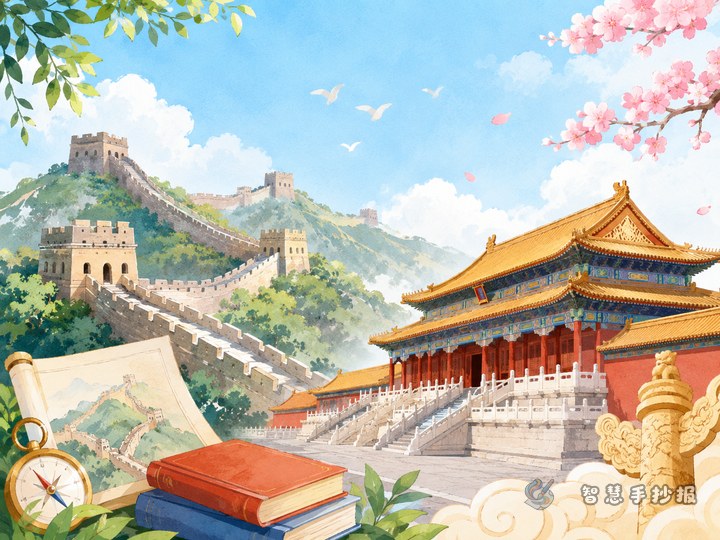
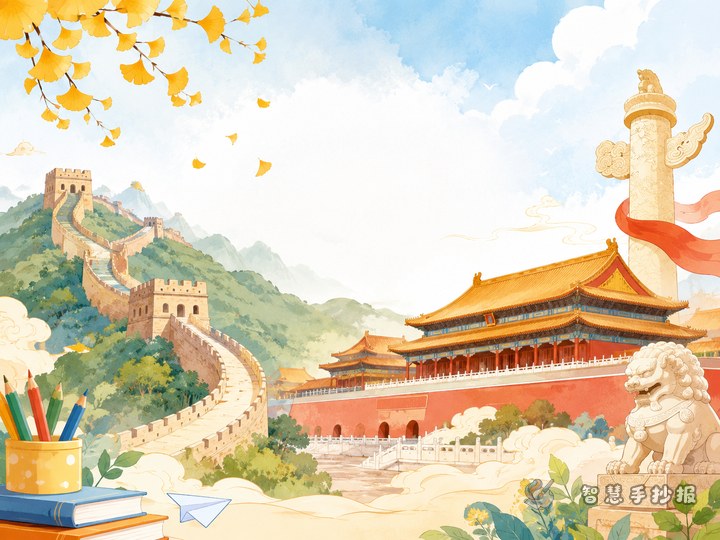
The Great Wall and the Forbidden City are huge topics. If a poster only says they are old and magnificent, the page can feel empty. A better plan is to choose three buildings that are easy to recognize and draw: a beacon tower, a corner tower, and Taihe Hall. Each one takes up a small space, with one short fact and one simple sketch.
- Keep each fact to one clear sentence.
- Give each building a small heading, such as “Message Tower” or “Layered Eaves.”
- Leave a small box for a simple drawing beside each fact.
Beacon Towers: The Message Relay on the Great Wall
A beacon tower is a common structure along the Great Wall. In the past, soldiers used it to send signals by lighting smoke or fire, passing the message from one tower to the next. For a poster, the key idea is “sending messages,” so students do not need a long explanation.
Short lines students can copy
- A beacon tower was used to pass messages along the Great Wall.
- When soldiers saw something important, they lit smoke or fire to signal the next tower.
- From a distance, a beacon tower looks like a small square platform standing high up.
To draw one, start with a simple trapezoid base, add a small shelter on top, and draw a few curved lines for smoke.
Corner Towers and City Walls: Small Details for the Edges
The Forbidden City has corner towers on its city walls. Their layered eaves make them perfect for the corners of a poster. A common saying describes the complex wooden structure, but for a school project it is enough to write that the corner tower has neat, upturned eaves and a delicate shape.
Ideas for a corner tower section
- Section name: Corner Tower Watch, A Small Tower on the Wall, or Notes on Upturned Eaves.
- Text: The corner towers stand at the four corners of the city wall. Their roofs turn upward and look light and graceful.
- Drawing: Draw a square base, add two roof layers, and lift the four corners slightly.
If the poster border looks empty, place small corner towers in the four corners and add a simple brick pattern along the wall.
Taihe Hall: The Big Roof on the Central Axis
Taihe Hall is one of the most impressive halls in the Forbidden City. It stands on the central axis and is part of the outer court. When writing about it, focus on the roof: double eaves, upturned corners, and small roof figures are easy to remember and easy to draw.
Short lines for the Taihe Hall section
- Taihe Hall stands on the central axis of the Forbidden City.
- The hall has a large double-eave roof with upturned corners and small figures on the ridge.
- Standing in front of it, visitors can feel the order and dignity of traditional palace architecture.
Students can draw only the roof and base instead of the whole building. Start with a straight ridge, add two layers of eaves, and place a few pillars below.
Fitting All Three Into One Layout
Once the three landmarks are ready, arrange them on an A4 or larger sheet. This plan keeps the page from looking crowded.
- Title area at the top: draw a winding wall on the left, a corner tower on the right, and write “Landmark Cards of the Great Wall and the Forbidden City” in the middle.
- Left side: two small cards, one for the beacon tower and one for the corner tower, each with a small drawing.
- Right side: a larger block for Taihe Hall, using “The Big Roof” as a subheading and writing the facts in three lines.
- Bottom strip: a short note titled “My Favorite Building” or “A Visit in One Sentence.”
Use brick gray, vermilion red, gold, and sky blue for the color scheme. Keep the background light so the drawings and text stand out. If students want to change the border, adjust the section shapes, or try a different title style, they can search for “智慧手抄报” in WeChat and continue creating the poster in the mini program.