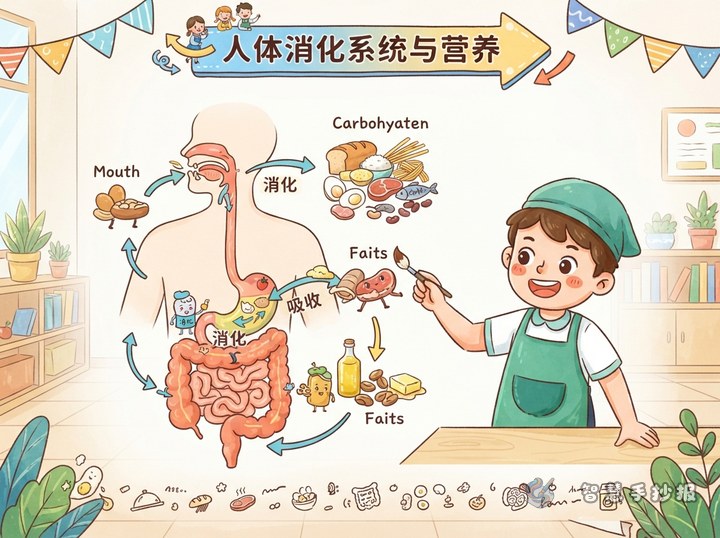
Turn the topic into a digestive-juice relay
Instead of filling the poster with complicated organ names, present saliva, gastric juice, bile, pancreatic juice, and intestinal juice as five helpful team members with different jobs. Place the words Digestive Juice Relay in the center and arrange five colorful information cards around it. Arrows can show how each helper contributes to digestion.
Use this opening sentence near the title: Nutrients in food cannot always be used by the body right away. Digestive juices help change them into smaller substances that are easier to absorb. It gives readers the main idea at a glance.
Meet the five digestive helpers
Saliva: the first helper
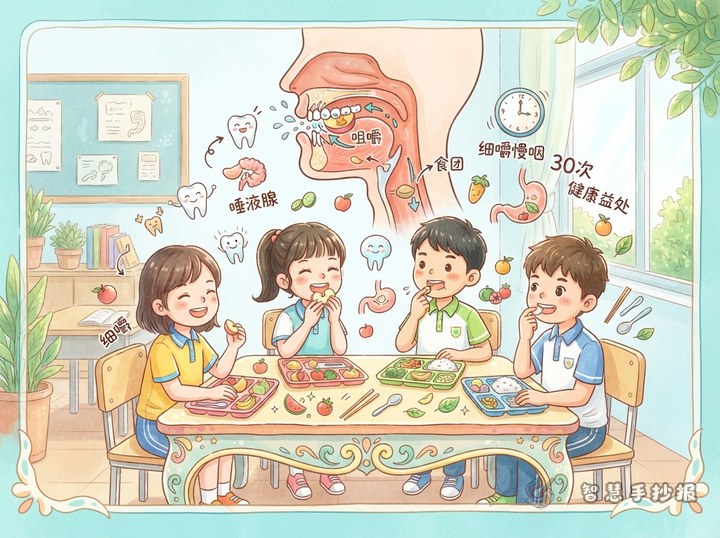
Saliva is released by the salivary glands. It moistens food and makes swallowing easier. An enzyme in saliva begins to break down starch, which is why food may taste slightly sweet after careful chewing.
Gastric juice: working in the stomach
Gastric juice contains stomach acid and digestive enzymes. The acid can destroy some microorganisms that enter with food, while the enzymes mainly help break down proteins. A protective lining helps shield the stomach wall from the acid.
Bile: preparing fats
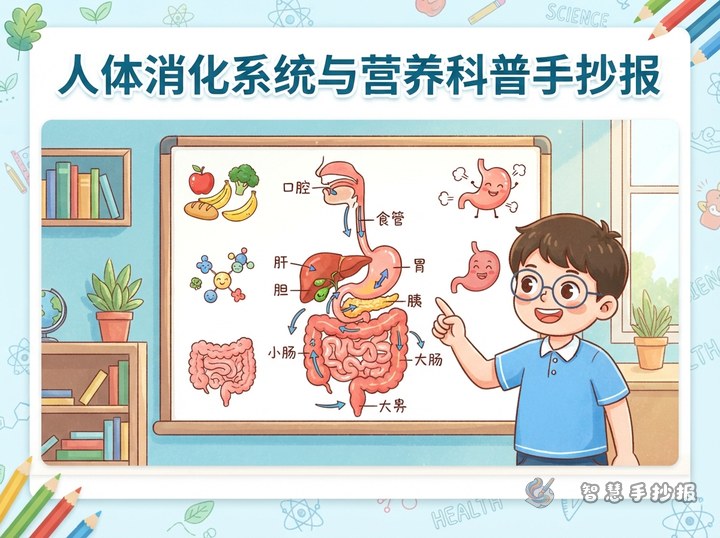
Bile is made by the liver and stored in the gallbladder. It enters the small intestine and breaks fat into tiny droplets. Bile is not a digestive enzyme; it helps fats come into better contact with the enzymes that digest them.
Pancreatic and intestinal juices: finishing the job
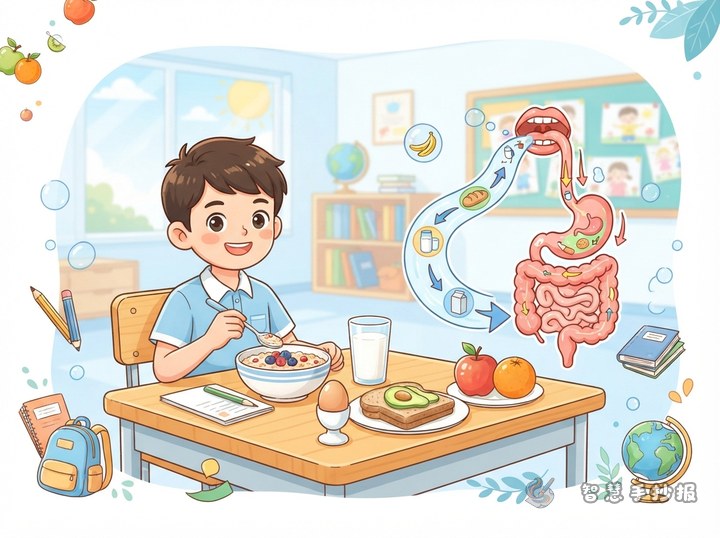
Pancreatic juice contains several enzymes that help digest carbohydrates, proteins, and fats. Intestinal juice also supports further digestion. The small intestine is an important place for digestion and nutrient absorption.
A science paragraph ready for the poster
Digestive juices are the body’s chemical helpers. Saliva begins the work in the mouth. In the stomach, gastric juice continues to break down food. In the small intestine, bile, pancreatic juice, and intestinal juice work together so that nutrients become easier to absorb. Each digestive juice has a different role, and together they help the body get the nutrients it needs for growth and daily activity.
Add five simple icons beside this paragraph: a water drop for saliva, a small stomach-shaped pouch for gastric juice, a green bottle for bile, a gear for pancreatic juice, and curved lines for intestinal juice. Simple symbols are enough if their meanings are clear.
A clear layout without drawing every organ
- Center: Draw a circular relay station with the title and one short opening sentence.
- Upper left: Place saliva and gastric juice in light blue and warm orange to show where the work begins.
- Upper right: Place bile, pancreatic juice, and intestinal juice in green, yellow, and purple so the roles are easy to tell apart.
- Bottom section: Add a science reminder such as Bile is not a digestive enzyme and The small intestine is an important place for nutrient absorption.
- Connections: Use curved arrows between the five cards. Write only short labels such as moisten, break down, disperse fat, and continue digestion.
Make the poster lively and easy to read
Use a rounded or handwritten style for the title and a clear font for the body text. Keep each information card to one or two key sentences instead of squeezing in a long encyclopedia entry. White, light blue, green, and orange create a bright palette while keeping the important points visible.
When the draft is finished, ask a classmate to explain the five roles from the cards. Check that bile has not been mislabeled as a digestive enzyme, and remember that digestion and absorption are related but not identical. If you need help arranging the title, sections, and layout, you can continue creating and adjusting the poster in the 智慧手抄报 WeChat mini program.