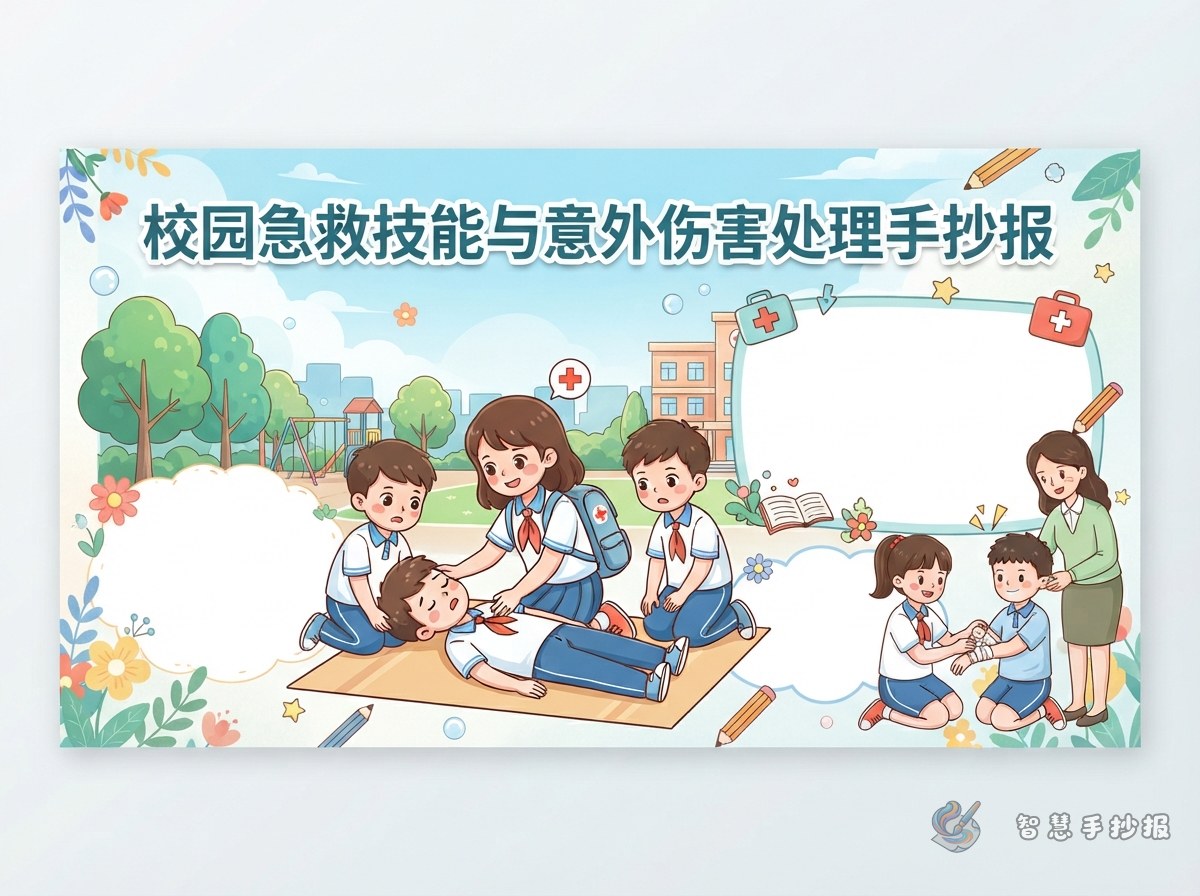
Build the Poster Around a Clear Emergency Route
Organize the poster around one practical question: what should students do when a classmate suddenly collapses at school? A simple “notice, call for help, and observe” route can guide the whole page. Emphasize that children should stay calm, alert an adult, give accurate location details, and avoid trying to handle the emergency alone.
First-Aid Steps Students Can Understand
- Check the area: Make sure there is no immediate danger from traffic, stairs, electricity, or a crowd.
- Look for a response: Speak clearly to the person and observe whether they respond and breathe normally. Avoid moving them without a clear safety reason.
- Get help immediately: Send someone to find a teacher or school nurse while another person calls the local emergency number and reports the exact school location.
- Watch for changes: Keep the area open and continue observing breathing. If the person is not breathing normally, tell the emergency dispatcher at once. CPR and an AED should be provided by a trained adult or according to dispatcher instructions.
Create a Bold “Do Not” Warning Zone
- Do not crowd around the person or block rescuers.
- Do not shake, pull up, or move the person unnecessarily.
- Do not give water, food, or medicine.
- Do not slap the face or assume the person is only sleeping.
- Do not hide the incident or attempt to manage it without an adult.
Turn the Layout into a School Emergency Map
Place the title at the top and highlight the words “What Should We Do?” Use the left side for numbered actions, the center for a small school map and help route, and the right side for a “Do and Do Not” comparison. At the bottom, add a sample emergency call card with spaces for the school name, building, floor, and nearby landmark. Red, yellow, and blue accents can separate warnings, actions, and useful information.
Add Interactive Details
Quick Situation Check
Include short choices such as “Should you gather around or find a teacher first?” These prompts help readers remember the correct response.
My School Help Map
Leave a small area for verified locations of the nurse’s office, teacher’s office, and any AED. Students should confirm these details with a teacher rather than inventing them.
Finish the Handwritten Poster
After choosing the sections, open the Smart Handwritten Poster WeChat Mini Program to arrange the title, text boxes, safety symbols, and decorations into a clear school first-aid poster.