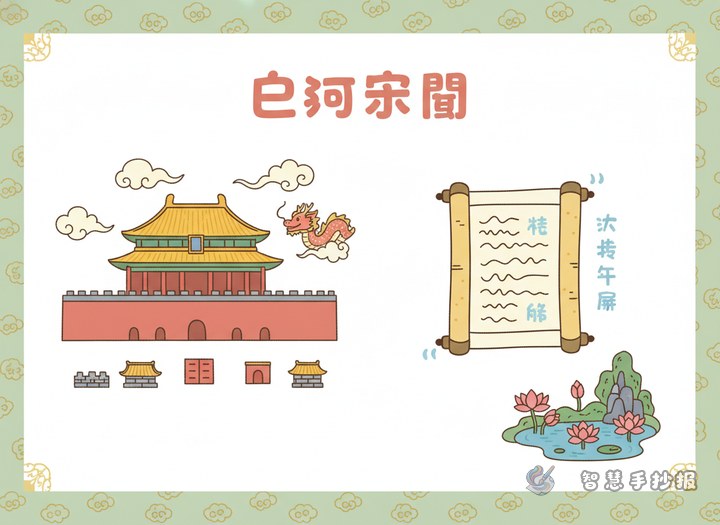

Start with the roof silhouette
Build a handwritten newspaper around the roof forms of traditional Chinese architecture. Draw a simple historic building in the center, then label its ridge, roof surface, and eaves. This gives readers a clear visual starting point before they explore the notes around it.
Turn roof types into short notes
You can introduce four common forms: hip roofs, gable-and-hip roofs, roofs with projecting gables, and flush-gable roofs. Keep each description focused on its outline. A hip roof slopes on all four sides; a gable-and-hip roof combines roof forms; a projecting-gable roof extends beyond the gable wall; and a flush-gable roof meets the gable wall. Roof forms vary with a building's purpose, region, and period.
Look closely beneath the eaves
Add a “Details to Notice” section with small sketches of eaves, roof tiles, and ridge ornaments. Explain what you observe in your own words. The outward sweep of the eaves shapes the roofline, while overlapping tiles create a visible pattern. Decorative motifs can enrich the drawing, but avoid assigning every motif a fixed meaning.
Let the layout follow the roofline
Try a layout with a broad top and smaller sections below. Put the title above a roof silhouette, place the main building sketch in the middle, and arrange notes about roof types and visible details on either side. Use curved lines for the eaves and short strokes for the tiles. Gray, teal, and vermilion work well, with a brighter accent for section headings.
Review the page before finishing
Sketch the title, illustration, and text areas lightly before writing neatly. Check that each label matches its drawing, the text remains legible, and the empty spaces feel balanced. You can also use the Wisdom Handwritten Newspaper WeChat mini program to organize your sections and layout ideas, then finish the page in a drawing style that suits you.