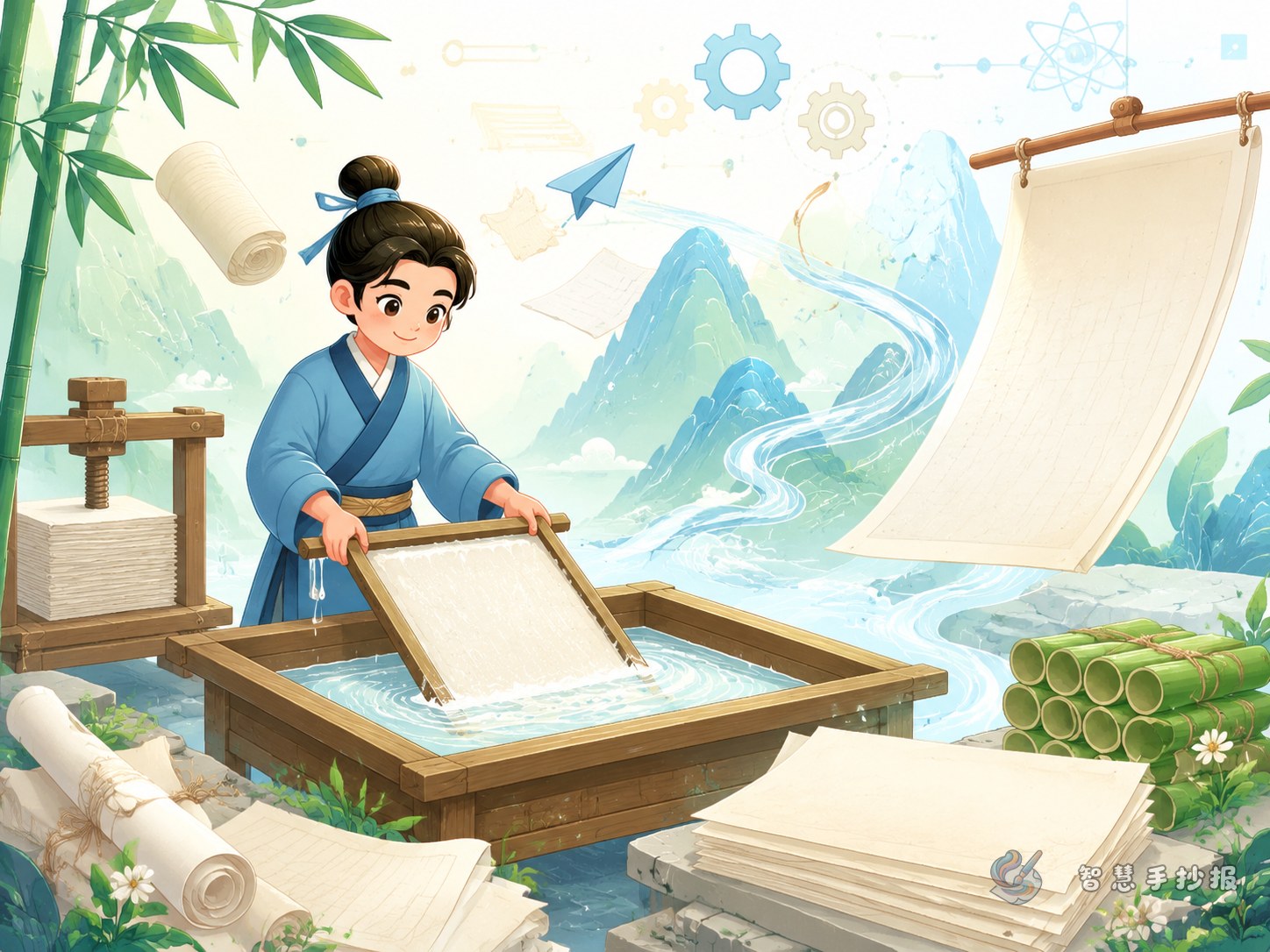
Start with the question: Where did paper come from?
A Cai Lun poster should not be only a short biography. A clearer idea is to build the page around the ancient wisdom behind one sheet of paper. In the title area, you can draw bamboo slips, cloth, and paper side by side so readers immediately understand the theme.
- Person keywords: Eastern Han Dynasty, Cai Lun, improved papermaking, easier writing.
- Science keywords: materials, pulp making, sheet forming, drying, spreading knowledge.
- Value keywords: careful observation, practical improvement, benefit to daily life.
Short text blocks students can use
Biography box
Cai Lun was an important innovator in the Eastern Han Dynasty. He improved earlier papermaking methods and used materials such as bark, hemp waste, rags, and old fishing nets to make paper. The improved paper was easier to write on and store, and papermaking later played an important role in cultural exchange and the spread of knowledge.
Science fact box
Before paper became widely used, people wrote on oracle bones, bamboo slips, wooden tablets, and silk. Bamboo slips were heavy, while silk was expensive. Paper made writing materials lighter and more practical. On the poster, students can use small comparison labels such as heavy, costly, light, and useful.
Lesson from the story
Cai Lun’s work shows that scientific progress often begins with careful observation in everyday life. When we notice a problem and try to improve it, even a small idea may help many people.
Turn the layout into a papermaking timeline
This topic works very well with a process layout. Instead of copying a long passage, draw five connected boxes from left to right: choosing materials, soaking, pounding into pulp, forming paper sheets, and drying.
- Top left: place the title and a simple portrait of Cai Lun, with a light paper-scroll background.
- Center: use the largest area for the papermaking process line with arrows and small icons.
- Right side: write short sections such as “Why paper mattered” and “What I learned.”
- Bottom border: add bamboo slips, brushes, paper rolls, and seal patterns to create an ancient science feeling.
Use soft colors and simple decorations
Good color choices include warm white, pale yellow, brown, and soft green. These colors suggest old paper and traditional culture. Use dark brown for the title outline and light backgrounds for text boxes. Avoid too many dark areas, because a readable poster usually looks cleaner and is easier to display in class.
A quick way to finish the poster
After choosing the Cai Lun and papermaking theme, prepare three groups of materials: a short biography, the papermaking process, and the importance of paper. Then open the Smart Handwritten Poster WeChat mini program to choose a suitable layout and organize the headings, text, and color ideas more efficiently.