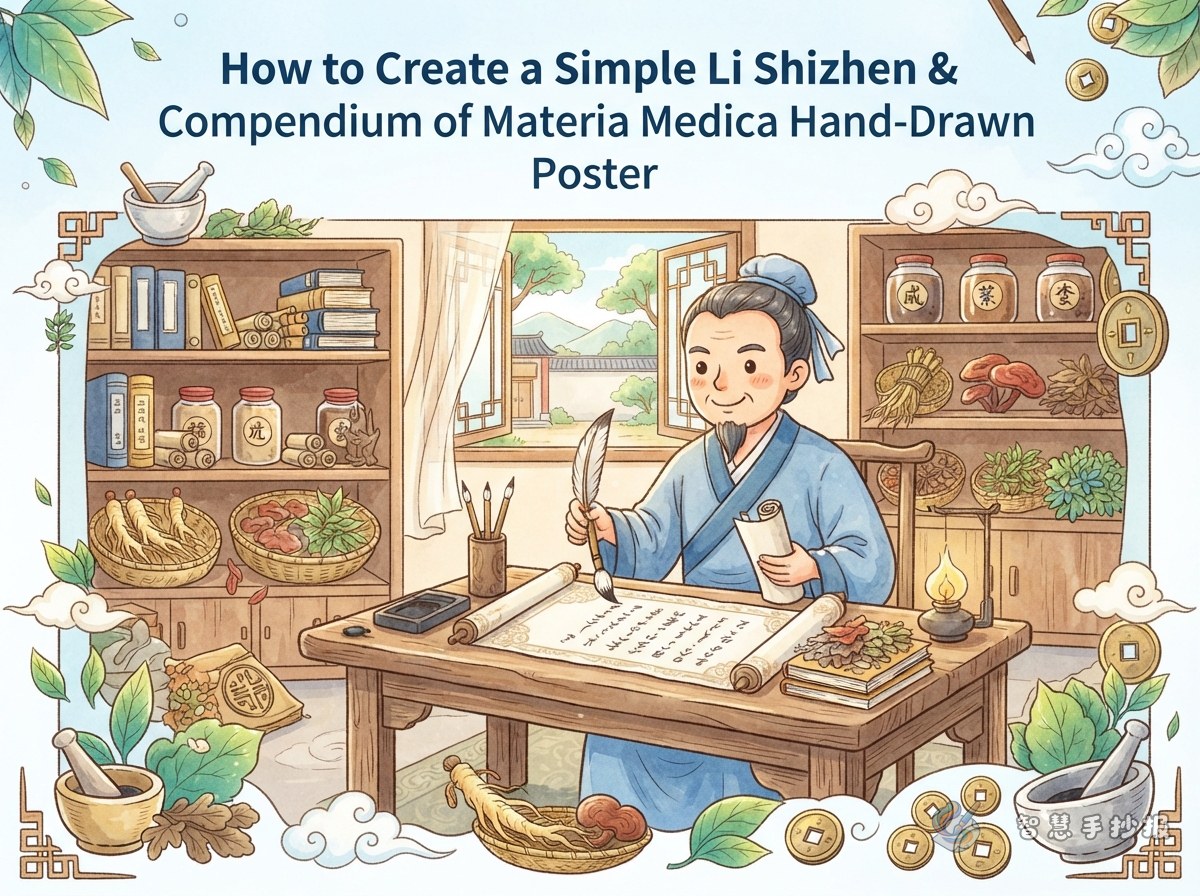
Choose One Story for the Whole Page
Rather than filling the poster with medical facts, focus on the idea of learning through observation and evidence. Li Shizhen was a medical scholar of the Ming dynasty who organized earlier knowledge, examined information carefully, and compiled the Compendium of Materia Medica. The poster should highlight curiosity, persistence, and careful verification instead of presenting remedies or treatment advice.
Four Short Sections Students Can Write
Meet Li Shizhen
Li Shizhen was a noted medical scholar in ancient China. He studied and organized medical knowledge, paid close attention to practical observation, and devoted great effort to compiling the Compendium of Materia Medica.
A Remarkable Book
The Compendium of Materia Medica is an important work in the history of Chinese medicine. It classified, compared, and organized a large body of earlier knowledge, showing how people studied nature and preserved what they learned.
From Questions to Records
Research requires more than reading. Use four small labels—“ask,” “observe,” “compare,” and “record”—to show how questions and evidence can gradually become organized knowledge.
What His Example Teaches Us
Li Shizhen’s story encourages students to look carefully, respect facts, and check uncertain information. Good learning involves asking questions and seeking reliable answers rather than simply memorizing conclusions.
Turn the Layout into a Mini Herb Garden
Draw an open ancient book in the center and place the main title across its pages. Put a profile card and simple portrait on the left, then position the book introduction on the right. Along the bottom, a winding path can connect the four research steps. Add leaves, seed shapes, old labels, or small cabinet drawers in the corners without covering the text.
- Main color: sage green for plants and natural observation.
- Background tone: warm beige for an aged-paper feeling.
- Accent: cinnabar red for section numbers and seal-like details.
- Borders: thin brown lines shaped like scrolls, labels, or leaf patterns.
Make It in a Clear Drawing Order
- Divide the paper lightly into a title area, illustration space, and four text sections.
- Write the main heading and sketch the central book or portrait first.
- Shorten the writing into readable paragraphs and keep the line spacing even.
- Add small leaves, labels, and research icons before outlining and coloring.
- Check names, punctuation, and spacing, then remove decorations that make the page crowded.
Add a Personal Discovery
Finish with a small “My Discovery” card describing a question that arose while researching Li Shizhen or observing a plant. Students who want to test different section arrangements can continue making the poster in the Zhihui Handwritten Poster WeChat Mini Program, then adjust the amount of writing to suit their grade level and paper size.