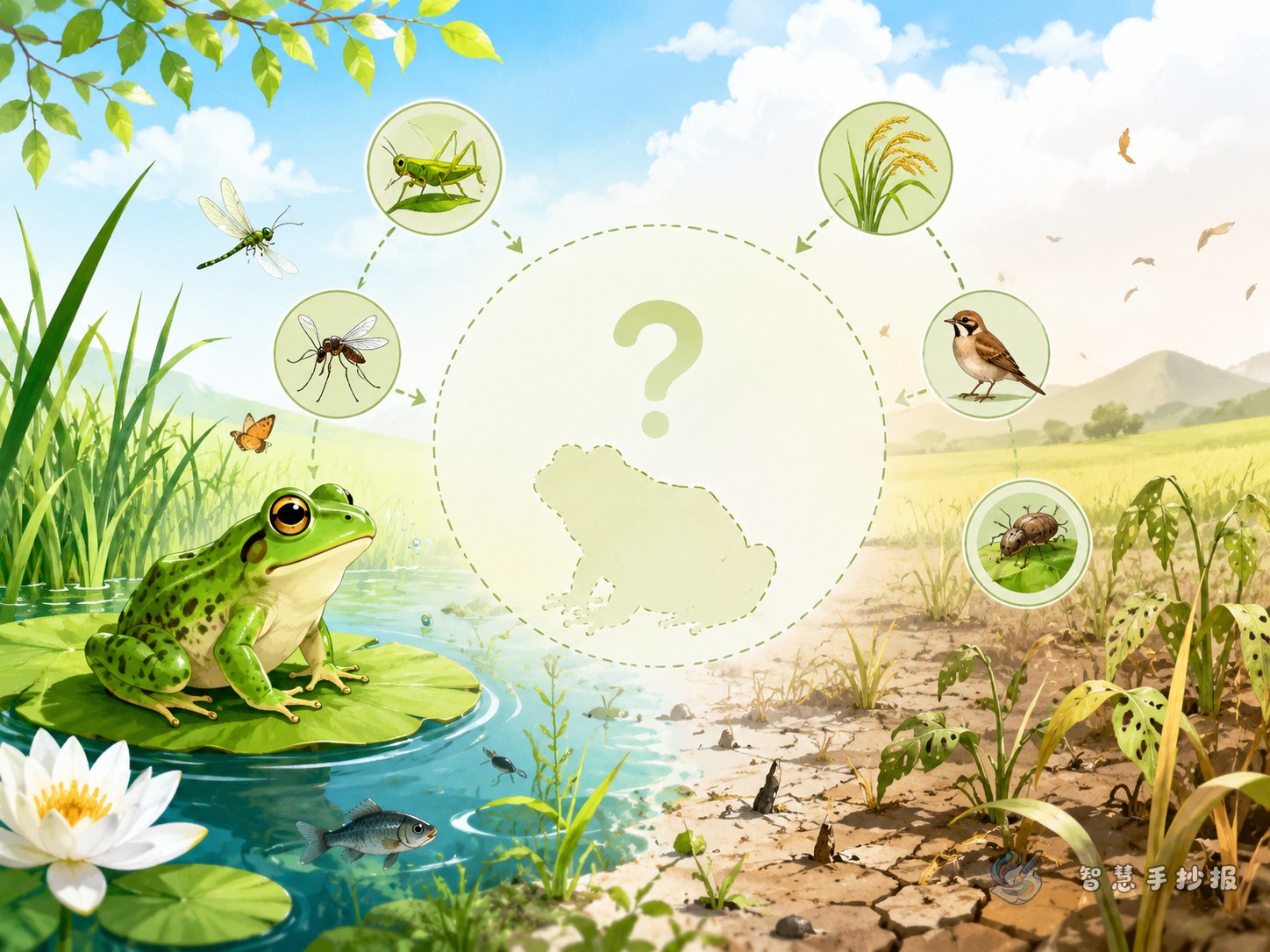
Start with a clear focus: What would happen to farmland without frogs?
This poster topic works best when frog protection and food chain knowledge are combined on one page. A strong main title can be What Would Happen to Farmland Without Frogs? It helps readers quickly understand the main question. In the opening paragraph, explain that frogs are not only interesting amphibians but also natural insect hunters in fields. If frog numbers drop, pests may increase, crops may suffer, and the balance of the ecosystem can be disturbed.
The writing does not need to be too difficult. For a student poster, it is enough to explain three simple ideas: frogs eat pests, frogs help protect crops, and when one link in the food chain becomes weaker, many other living things are affected.
Ready-to-use content for the poster
What is a food chain?
A food chain shows how living things depend on one another. Plants grow with sunlight, water, and nutrients. Insects eat plants, frogs eat insects, and snakes or birds may eat frogs. Each part is like one ring in a chain. If one ring is missing, the whole system may become unstable.
Why are frogs important?
- Frogs eat mosquitoes, moths, and many crop pests.
- They help reduce insect damage in fields.
- They are also food for other animals.
- Because frogs are sensitive to environmental change, they can show whether a habitat is healthy.
What may happen if frogs become fewer?
- Pest numbers may rise.
- Crops may face greater damage.
- People may rely more on chemicals to control insects.
- Animals that feed on frogs may also be affected.
How to organize the page
For a neat handwritten newspaper, divide the page into four areas: a question area, a knowledge area, an action area, and an illustration area. This makes the layout easier to read.
- Main title area: Use a title such as “What Would Happen to Farmland Without Frogs?”
- Knowledge area: Introduce frog habitats, diet, and ecological role.
- Food chain diagram area: Write a simple chain like “plants → insects → frogs → snakes/birds”.
- Action area: List ways to protect frogs and wetlands.
- Quote area: Add a short message such as “Fewer frogs may mean more pests.”
Drawing ideas and color choices
Illustrations can include rice fields, ponds, lotus leaves, insects, tadpoles, and frogs. A frog sitting on a lotus leaf in the center can make the theme stand out. Small pictures of dragonflies, fish, and plants can help show the wetland environment.
Use green, blue, and light yellow as the main colors. Green shows life and farmland, blue represents water, and yellow can highlight the title or key points. Do not fill every space with text. A clean layout with some blank space usually looks better.
How to end the poster well
The conclusion should return to the idea of ecological protection. You can write that protecting frogs is not only about saving one animal. It is also about protecting farmland, wetlands, and the balance of the food chain. Every small creature may have an important job in nature.
If you want to keep improving your page with title styles, borders, and layout ideas, you can continue designing in the Zhihui Handwritten Newspaper WeChat mini program.