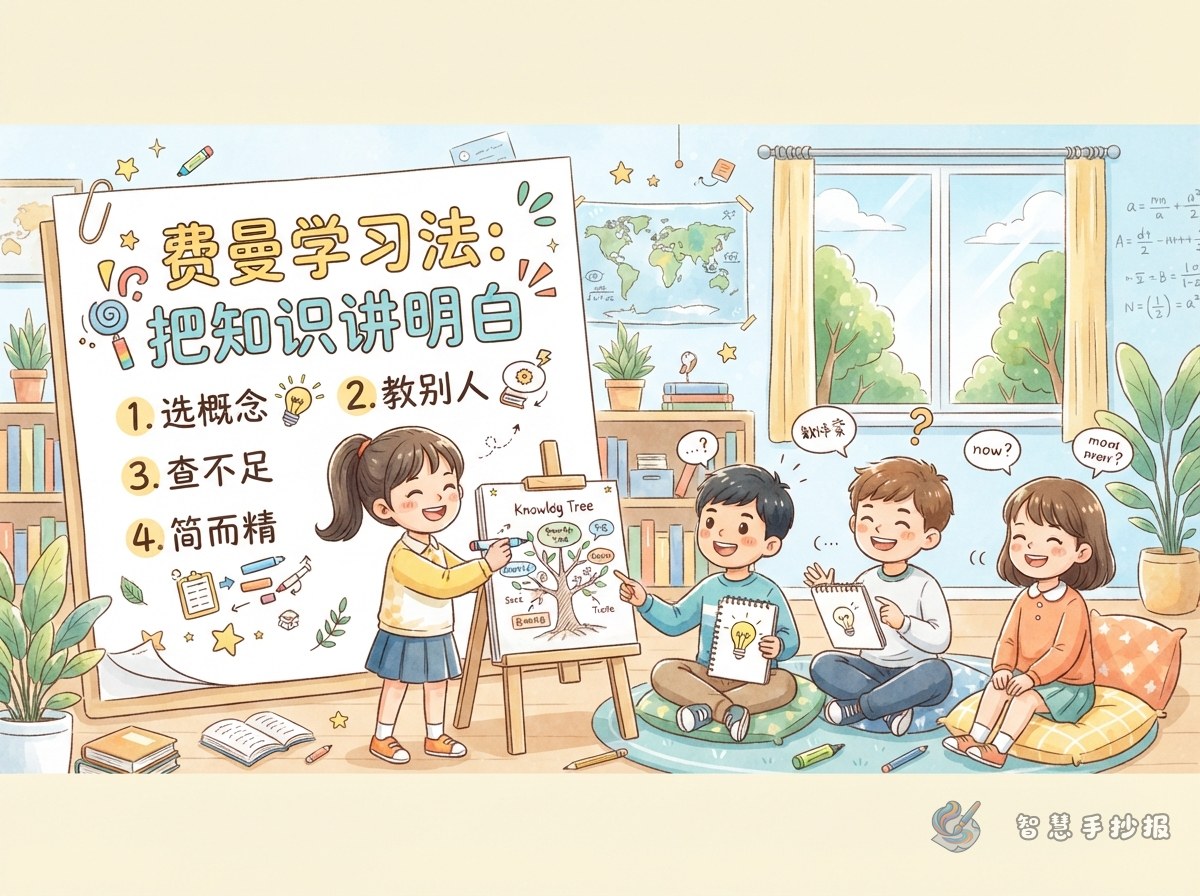
Turn the Main Idea into a Little Lesson
The Feynman Technique begins with a simple test: after learning something, explain it in your own words as if you were teaching someone else. If the explanation is unclear, return to the textbook and review the missing part. For a handwritten newspaper, make a “little teacher” the central image so the method is easy to understand and fun to look at.
Ideas for the Center Illustration
- Draw a student holding a small blackboard or book, with a speech bubble saying, “Can I explain it clearly?”
- Decorate the center with chalk, question marks, stars, books, and memory cards.
- Use a short title such as “The Feynman Technique: Explain It Clearly” in the most noticeable area.
Turn the Learning Process into Four Sections
Instead of filling the page with long paragraphs, divide the method into four connected steps. Readers can follow the arrows and understand how to use it.
- Choose a topic: Pick one idea to understand today, such as fractions, a poem, or a science observation.
- Try to explain it: Use simple words as if you were teaching a younger student instead of repeating the textbook.
- Find the gaps: Mark the parts that are difficult to explain, easy to confuse, or hard to support with an example.
- Organize it again: Check the textbook or other learning materials, then explain the idea again in clearer and more accurate language.
Connect the four sections with colored note cards or draw them as a learning path from the upper left to the lower right. This creates a natural reading order.
Text You Can Add to the Handwritten Newspaper
Helpful Study Tips
- Explain the idea in your own words before checking the book.
- Give an example to make your understanding more concrete.
- Do not skip a confusing part; write down the question.
- Explaining it to a classmate, parent, or yourself is a useful test.
A Short Slogan
“Memorizing is not the same as using knowledge; explaining it clearly shows real understanding.”
You can also add an “example card.” For fractions, draw a cake divided into equal parts. For a poem, describe the scene in your own words. Concrete examples are more suitable for a handwritten newspaper than abstract explanations.
Make the Layout Show a Change from Unclear to Clear
Use color to show progress: light blue for beginning to think, orange for question marks and difficulties, and green or yellow for ideas that have been reorganized. Along the edge, draw three understanding stars labeled “I can explain it,” “I can give an example,” and “I can use it.” Color in a star whenever one goal is completed.
If the paper is large, leave a space at the bottom called “My Lesson for Today” and write one idea you plan to explain to someone else. Before drawing, you can check layout combinations in the Zhihui Shouchaobao WeChat Mini Program and then adjust the sections to fit your paper neatly.
A Final Check Before You Finish
- Is the title clear enough to show that the topic is the Feynman Technique?
- Are the four steps in order, with arrows and sections that are easy to follow?
- Have you used short sentences and included a concrete example?
- Do the decorations leave the key text visible, and are there only three to five main colors?
This design does more than introduce a study method. It also becomes a practical “understanding checklist” that students can follow while learning.