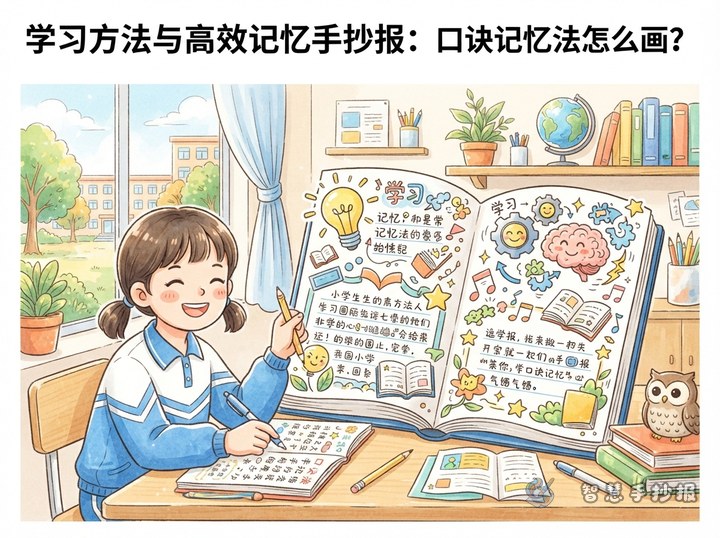
Why a multi-sensory memory poster is worth making
Many pupils revise by scanning the page once. Their eyes move, but their mouth stays still, their hand never writes, and their mind wanders, so the information disappears as soon as the book closes. A multi-sensory approach is simple: use the eyes, voice, ears, hands and brain together. Look once, read once, write once, then run it through your mind once more.
Making a poster about this method gives you a revision flowchart on one sheet. Stick it on the desk, and before every revision session you can check which channel you have not used yet.
A line to open with
- Using several senses once beats using only your eyes five times.
- See it, say it, write it, think it — four roads lead to the same memory.
- Memory is not about having looked; it is about having used.
Four panels for four memory channels
Panel one: the eye channel — look before you memorise
Explain what to do with your eyes: skim the whole passage first to see what it is about, then pick out key words and circle them in colour, then break long sentences into shorter ones you can follow.
Panel two: the voice and ear channel — read it aloud
Show how sound helps: read the text out loud, listen to whether you said it correctly, test each other with a classmate, and explain today's lesson to a family member. If you can explain it, you know it.
Panel three: the hand channel — write it down
List hands-on actions: close the book and write from memory, sketch a quick diagram, make small word cards for tricky spellings, or copy facts into a timeline or table.
Panel four: the mind channel — recall without looking
Describe silent practice: close the book and replay the content in your head, go over today's lesson before sleep, set yourself two small questions, and mark the parts you could not answer.
Examples you can copy straight onto the poster
- Memorising a poem: look at the picture and imagine the scene, read it aloud three times, copy it once, then recite it with your eyes closed.
- Learning an English word: look at the spelling, say the pronunciation, write it three times, then use it in one short sentence.
- Remembering a science idea: draw a simple diagram, read the definition, write three key words, and explain it to a classmate.
- Times tables: read the table aloud, clap the rhythm with your hands, write it from memory, then say it silently in your head.
Layout, colours and a corner checklist
Start with a central image — a brain, a hand, a four-leaf clover, or a hand holding up four fingers — and draw four lines from it out to the four panels.
- Put the title at the top, keep it large, and outline it in colour.
- Give each panel its own border colour: blue for the eye panel, orange for voice and ears, green for hands, purple for the mind.
- Leave a short ruled space in each panel labelled “what I will try”.
- Add a small box in the bottom corner called “senses I used today”, with four or five squares to tick.
Do not overfill the page. Three to five sentences per panel is plenty, and the blank space will make the whole poster easier to read.
Keep using the poster after it is finished
Stick the poster on your desk or the cover of a textbook. Before each revision session, follow the four panels in order: look, read aloud, write, then recall. After a week, circle the one or two channels that helped most and focus on them next time.
If you would like to try another study method, open the ZhiHui ShouChaoBao mini program in WeChat, pick a template, and change the panel names and colours to build your own study-skills poster.