Turn the topic into a learning conversation
This handwritten newspaper does not need to be a list of academy names and historical facts. Instead, turn the ancient academy tradition of teaching, discussion, and reflection into a conversation between a teacher and students. A strong central line is Reading should lead to understanding, and learning should welcome questions. Use it as your own theme sentence rather than presenting it as a historical quotation.
Build the page around three questions
- Why do we read? To broaden our knowledge, understand principles, and become more thoughtful in our actions.
- What should we do when something is difficult? Read carefully, look for clues, and ask a teacher or classmate for help.
- How can we use what we learn? Bring knowledge into daily life and test its value through action.
Three text blocks ready for the page
Lesson Corner: Understanding through exchange
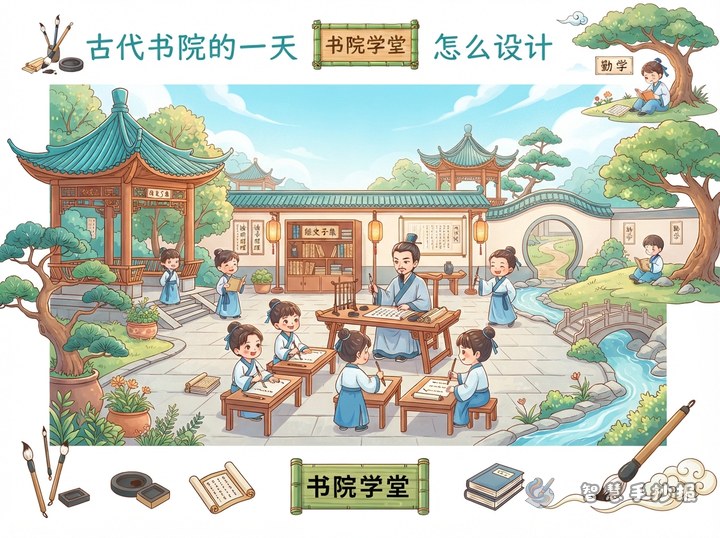
Ancient academies often connected reading with explanation and discussion. A teacher could clarify difficult points, while students shared ideas and gradually reached a deeper understanding through reflection. You can write this short passage: Reading alone brings knowledge; exchanging ideas helps us discover new ways of seeing.
Question Cards: Let questions begin progress
Draw three small cards labeled “What did I understand?”, “What do I still want to know?”, and “How will I find the answer?” This section shows the spirit of learning in an ancient academy while connecting the theme with a child’s own study habits.
Spirit Summary: Learn, ask, think, and act
For the closing section, write: The spirit of learning is more than remembering famous sayings. It means reading carefully, asking actively, thinking calmly, and putting good ideas into everyday actions. This works well as a summary along the bottom.
Make the layout feel like a real dialogue
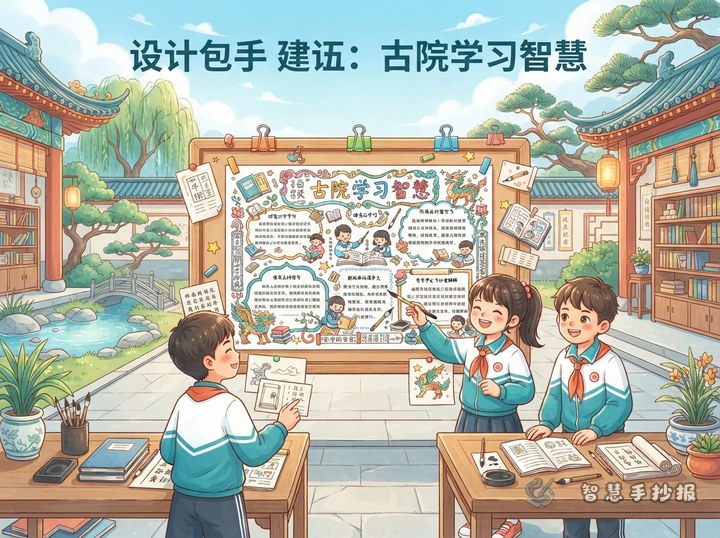
Try a structure with a conversation in the center, columns on both sides, and an action section at the bottom. Place the title inside a scroll or roof-shaped frame. In the middle, draw a teacher and two or three students with speech bubbles showing the steps of asking, thinking, and answering. Put question cards on the left, lesson notes on the right, and a section called “My Learning Action” at the bottom.
- Use deep blue or muted red for the title to create a traditional but lively mood.
- Use brown and warm cream for people, books, and roof details to suggest an old academy.
- Keep each speech bubble to one or two sentences so the page remains open and readable.
- Add bamboo slips, brushes, ink stones, or bookmarks as small decorations without covering the text.
Connect ancient learning with school life today
Add a small “Then and Now” section near the bottom. Students in ancient academies could solve doubts through teaching and questions; today, we can learn through classroom questions, reading sources, group discussion, and reviewing mistakes. This comparison keeps the page from becoming a simple history summary and shows what the learning spirit means to you.
Four steps to finish a clear and attractive page
- Choose the title, central sentence, and three main questions. Remove details that do not support the theme.
- Sketch the title area, dialogue area, text blocks, and decoration zones in pencil.
- Copy the text neatly and draw the people, books, and roof lines while leaving enough space between sections.
- Unify the borders and colors, then check the readability, the flow of the questions and answers, and the clarity of the action goal.
To make layout work easier, prepare the dialogue text first and then continue designing in the Smart Handwritten Newspaper WeChat mini program, where the text, columns, and decorations can be adjusted together.