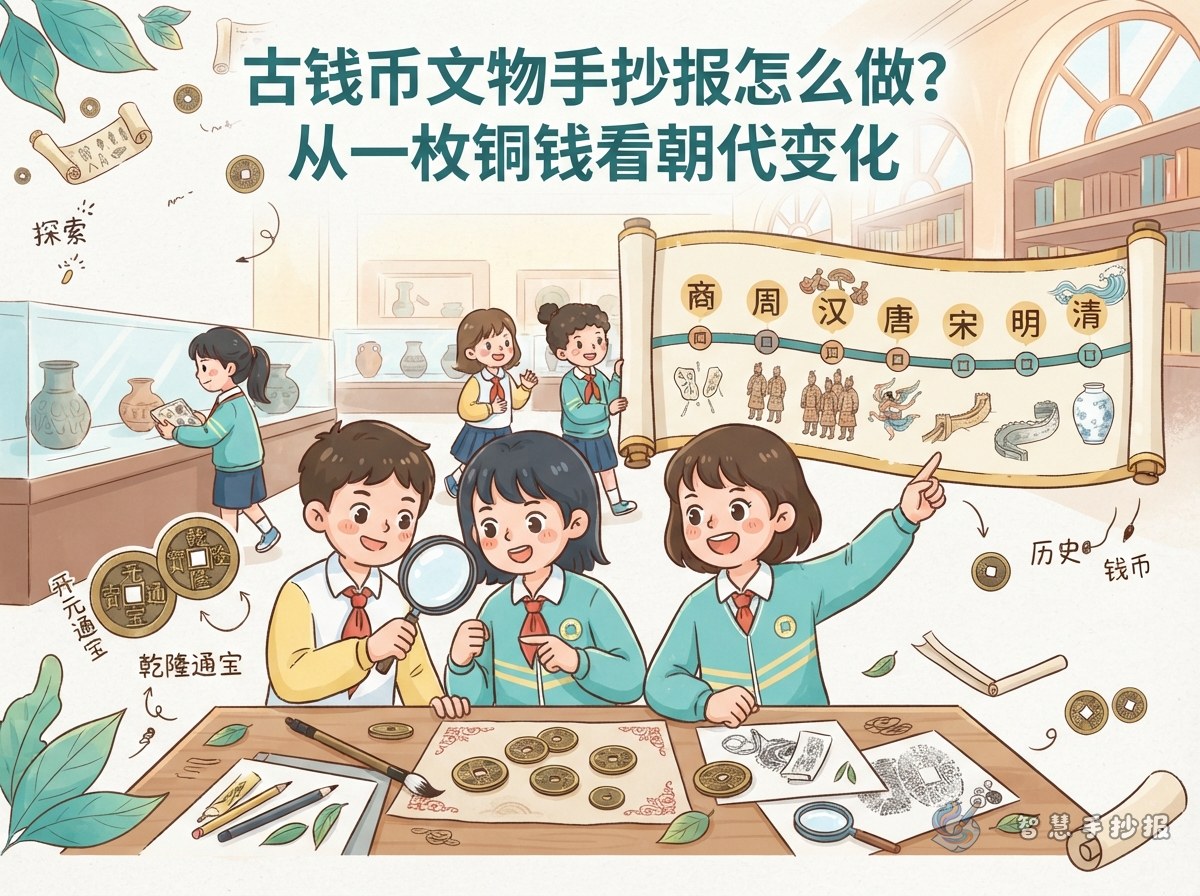
Start With One Narrow Angle, Not the Whole Museum
The biggest trap in a museum study handwritten newspaper is writing a travel diary: you enter the hall, you walk past the cases, you leave, and every sentence is a summary. The page ends up wide but shallow. A better method is to shrink the theme down to one kind of artifact. Ancient coins are ideal because they are small, easy to recognize, different in every period, and simple to draw yet rich to describe.
Give your title a little curiosity, something like "One Copper Coin Across a Thousand Years" or "What Are the Characters on a Coin Telling Us?" A title with a question in it feels more like a real project than a plain label written in the middle of the page.
What to Note Down at the Coin Display
Many students realize at home that they did not record enough detail. Stand in front of the coin case and jot down notes in this order, and the material will be ready to use later:
- Shape: round with a square hole, knife shaped, spade shaped, or round without a hole. Note whether the rim has any pattern.
- Inscription: how many characters are on the surface, what style of writing they are, and whether they read across or down.
- Material and feel: bronze, iron or something else, and whether it looks bright or dull, thick or thin.
- The name on the label: copy the exact term used, which is far better than writing "an old coin".
- Your own question: why is the hole square? How did people string coins together to carry them? These questions become the liveliest lines on your page.
Text Sections You Can Copy Straight Onto the Page
Section One: The Coin Profile
Introduce your main character in three or four sentences. For example: "I chose the round coin with a square hole. Its outer rim is round and the center hole is square, which made it easy to thread onto a rope and carry as a string. The characters on its surface usually marked weight, dynasty or the reign in which it was cast."
Section Two: The Secret in the Characters
The writing on a coin is more than text; it is also calligraphy. Try a small comparison: some inscriptions have squared, angular strokes and look firm, while others have rounded, flowing strokes and look elegant. Add one line saying that the same character looks different depending on the period, and the section immediately feels thoughtful.
Section Three: From the Coin to Daily Life
Connect the artifact to real life. For coins to circulate, there had to be markets, buying and selling, standards of measurement, and people who cast and managed the money. You can imagine a short scene: someone holding a few coins to buy rice or cloth, the metal ringing softly in the hand. That picture is far more engaging than a plain description.
Let the Coin Shape the Layout
The coin itself is a natural design idea. Using it to divide the page gives the whole sheet a stronger theme than ordinary rectangular boxes:
- Enlarge the round outline with the square hole in the middle and turn it into a central title area, writing your topic where the characters would be.
- Draw a string of small coins as a dividing line, placed straight or at a slight angle, to separate the sections.
- Add a small "coin file" card in one corner, listing name, shape and material in three short lines.
- Choose a calm palette: cream, ochre and deep brown as the base, with a touch of dark green. This suits the mood of a cultural relic better than bright red and green everywhere.
Order of Work, From Draft to Finished Sheet
- Circle the key words in your visit notes, cross out duplicates and keep only three or four main points.
- Plan the sections and their positions on scrap paper, marking where text goes and where drawings go before starting the final copy.
- Make the title largest, section headings second, and body text smallest, so the page has clear levels instead of looking crowded.
- Write the text first and add drawings and decorations last, so you do not run out of space for writing.
- Leave a small corner for "What I Discovered", one honest sentence about your visit, and the page closes naturally.
If drawing grids and gathering material takes too long, you can search for "Smart Handwritten Newspaper" in the WeChat mini program, pick a relic or coin themed layout, fill in the text you have prepared, and then add your own drawings by hand. The result will still feel personal.