Turn the Page into a Knowledge Map
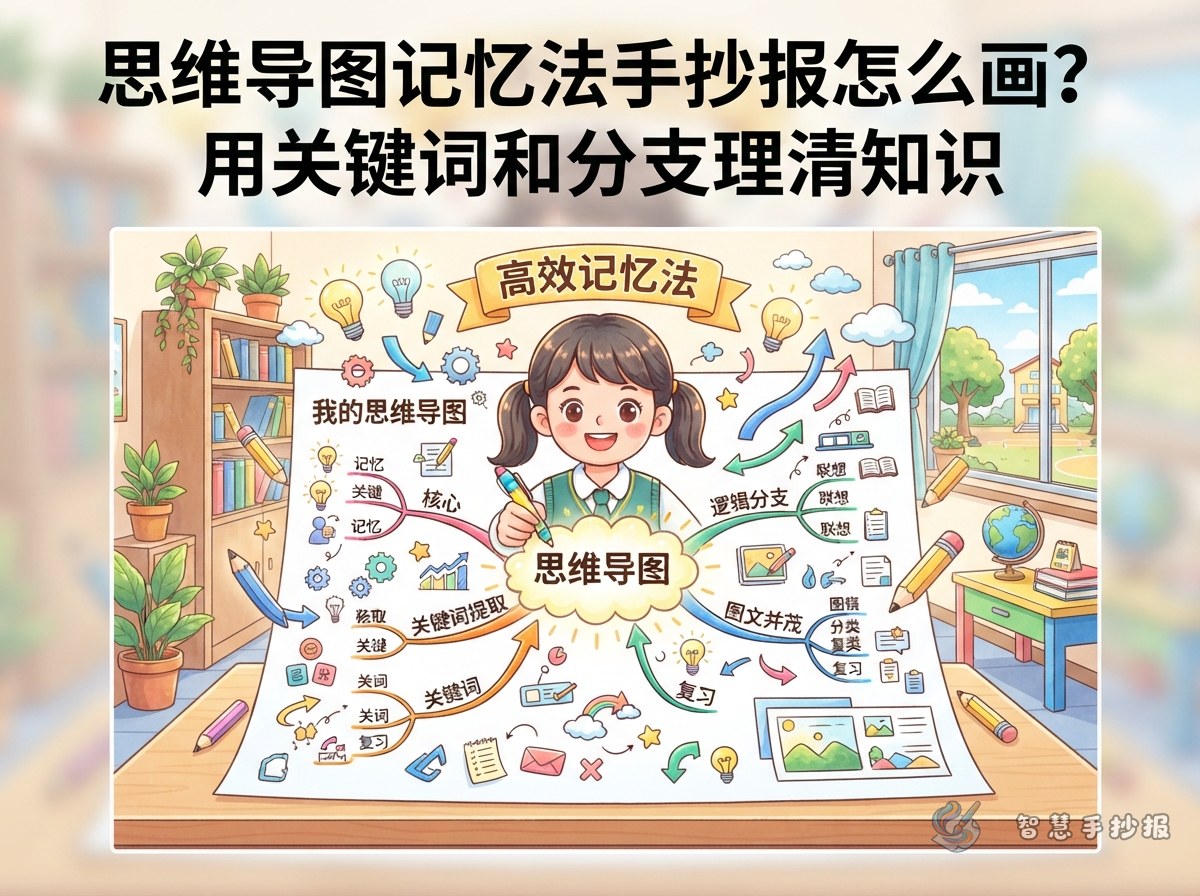
A mind map begins with one central topic and connects related ideas through branches. On a handwritten poster, make keywords, relationships, and levels of information the visual focus instead of filling every space with long paragraphs.
Draw an open book, light bulb, brain, or knowledge tree in the center and write “Mind Map Memory Method” inside it. Extend four main branches toward sections about the method, its steps, memory tips, and a practical example.
Ideas for the Four Main Branches
Branch One: Find Keywords
After reading, avoid copying every sentence. Identify the most useful words, such as a person, time, place, cause, feature, or result. Accurate keywords provide clues that make details easier to recall.
Branch Two: Connect Related Knowledge
Place similar ideas on the same branch. Use lines to show sequence, cause and effect, comparison, or parallel ideas. This turns separate facts into an organized structure.
Branch Three: Add Visual Associations
Draw simple symbols beside keywords. A clock can represent time, a question mark can show a problem, and a star can mark an important point. Keep the pictures small and easy to recognize.
Branch Four: Practice Active Recall
After finishing the map, cover part of it and try to explain the details by looking only at the main branches. Mark anything you cannot remember in a different color and review it first next time.
Short Text Ready for the Poster
- Definition: A mind map uses keywords and branches to organize knowledge and reveal connections between ideas.
- Quick reminder: Choose the center, build the levels, find keywords, connect ideas, and recall from the map.
- Design tip: Colors should separate categories rather than decorate every word, and pictures should support rather than cover the text.
- Practice idea: Create a review map for a reading passage, a math unit, or a set of new vocabulary words.
Build a Clear and Balanced Layout
- Sketch the center image and four section areas lightly in pencil. Let the center occupy about one quarter of the page.
- Make the main branch lines slightly thicker than the smaller branches to show different levels.
- Give each main branch one primary color and use that color consistently for related information.
- Add small boxes in the corners for a mnemonic, reminder, or example without crowding the branches.
- Check that the title is visible, the writing is easy to read, and every branch can be followed outward from the center.
Show How the Method Works
Add a small “My Example” area near the bottom. Place “What Plants Need to Grow” in the center, then create branches for sunlight, water, air, and a suitable temperature. Write only one or two points on each branch so readers can understand the method at a glance.
To refine the title style, section placement, or overall composition, continue creating the project in the 智慧手抄报 WeChat Mini Program, choose a layout that fits the paper size, and then copy and decorate the final design by hand.