Let a Melody Line Lead the Page
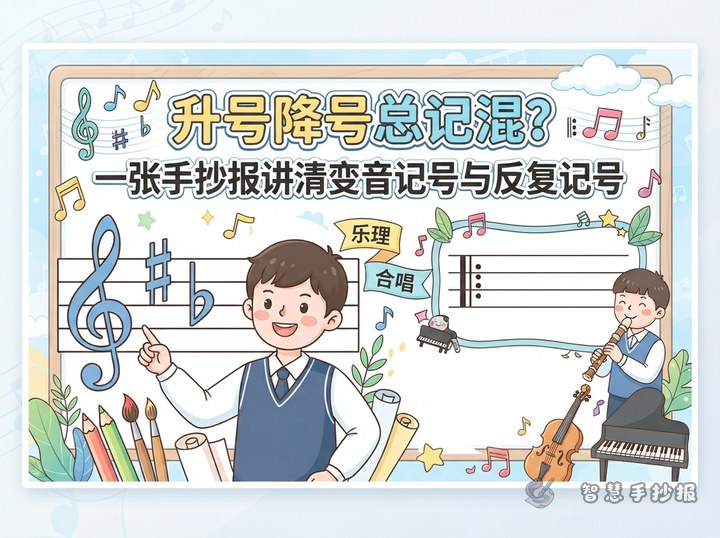
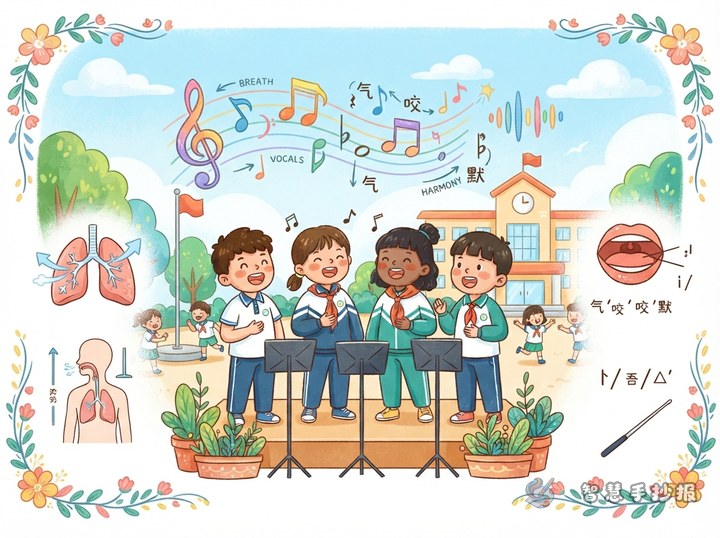
Use the idea of a melody traveling across the page as the main design concept. Draw a curved staff from the upper left to the lower right, adding a treble clef, colorful notes, and students singing together. This creates a strong music image and naturally connects the different sections.
- Upper left: Place the main title with a small bouncing note or microphone.
- Center: Draw the staff, melody line, and a school choir scene as the visual focus.
- Open areas: Add music theory cards, choir tips, and a short music message around the main picture.
Turn Basic Music Theory into Small Cards
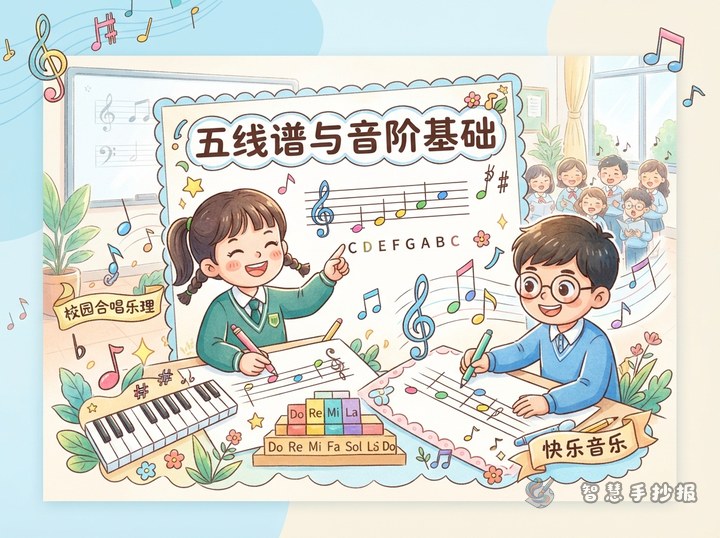
A primary school poster should not be filled with difficult explanations. Turn each idea into a short card of two or three sentences and pair it with a simple symbol.
Musical Note Card
Suggested text: Musical notes are symbols used to record the pitch and length of sounds. We often sing do, re, mi, fa, sol, la, and ti to show different pitches. When notes are arranged together, they create a melody.
A Quick Melody Quiz
- What is a melody? A melody is a series of notes connected in a particular order and range.
- What is a staff used for? Notes placed on its lines and spaces help us see changes in pitch.
- What does a rest show? It marks a brief silence, giving the music room to breathe.
Give the School Choir Its Own Corner
Set aside a section called Our Singing Voices to share feelings and simple practice ideas from school choir activities. Add a classroom, music stand, songbook, and students singing. The figures do not need to be complicated; round faces and simple poses can create a lively scene.
Ready-to-Use Text
Music message: One singing voice can sound clear, but voices together can become a powerful melody.
Choir tip: Stand naturally before singing, listen carefully to the musical cues, and listen to one another during practice. This helps the group sound more together and pleasant.
Section title ideas: Melody Detective, Where Our Song Begins, My Music Discovery, and Choir Time at School.
Finish with Color, Borders, and a Clear Order
- Use a pencil to mark the title area, the central melody line, and three card positions before writing any text.
- Use blue or purple for the staff, yellow or orange for the notes, and green for plants or border details.
- Make the title larger than the body text. Keep each paragraph short and highlight key words with colored lines or dots.
- Trace the final lines, add stars, notes, or paper planes, and check that every word and musical symbol is complete.
After sketching, you can open the 智慧手抄报 WeChat mini program to organize the layout and choose a suitable style, making the music poster easier to finish and share.