Start with a Room-Measurement Story
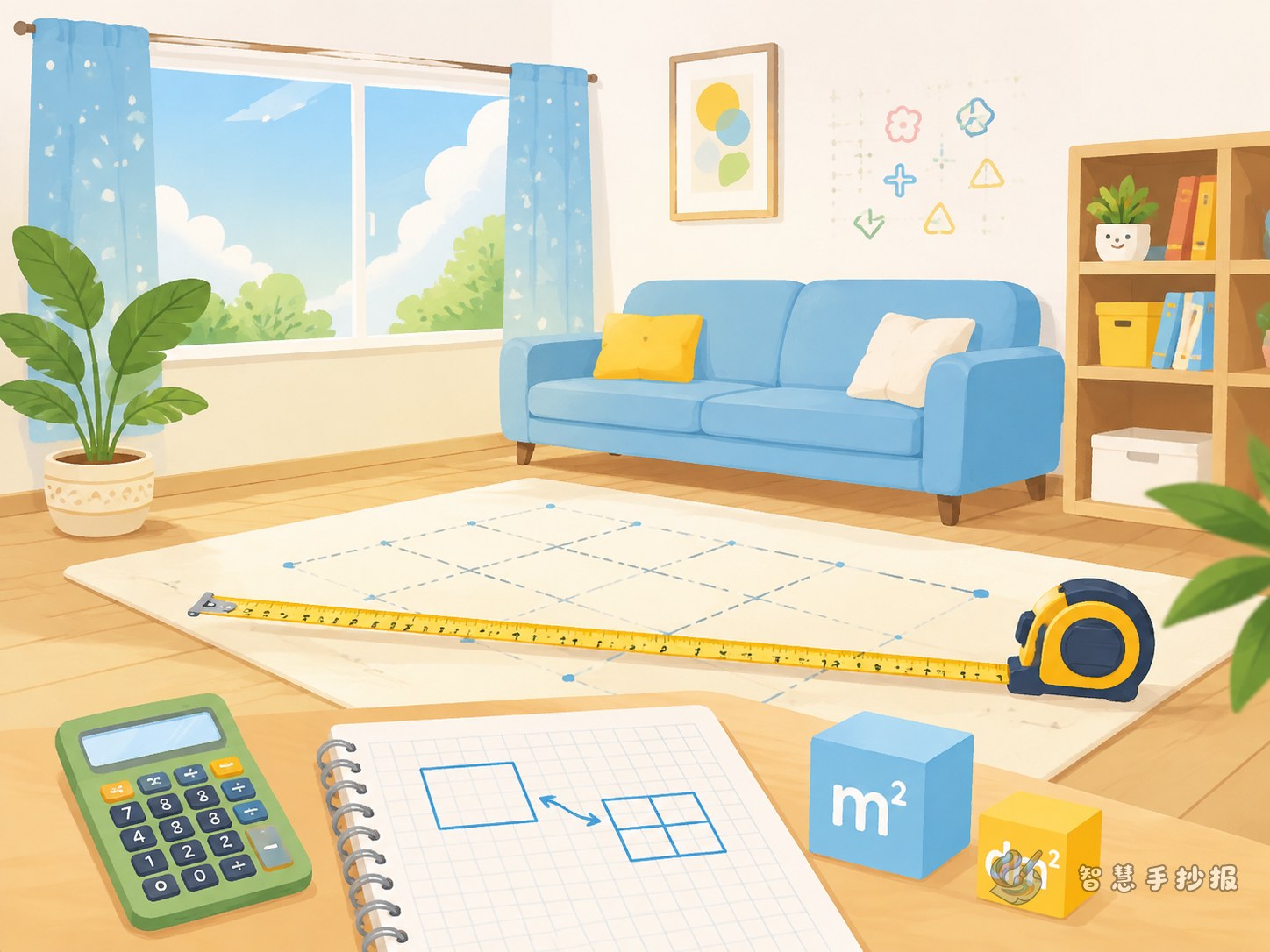
This math poster can follow the idea of measuring a small room. Imagine using a ruler to measure a desk, a floor mat, or the floor itself, and then changing the measured area into different units. The setting makes the relationship between square meters, square decimeters, and square centimeters easier to understand.
Draw a simple room in the center with a desk, mat, books, and ruler. Use the title “The Area Unit Detective” and connect the objects to short math notes with arrows.
Turn Unit Conversions into a Grid Map
The key facts are: 1 square meter equals 100 square decimeters, 1 square decimeter equals 100 square centimeters, and 1 square meter equals 10,000 square centimeters. Draw a large square with a side length of 1 meter, then divide both its length and width into 10 equal parts. The result is 100 small squares, each measuring 1 square decimeter.
Point out that area units do not change by only 10 times. Since both length and width change, the factor is 10×10=100. Therefore, 1 square meter is not 10 square decimeters; it is 100 square decimeters.
Write Three Everyday Conversion Problems
- Floor mat: A mat has an area of 2 square meters. In square decimeters, it is 2×100=200 square decimeters.
- Desk pad: A desk pad has an area of 30 square decimeters. In square centimeters, it is 30×100=3,000 square centimeters.
- Room floor: A floor has an area of 50,000 square centimeters. In square meters, it is 50,000÷10,000=5 square meters.
Add multiplication and division arrows beside the examples. Changing from a larger area unit to a smaller one usually means multiplying; changing back means dividing. Always check the target unit before calculating.
Four Sections for a Complete Poster
- Unit Dictionary: Explain that square meters work well for rooms and classrooms, square decimeters for desktops and mats, and square centimeters for book covers and small cards.
- Conversion Steps: Show “square meter → square decimeter → square centimeter,” with ×100 written on each step.
- Measuring Corner: Include the formula area=length×width and add a small desk or mat example.
- Detective Challenge: Ask whether “3 square meters equals 30 square decimeters” is correct, then reveal the answer: 300 square decimeters.
Arrange the Page So the Math Stands Out
Try a central illustration with four surrounding sections. Put the title at the top, the grid map on the left, everyday problems on the right, and the unit dictionary and challenge along the bottom. Give each unit its own color, such as blue for square meters, green for square decimeters, and orange for square centimeters.
Make numbers and equations larger than the explanations, and keep each section short. Before finishing, check the unit names, multiplication or division direction, and final answers. Use a ruler for clean lines and borders. To organize the sections and continue making the poster, you can also use the WeChat mini program Zhihui Shouchaobao.