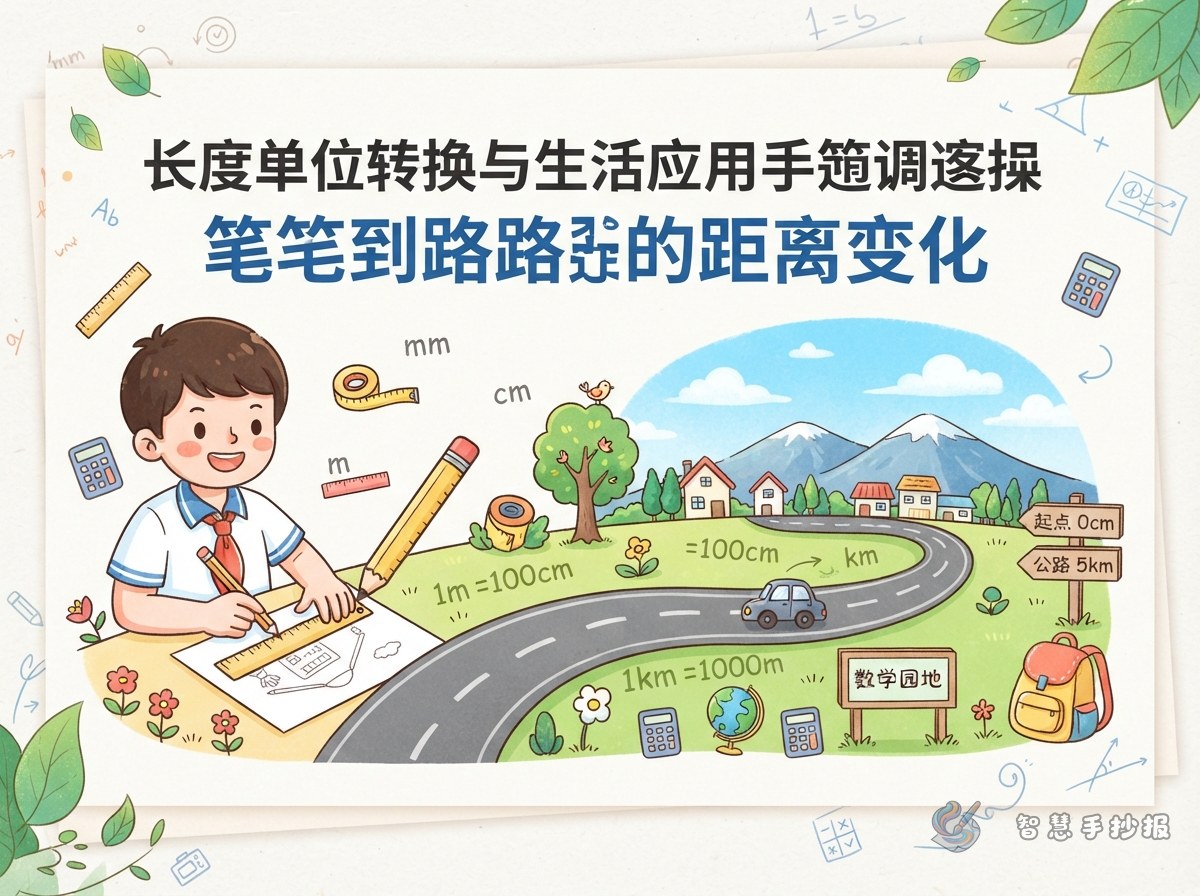
Draw a Journey of Length
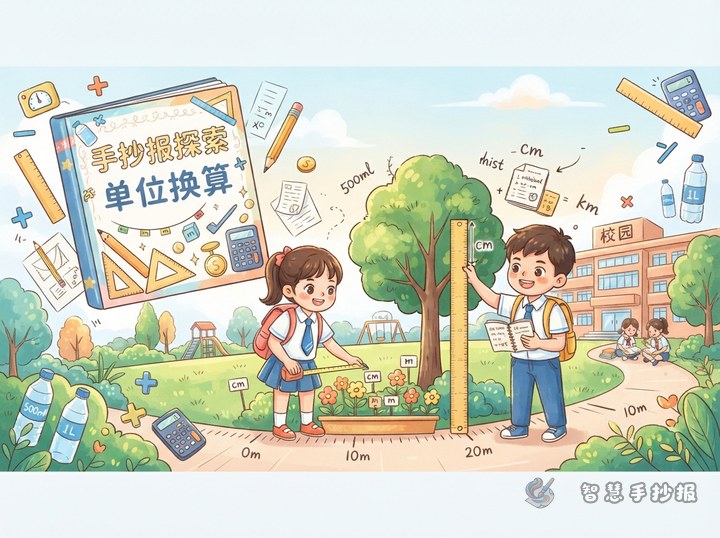
Design the poster as a journey from the smallest unit to the largest: millimeters can stand for tiny marks on a pencil tip, centimeters can measure stationery, decimeters can describe part of a book or shelf, meters can describe height or room length, and kilometers can describe roads or distances between places. Draw a colorful route across the center and place millimeter, centimeter, decimeter, meter, and kilometer signs along it.
Turn Conversion Rules into a Step Ladder
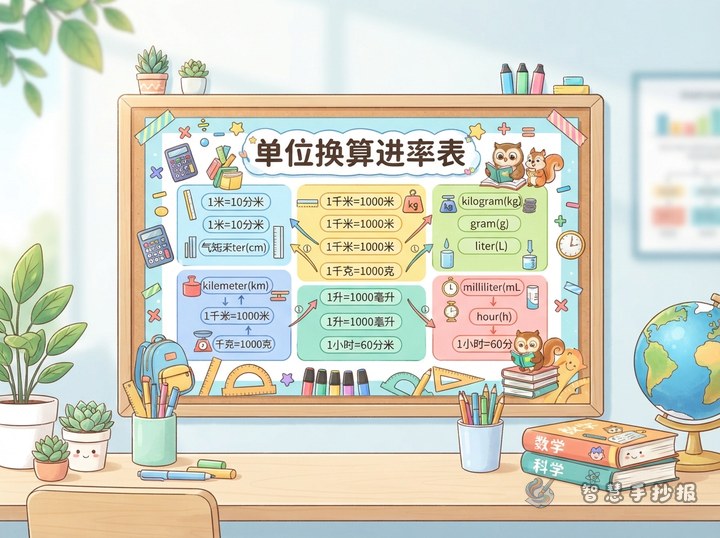
Place a clear unit ladder in the middle of the poster: 1 centimeter = 10 millimeters, 1 decimeter = 10 centimeters, 1 meter = 10 decimeters, and 1 kilometer = 1,000 meters. Use arrows to show the direction of conversion. Add a reminder that changing a larger unit into a smaller unit usually makes the number larger, while changing a smaller unit into a larger unit usually makes the number smaller.
Include three simple examples: 35 centimeters = 350 millimeters, 2 meters 30 centimeters = 230 centimeters, and 3 kilometers = 3,000 meters. Draw a ruler, footprints, or road signs beside the examples so that readers can connect the numbers with real distances.
Four Everyday Observation Cards
- Stationery card: Use millimeters or centimeters to record the length of an eraser, pencil, or ruler. Remind readers to start measuring from the zero mark.
- Height card: Show how 1 meter 35 centimeters becomes 135 centimeters, demonstrating how to convert a mixed measurement.
- Sports card: Use meters for activities such as jumping or short runs, and kilometers for longer routes. Explain why different distances need different units.
- Map card: Draw two places connected by a route. Use kilometers for a long journey and meters for a shorter distance.
Make the Layout Look Like an Open Ruler
A horizontal layout works well: draw an enlarged ruler and the unit ladder on the left, place the length journey and conversion examples in the center, and arrange the observation cards on the right. The title could be “A Journey Through Length Units.” Use different colors for small and large units. Ruler marks, arrows, footprints, and road signs make good decorations, but leave enough open space around the formulas and examples.
Finish with a Measurement Discovery
Leave a small section at the bottom called “Let Me Measure.” Ask students to choose three nearby objects, estimate their lengths, measure them with a ruler, and record the units and conversions. This ending makes the poster interactive and shows that unit conversion is useful not only in math exercises but also when describing real distances. After planning the text and sketch, you can continue arranging the poster in the WeChat mini program “Zhihui Shouchaobao.”